
Hugh arrived at the house on a rainy Tuesday afternoon, carrying a folder beneath his arm. He had called twice that morning, saying he wanted to show me the documents he claimed would clear his name. I had told him the same thing each time: if the records were relevant to the investigation, he needed to provide them through the proper process.
He came anyway.
Lupita was helping Dad with his lunch when the doorbell rang. I looked through the window and saw Hugh standing on the porch, his hair damp and his jacket collar turned up. He glanced toward the street before pressing the bell again.
I went outside and closed the door behind me.
“You shouldn't be here to pressure me,” I said.
“I'm not pressuring you. I'm trying to fix this.”
“Then give the documents to the investigator.”
He lifted the folder. “These are receipts. I have proof that I spent money on Dad.”
“Then the investigator can review them.”
“You won't even look?”
I hesitated. Part of me wanted to take the folder and discover that there was a reasonable explanation for at least some of the withdrawals. I wanted the months of uncertainty to end. I wanted to believe that my brother had not deliberately taken advantage of our father's illness.
But I also knew that Hugh had repeatedly tried to make the issue a private disagreement between us. If I reviewed his papers alone, he could later claim I had agreed with his explanation or accepted a settlement. I needed the facts assessed independently.
“You can send copies through the investigator,” I said. “I'm not refusing to see evidence. I'm refusing to make a private decision about it.”
His face tightened.
“You've always needed someone official to tell you what to think.”
“No. I need someone impartial to establish what happened.”
He lowered the folder.
“Do you know what this is doing to me?”
I looked at him for a long moment. “Do you know what it did to Dad when his supplies couldn't be paid for?”
“I didn't leave him without anything.”
“The account was empty. Lupita's card was declined. I had to cover the expenses from my wages.”
“I was going to put the money back.”
“When?”
He did not answer.
I stepped back toward the door. “Please provide the documents through the investigator, Hugh. I won't discuss this further on the porch.”
He stared at me as though he wanted to say something cruel enough to make me retreat. Instead, he turned and walked toward his car. I watched him leave, then went inside and wrote down the time of the visit and what had been said.
I did not enjoy treating my brother's behavior as something that needed documentation. But the pattern had become too clear to ignore. Whenever the facts closed in, Hugh tried to move the conversation away from the records and toward my supposed disloyalty. If I became defensive, he could argue about our relationship instead of the missing money.
I would no longer follow him into that argument.
A few days later, the investigator confirmed receipt of additional documents from Hugh. The records were being reviewed alongside the bank statements and the timeline of Dad's care expenses. I was told that the investigation would take time and that I should continue to keep the account secure and maintain accurate records.
I thanked the investigator and returned to my routine.
At five every morning, I went to the bakery. I helped prepare the dough, checked the ovens, and packed orders while the town was still dark. By the time I returned home, the smell of yeast and warm bread clung to my clothes. Lupita gave me an update on Dad's morning, and I checked his medications and appointments. Some afternoons, I took him outside to sit in the sun. Other days, we watched old train programs together.
The ordinary work of caring for him continued while the investigation moved forward. I learned not to let every unanswered question consume the day. Dad needed me present, not merely worried.
One afternoon, he became upset because he could not find his work boots. He insisted he had to leave for the depot before the supervisor arrived. I searched the bedroom with him, even though I knew the boots had been put away years earlier. When he began to panic, I sat beside him and asked him to tell me about his job.
He spoke slowly, describing the sound of metal wheels, the cold air on winter mornings, and the way the men shared their lunches. His voice grew steadier as the memories unfolded. For a few minutes, he was not a confused old man in a house he sometimes failed to recognize. He was Arthur, a railroad worker who had taken pride in doing his job well.
When he finished, I brought him a cup of tea.
“Will you tell me if the train is late?” he asked.
“I will.”
He nodded and settled into his chair.
I sat beside him, listening to the rain tap against the window. I could not restore his memory. I could not make Hugh responsible. But I could keep Dad's life as safe, comfortable, and dignified as possible.
The investigator contacted me again the following month. The bank records and the documents provided by Hugh had been examined, and the case was moving toward a formal decision about the withdrawals. I was asked to confirm several care expenses and provide copies of the receipts. I sent everything promptly, making sure each amount could be traced to a date and purpose.
The records showed that the money Hugh had withdrawn had not been accounted for as Dad's ordinary care expenses. Some of the receipts he provided related to purchases that were not clearly connected to Dad, and they did not establish that the full amount had been spent for his benefit. The investigator explained that the authorities would determine what further action was justified based on the evidence and applicable law.
I felt no satisfaction in hearing that. I had wanted an explanation, and the documents had failed to provide the one Hugh kept promising. The uncertainty was giving way to a clearer record of what had happened, but it was not bringing back the money Dad had lost.
I asked what steps I should take to protect the account while the matter continued. The investigator advised me to maintain the safeguards already in place and to report any attempt to bypass them. The bank confirmed that it would follow the guardianship order and would not process transactions that conflicted with the authority on file.
For the first time in months, I could plan Dad's care without wondering whether the pension would disappear before the bills were paid.
I arranged for the regular expenses to be tracked in a dedicated ledger. Each payment was recorded, and each receipt was kept in a folder. The system was simple, but it gave me confidence that Dad's money was being used for him and that anyone reviewing the account could see exactly where it went.
Hugh continued to insist that I had destroyed the family. He told relatives that I had chosen strangers over my own brother and that I was determined to see him punished. Some people believed him. Others, including Aunt Margaret, asked to see the records before drawing conclusions. I showed her the statements and the unpaid care expenses. She did not claim to know what had happened to every dollar, but she stopped repeating Hugh's version of events.
“I should have asked questions sooner,” she told me.
“So should I,” I replied.
She looked surprised.
“I knew he wasn't helping much,” I explained. “I knew he was unreliable. I didn't want to believe he would use Dad's illness this way. I kept hoping that if I explained how serious things were, he'd finally step up.”
My aunt reached across the table and squeezed my hand.
“You can't make someone care by giving them enough chances.”
I thought about that sentence for a long time.
The formal process eventually reached its conclusion. The authorities determined that Hugh's handling of the pension funds warranted consequences, and he was required to account for the money he had taken. The precise financial recovery proceeded through the appropriate channels rather than through a private agreement with me. I was informed of the outcome and given instructions about the records needed to protect Dad's remaining funds.
I did not treat the result as a victory. The process had established that the withdrawals could not simply be dismissed as a family misunderstanding, and it had placed responsibility where it belonged. But Dad had still lost money he needed, and I had spent months carrying the uncertainty while trying to keep his care uninterrupted.
Hugh did not call to apologize.
He sent one message saying that I had made it impossible for him to visit Dad. I answered that he could contact me to arrange an appropriate visit, provided he respected the safeguards around Dad's care and finances. I would not use Dad to punish him, but I would not allow access to the pension as the price of maintaining family peace.
He did not respond.
I felt grief about that, although not surprise. Hugh had spent his life expecting family to absorb the consequences of his choices. When that expectation finally met a boundary, he interpreted it as rejection. I could understand how he saw the situation without accepting his interpretation as the truth.
Dad's life grew quieter as his dementia progressed. He needed more help with dressing, meals, and moving around the house. Some days, he called me by my mother's name. Other days, he knew me but could not remember why he had been worried. We adapted the house to make it easier for him to move safely and worked with his doctor to adjust his care as his needs changed.
The pension continued to support his expenses, and I kept the records updated. The bank account was no longer a mystery I had to solve every month. I could see the deposits, the payments, and the balance. When an expense came due, I knew where the money was and could make the payment without fearing that someone had emptied the account overnight.
One evening, I found Dad looking through an old family album. He had turned to the photograph of himself beside the locomotive, with Hugh and me standing at his side. He touched the picture of my brother, then the one of me.
“My children,” he said.
“Yes, Dad.”
He studied the photograph for a while.
“Did I do right by you?”
The question was so clear that I stopped breathing for a moment. I did not know whether he understood the full meaning of what he was asking or whether the words had surfaced from a memory unrelated to the present. I could not know what he would have said if his mind were as sharp as it had once been.
I sat beside him and took his hand.
“You worked hard for us,” I said. “You took care of us.”
He nodded slowly, as if that answered something he had been searching for. Then he looked back at the picture and began telling me about the railroad again.
I did not mention Hugh or the bank. Dad did not need to carry the burden of his son's actions when he could no longer understand them. He needed comfort, and I could give him that.
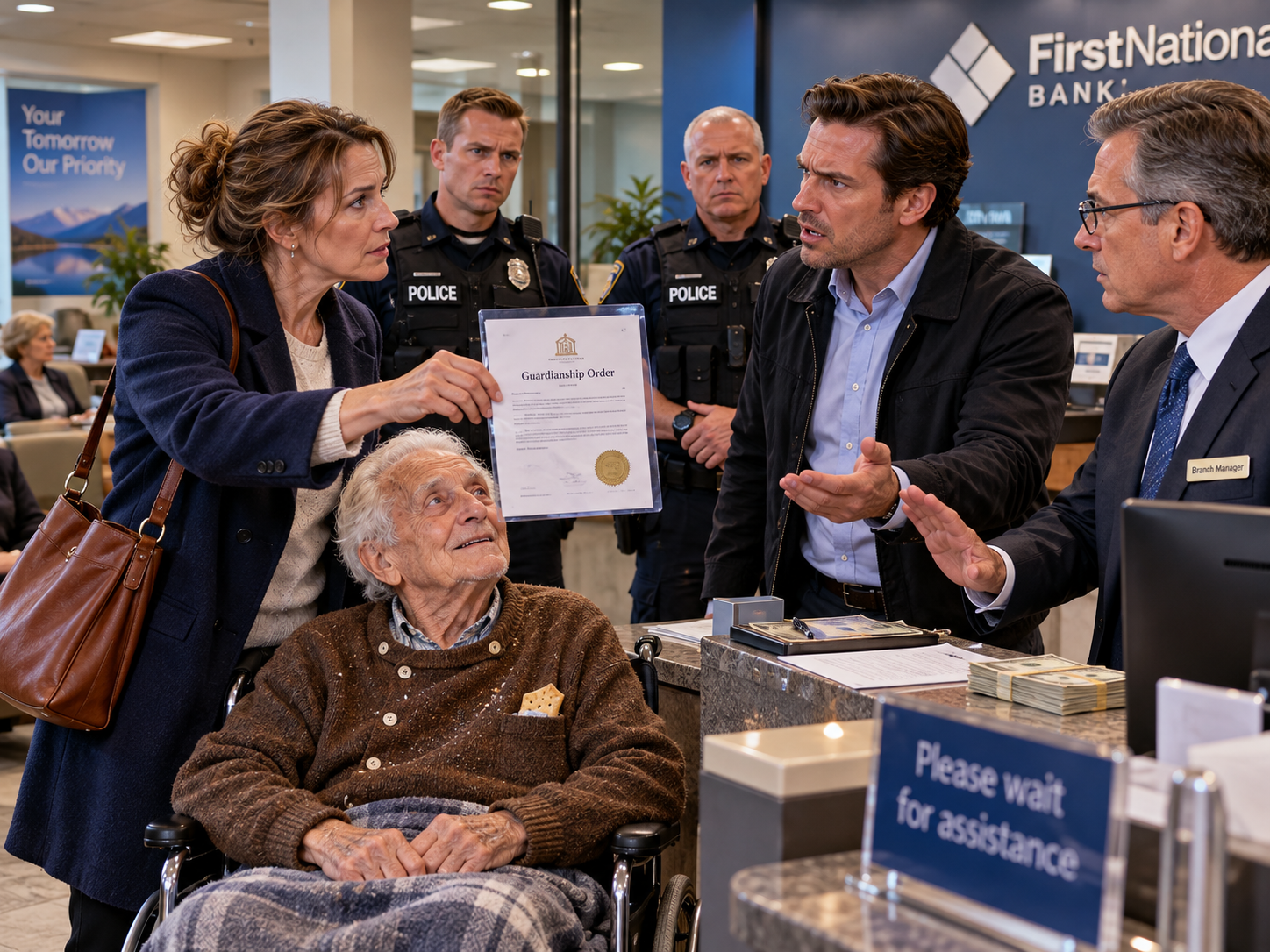
Later, after Dad was asleep, I sat at the kitchen table with the guardianship decree and the final records filed away in their proper folders. I thought about the morning Hugh had pushed Dad through the bank doors, convinced that nobody would stop him. I remembered the manager's hand covering the cash, the officers approaching, and Dad asking whether the train had arrived.
I had imagined that stopping the withdrawal would feel like taking back control. In reality, it had been the beginning of a long process of making sure Dad's needs were protected by more than my exhaustion and good intentions. I had learned that love could not substitute for safeguards, that family ties did not make financial abuse harmless, and that refusing to look away was sometimes the only way to protect someone who could no longer protect himself.
I still wished Hugh had chosen differently. I wished he had brought groceries, helped with appointments, or simply sat beside Dad without expecting anything in return. I wished he had asked for help before taking money that belonged to our father's care.
But wishes could not be the foundation of Dad's safety.
The foundation had to be the records, the legal protections, the people who showed up, and the ordinary work of making sure he had what he needed.
The next morning, I woke before the bakery ovens were fully warm. I packed Dad's lunch, checked his medication schedule, and left instructions for Lupita. Before I walked out the door, I bent down and kissed Dad's forehead.
“I'm going to work,” I told him. “I'll be back later.”
He opened his eyes and looked at me.
“Don't miss the train,” he murmured.
I smiled, though my throat tightened.
“I won't, Dad.”
Then I went to work, carrying the knowledge that I could not make my brother become the son our father deserved. I could not recover the years Hugh had spent avoiding responsibility, and I could not restore the memories dementia had taken from Arthur.
What I could do was protect the life my father still had.
And this time, no one was going to empty it while pretending he could not understand what was being taken.
Click here to continue reading: PART 5: My Brother Stopped Calling After the Investigation, but the Silence He Left Behind Forced Me to Face a Different Kind of Loss
My Brother Thought Our Father’s Memory Loss Had Made Him Easy to Rob, Until the Bank Manager Read the Papers I Had Brought
Part 4 of 20

