
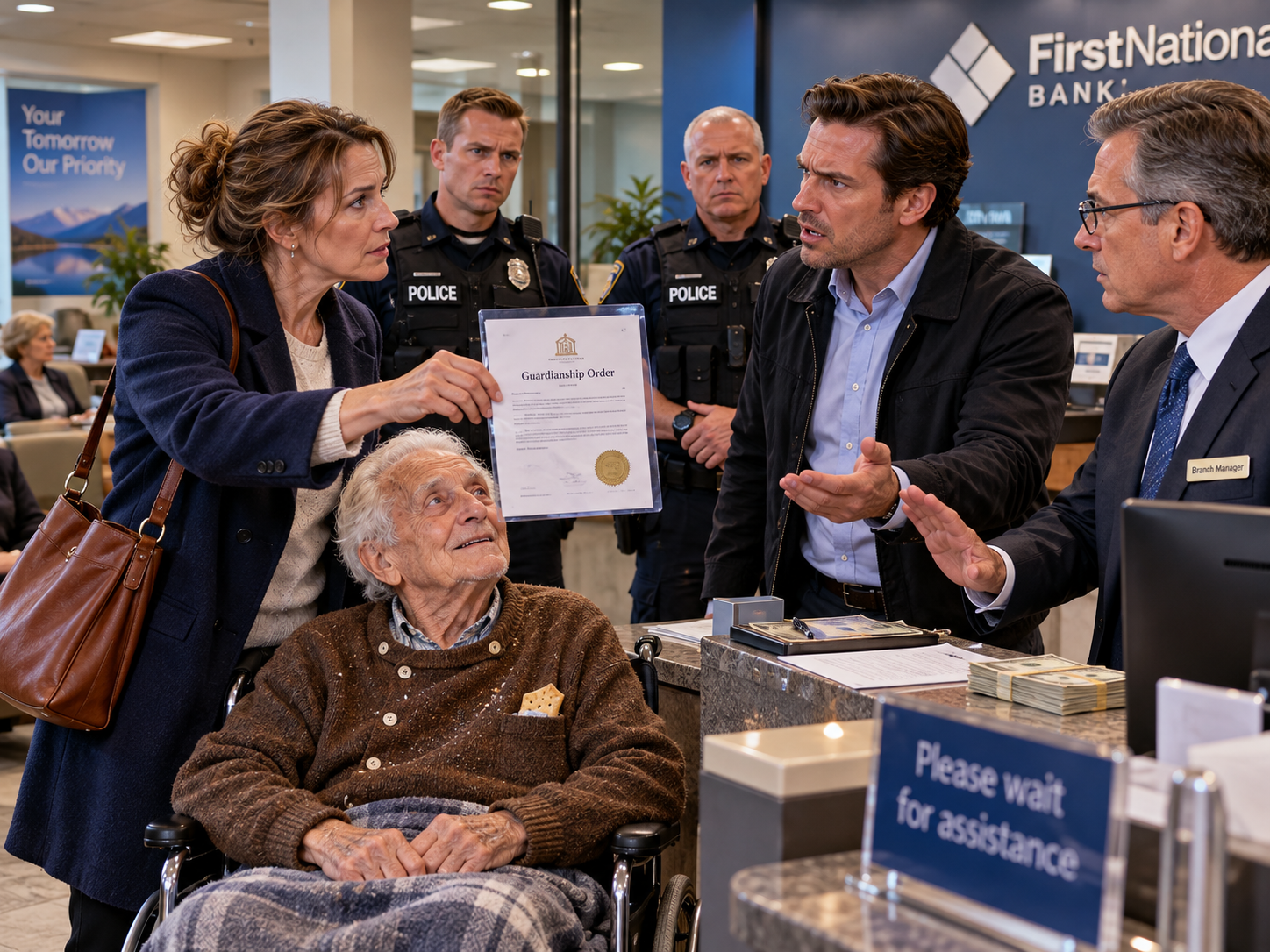
“Do not process that withdrawal.”
The branch manager's voice cut through the ordinary noise of the bank. A printer hummed behind the teller counter. Someone near the entrance was asking about a missing debit card. An elderly man in a flat cap held a number ticket between two fingers and stared at the display above the waiting area. Nothing about the morning had prepared the customers for the sudden stillness around my brother.
Hugh turned toward the manager, his fingers still resting on the counter beside Dad's savings passbook. He wore a dark jacket over a crisp shirt, expensive sneakers that had never seen a railroad yard, and the silver watch he liked to adjust whenever he wanted someone to notice it. His expression carried the irritated confidence of a man who believed every delay could be overcome by speaking loudly enough.
“What are you talking about?” he demanded. “My father is making a withdrawal.”
The manager did not move his hand from the transaction documents. “I'm asking you to step away from the counter, sir.”
Dad sat in his wheelchair a few feet behind Hugh. His brown sweater was buttoned unevenly, one side of the collar folded inward. A cracker rested in the pocket, leaving a pale trail of crumbs against the fabric. His hands lay loosely in his lap, and his gaze drifted between the teller's nameplate and a poster advertising savings accounts.
He looked peaceful.
That was the part that hurt most.
Hugh had brought him into the bank believing that Dad's confusion made everything easier. Dad would not understand the forms, the questions, or the money changing hands. He might not remember the trip by dinner. He certainly would not be able to explain what had happened afterward.
But I was standing behind Hugh, with the manager beside me and two police officers approaching from the entrance. For once, the person who understood exactly what was happening was not the one holding the passbook.
I stepped forward.
“Hugh, take your hands off Dad's account.”
He spun around. His eyes moved from my face to the manager, then to the officers. The impatience disappeared so quickly that I saw the frightened man underneath it before he could cover himself.
“Claudia? What are you doing here?”
“Making sure Dad's money stays where it belongs.”
He gave a short laugh, but it sounded forced. “You've lost your mind. I'm helping him.”
“Helping him buy groceries? Pay for his medicine? Keep the home health aide paid?”
His mouth tightened.
“Don't start this here.”
“Where would you prefer? Somewhere without witnesses?”
One officer stopped beside the counter. The other remained near Dad's wheelchair, leaving enough space that Dad would not feel surrounded. Both were calm, their hands visible, their expressions professional. The manager had told them what I had documented before Hugh arrived. They knew why we were concerned, but they had come to establish what was happening, not to decide a person's guilt from a family argument.
Hugh looked at them and straightened his shoulders.
“This is a misunderstanding,” he said. “My father wants to withdraw his pension. I'm his son. I have every right to help him.”
The teller, a young woman with her hair pulled into a tight bun, glanced toward the manager. The cash she had begun preparing remained on the counter, separated from the passbook by the manager's hand.
“Sir,” the manager said, “we have received legal documentation concerning your father's financial authority. We must verify that documentation before any transaction can proceed.”
“What documentation?”
I reached into my bag.
The guardianship decree was inside a clear folder, along with the medical evaluation, bank statements, and copies of the withdrawals Hugh had made during the previous months. I had arranged every page in chronological order because I knew he would try to turn a pattern into a series of unrelated explanations.
I placed the decree on the counter.
“My legal guardianship order,” I said. “It authorizes me to manage Dad's financial affairs and make decisions within the scope of the court's order. The bank has a copy on file.”
Hugh stared at the document.
For a moment, he seemed unable to connect the words on the page with the situation in front of him. Then his face reddened.
“You did this behind my back?”
“I did it after you drained his account and left him without money for his care.”
“I didn't drain anything!”
The officers exchanged a brief glance. The manager slid the passbook away from the cash and asked Hugh to step back. He refused at first, insisting that the transaction belonged to their father and that I had no right to interfere. The officer nearest him repeated the request, this time with the unmistakable authority of someone who would not ask a third time.
Hugh stepped away.
I did not feel triumphant. My knees were trembling, and my fingers had gone cold. I had imagined this moment during countless sleepless nights, picturing Hugh confronted by the consequences of what he had done. I had expected relief when the plan finally came together.
Instead, I was watching my father smile at a ceiling light while strangers discussed whether his own son had taken advantage of him.
Dad lifted his head.
“Claudia?” he said.
I went to him immediately and crouched beside his wheelchair.
“I'm here, Dad.”
He studied my face, his eyes searching as though a familiar picture had been taken out of an album and placed in front of him without its caption.
“Has the train come?”
The question broke something open inside me. My father had worked on the railroad for most of his adult life. When I was small, he would come home smelling of metal, cold air, and machine oil. He used to tell Hugh and me stories about long routes and difficult repairs, about men who learned to trust one another because a mistake could put an entire crew in danger.
Now he could not always remember which house was his.
“No train today, Dad,” I said softly. “We're just taking care of some paperwork.”
He nodded, satisfied with the explanation. Then he reached for my sleeve and rubbed the fabric between his thumb and forefinger.
“Your mother packed lunch?”
I swallowed.
“She'll be waiting for us later.”
I didn't know whether he meant our mother, who had died years earlier, or some other memory that had drifted to the surface. I simply held his hand until he relaxed.
Behind me, Hugh was explaining that the money was a family matter. He said he had taken Dad to the bank before and had never been stopped. He said I was making him look like a criminal because I resented being the one who handled Dad's care.
The officer asked him to describe the purpose of the withdrawal.
“Dad needs cash,” Hugh replied.
“How much?”
“Whatever is available.”
“For what specific expenses?”
Hugh hesitated.
“Household things. Medical supplies. Whatever he needs.”
I turned toward him. “Then name one thing you bought for him with the last withdrawal.”
He glared at me. “I'm not answering your questions.”
“You were willing to answer the bank's questions when you thought the money was coming to you.”
“That's enough, Claudia.”
“No, Hugh. It isn't.”
The manager asked the teller to preserve the transaction records and retain copies of the withdrawal request and any documents Hugh had presented. He also confirmed that the bank would follow the guardianship order and its internal procedures before allowing further access to the account. No money had been released that morning.
Hugh's eyes moved toward the exit.
One officer noticed.
“Sir, please remain here while we clarify the situation.”
“I have somewhere to be.”
“You can explain that to us after we've established the facts.”
Hugh looked at me as if I had arranged every obstacle in his life. He had always believed that the person who finally said no was responsible for the trouble that followed. When he borrowed money, the lender was unreasonable. When he missed a deadline, the employer was unfair. When I asked him to help care for Dad, I was trying to control him.
Now, faced with a document he could not talk his way around, he had nowhere easy to direct his anger.
My name is Claudia. I am forty-six years old, and for years I have been the person who makes sure my father has what he needs. I wake before dawn to work in a bakery, where the ovens turn the air heavy with yeast and sugar before most people have opened their curtains. I come home smelling of flour and hot metal, change my shoes, and check Dad's medicines, meals, and appointments.
My father is seventy-nine. He spent his life working on the railroad, and when his memory began to fail, he tried to hide it. He would repeat questions, forget where he had put his keys, or stand in the kitchen looking uncertain about how to use an appliance he had handled for decades. At first, we blamed exhaustion and age. Later, the doctor explained that the changes were more serious.
Dementia did not arrive as one dramatic event. It took things from him a little at a time.
Some mornings he knew me immediately. Other days, he called me by my mother's name or asked whether I was the girl who used to bring him lunch at the depot. He sometimes became frightened when familiar rooms seemed unfamiliar. On better afternoons, he could still recognize an old photograph and laugh at a memory that had survived the fog.
I learned to measure a good day by small things: whether he ate without difficulty, whether he recognized the bathroom, whether he could sit outside for ten minutes without becoming restless. The home health aide, Lupita, helped me manage the parts of his care I could not cover while working. She was patient with him and careful with his dignity. When Dad became confused, she never spoke over him as though he were absent.
His pension was not a fortune. It was simply the money he had earned after decades of work, and it helped keep his remaining life comfortable. It paid for adult diapers, blood pressure medication, eye drops, medical appointments, soft food, and the oxygen equipment he needed when his breathing became difficult. My bakery wages covered what I could, but there was no room for a sudden loss of funds.
Hugh knew all of this.
He was Dad's oldest son, and he had inherited his father's confidence without inheriting much of his father's sense of responsibility. He arrived wearing new clothes and carrying expensive gadgets, then complained about his debts as if they were injuries inflicted on him by an unkind world. Whenever I asked him to take Dad for an appointment or cover a few hours so I could rest, he reminded me that he was busy.
“I have a life, too,” he would say.
“So do I.”
“You chose to take this on.”
I had not chosen Dad's illness, but I had chosen not to leave him alone in it. Hugh treated that decision as a convenient arrangement that allowed him to remain uninvolved.
Three months earlier, I had noticed the first unmistakable sign that something was wrong with the pension account. The deposit appeared on the fifteenth, as it always did. By the end of the day, the balance had fallen to almost nothing.
I assumed I had misread the statement. I was tired enough to forget where I had left my keys and occasionally put the milk in the wrong cupboard. I checked the records again and saw a large withdrawal at the same branch Hugh used whenever he took Dad out.
Then Lupita called me from the house.
“Claudia, the card was declined,” she said. “I was trying to buy Dad's supplies. The account doesn't have enough money.”
I remember standing beside the bakery's industrial sink, one hand resting on the stainless-steel counter. The smell of rising dough filled the room. Around me, people were moving trays and calling out orders, but all I could hear was Lupita telling me that there was no money for the things Dad needed.
I checked the transaction history that evening.
There were three substantial withdrawals, each made soon after Hugh had taken Dad away under the pretense of going to the park. The dates matched the days the pension had been deposited. The amounts were too large to be explained by a few groceries or a pharmacy visit.
When I confronted Hugh by telephone, he did not deny taking Dad to the bank. He said he had helped with a withdrawal, then insisted that he was entitled to some of the money because he was the eldest son.
“Dad needs that money for his care,” I told him.
“He doesn't even understand what happens to it.”
The casualness of the answer was worse than a confession. Hugh was not claiming that Dad's needs had been met. He was telling me that Dad's inability to understand made the withdrawals easier.
I ended the call before I said something I could not take back.
After that, I began keeping records. I requested bank statements, copied the transaction dates, spoke with Dad's doctor, and arranged a cognitive evaluation. I sought legal advice about protecting his finances and making sure decisions could be made in his interests when he could no longer understand the consequences himself. The process took time, paperwork, and more money than I wanted to spend, but I continued until the court issued the guardianship decree.
I did not tell Hugh when the order was finalized.
He had already shown me what he did when he believed nobody could stop him. I wanted the bank to receive the proper documentation and understand what I was asking it to do before another withdrawal could take place.
On the morning of the fifteenth, I left Dad with his hair combed and his brown sweater on. I kissed his forehead and told Lupita that Hugh might come by.
“Are you going to let him take your father?” she asked, her face tight with worry.
“Today, yes.”
She looked as if she wanted to argue, but she trusted me enough to wait for an explanation.
By ten-thirty, I was in the bank manager's office. I laid out the guardianship decree, the medical evaluation, the statements, and a photograph of Dad from years earlier, when he could lift a grandchild onto his shoulders without thinking about the effort. The manager read everything, then asked whether I understood the seriousness of making an allegation against a family member.
“I understand,” I said. “I'm not asking you to assume he's guilty. I'm asking you to stop a transaction that may harm a vulnerable customer and preserve the evidence.”
That was why the police were there when Hugh arrived.
Now, with the withdrawal stopped and the records being secured, I watched my brother's face change as he realized that this was no longer a private argument he could end by hanging up the phone.
The officer asked him to explain the previous withdrawals. Hugh began to speak, then looked at Dad.
For a moment, I thought he might apologize.
Instead, he pointed at our father and said, “He gave me permission.”
Dad was smiling at a poster of a train.
The officer followed Hugh's gesture, then looked back at him. “We'll need to establish whether your father understood those transactions and what happened to the funds afterward.”
Hugh swallowed.
I had brought the papers to stop him from taking another dollar. I had not yet learned what he would say when he could no longer pretend the money had disappeared by accident.
Click here to continue reading: PART 2: The Withdrawals Were Only the Beginning, Because My Brother Had a Story Ready for Every Missing Dollar Except the One That Paid for Dad’s Care
My Brother Thought Our Father’s Memory Loss Had Made Him Easy to Rob, Until the Bank Manager Read the Papers I Had Brought
Part 1 of 20

