
The anniversary arrived quietly.
Naina knew the date immediately.
She had never forgotten it.
For eighteen years, she had carried that day like a hidden stone inside her chest. She knew the month, the weather, the smell of wet pavement, the road she had taken, and the moment she had removed her mangalsutra.
She had tried not to remember.
Memory had never obeyed her.
That morning, she woke before Arvind.
Rain tapped softly against the window.
For a moment, the old sensation returned.
Guilt.
Then she looked beside her.
Arvind was there.
No pillow.
No distance.
Just his hand resting near hers.
She breathed slowly.
When he woke, he looked at her.
“You're quiet.”
“Yes.”
He knew immediately.
“The date?”
She nodded.
He did not pretend not to understand.
For years, he had also remembered it.
“Do you want to talk?”
Naina hesitated.
“Yes.”
They made tea.
Instead of sitting at the dining table, they went to the balcony.
The rain had stopped.
The city smelled damp and clean.
Naina wrapped both hands around her cup.
“I thought today would always hurt like this.”
Arvind listened.
“It doesn't hurt the same anymore.”
“No.”
“Does it hurt you?”
He looked toward the street.
“Sometimes.”
Naina nodded.
“Me too.”
There was no shame in saying it.
The past did not disappear simply because they had forgiven each other.
Arvind leaned back.
“I used to think remembering meant keeping the punishment alive.”
“And now?”
“Now I think remembering can mean knowing what not to repeat.”
Naina looked at him.
“That is different.”
“Yes.”
They sat quietly.
After breakfast, Naina went through an old drawer.
She found several papers.
Some were meaningless.
Old receipts.
Expired documents.
A letter she had written years earlier and never given Arvind.
She unfolded it.
The handwriting was hers.
The words were filled with guilt.
She read only the first few lines before folding it again.
Arvind entered the room.
“What is that?”
“Something I wrote a long time ago.”
“Do you want to keep it?”
Naina shook her head.
He waited.
She tore the paper into pieces.
Not angrily.
Not dramatically.
Just carefully.
Then she placed the pieces in the bin.
Arvind watched.
“You're sure?”
“Yes.”
“What if you regret it?”
“I won't.”
He nodded.
“There are some things worth remembering,” she said, “but not every object deserves to survive the memory.”
He understood.
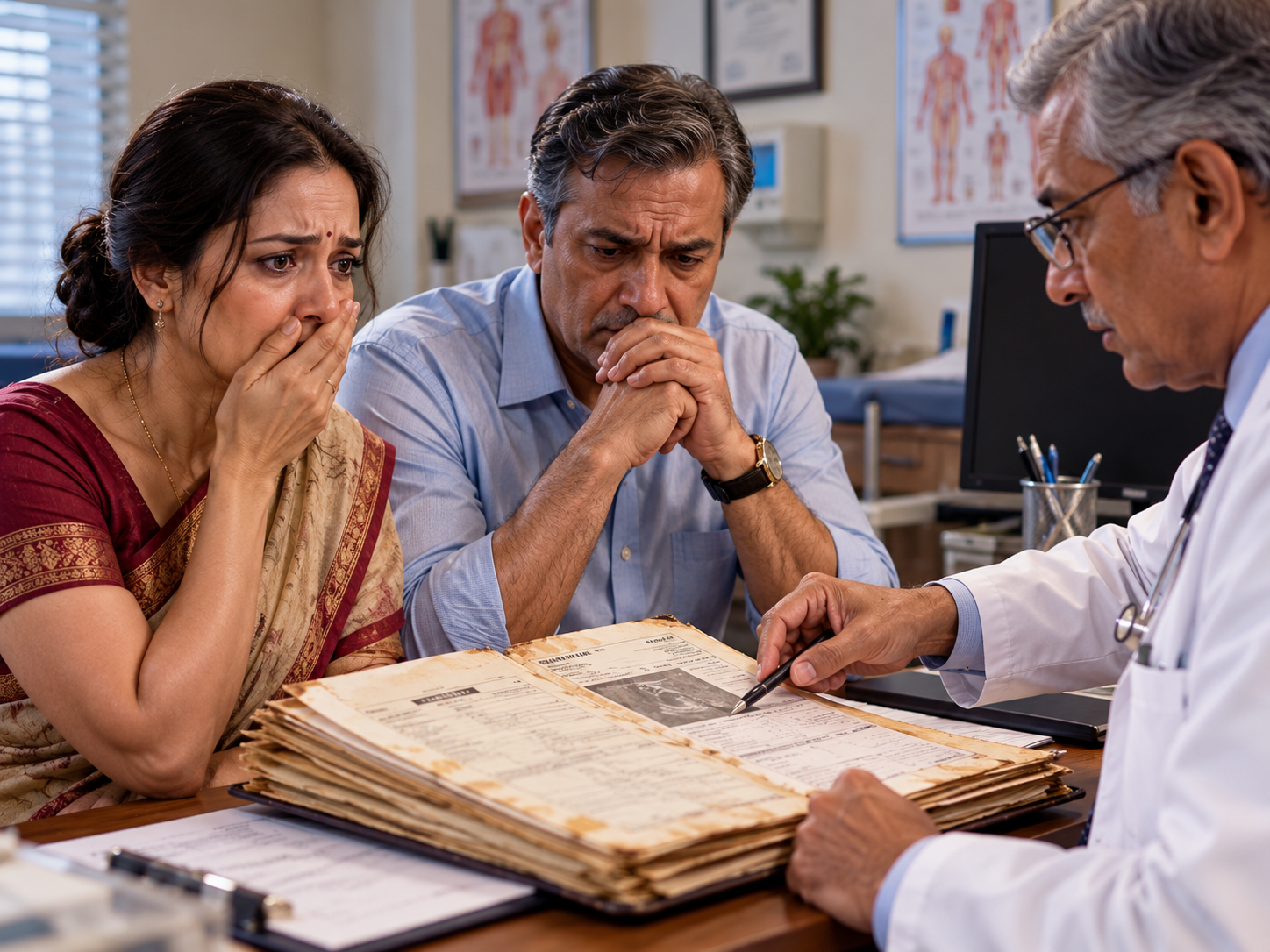
Later, Arvind opened the drawer containing his medical records.
He removed the old yellow file.
Naina looked at it.
“You're keeping that?”
“Yes.”
“Why?”
“Because this one isn't something I want to forget.”
She nodded.
The file contained the evidence of a fear he had once hidden.
It contained the old blood results.
The recommendations he had refused.
The note about his decision not to inform his wife.
And the signature that had helped preserve the secret.
Naina touched the edge of the folder.
“I'm glad we kept this.”
“So am I.”
“Not because it proves you were afraid.”
“No.”
“Because it reminds us what silence can cost.”
Arvind looked at her.
“That too.”
He returned the file to the drawer.
Then he closed it.
Neither needed to open it again that day.
In the afternoon, Meera called.
“Ma, are you okay?”
Naina smiled.
“Yes.”
“You sound different.”
“Maybe I'm tired.”
“Did you and Baba talk about the anniversary?”
Naina paused.
“Yes.”
Meera was silent for a moment.
“I'm glad.”
“Why?”
“Because I used to worry that you both were pretending not to remember.”
“We remember.”
“That's okay.”
“Yes.”
After the call, Naina told Arvind.
He nodded.
“She understands.”
“She does.”
That evening, Rohan called too.
He did not mention the date.
He simply asked whether they had eaten.
Naina realized something.
Their children no longer needed to protect them from the past.
The past belonged to their parents.
The children could love them without becoming caretakers of their pain.
That was another kind of healing.
Dinner was simple.
Rice.
Vegetables.
A small bowl of yogurt.
Arvind complained that the vegetables needed more salt.
Naina told him to add it himself.
He did.
They laughed.
Later, they washed the dishes together.
Naina dried them.
Arvind put them away.
It was an ordinary task.
But eighteen years earlier, she would never have imagined that an ordinary evening could feel like a gift.
Before bed, Arvind stood beside the window.
“Naina.”
“Yes?”
“Thank you for staying.”
She looked at him.
“You don't owe me thanks for staying.”
“I know.”
“And I don't owe you gratitude for staying either.”
He nodded.
“We both stayed for different reasons.”
“Yes.”
“And now?”
Naina stepped closer.
“Now I stay because I choose to.”
His eyes filled.
“That means more.”
She took his hand.
“And I need you to understand something.”
“What?”
“I forgive you.”
He looked at her.
“For what?”
“For making me believe that punishment was the only price I could pay forever.”
His eyes closed briefly.
When he opened them, he nodded.
“I accept that.”
She squeezed his hand.
“And I forgive myself.”
He exhaled.
“I've been waiting to hear you say that.”
“I know.”
They went to bed.
The mattress felt different without the pillow.
Not because the mattress had changed.
Because they had.
Arvind lay on his side.
Naina turned toward him.
Their hands found each other beneath the blanket.
Neither spoke for a while.
Outside, rain began again.
The same city.
The same monsoon.
The same season that had once carried her toward the worst decision of her life.
But this time, the rain did not drag her backward.
It simply fell.
Arvind's thumb moved slowly over the back of her hand.
“Are you awake?”
“Yes.”
“Good.”
“Why?”
“I wanted to say something.”
“What?”
“I love you.”
Naina closed her eyes.
The words were simple.
They did not erase anything.
They did not make the betrayal disappear.
They did not make eighteen years disappear.
They did not turn either of them into innocent people.
But they were true.
“I love you too,” she whispered.
They remained there, holding hands.
No pillow.
No wall.
No ledger.
Only two imperfect people who had finally understood that accountability was not the same as lifelong punishment.
In the morning, they would wake.
They would make tea.
Arvind would complain about the newspaper.
Naina would water the jasmine.
The children might call.
The grandchildren might visit.
There would be appointments, bills, arguments about groceries, forgotten keys, birthdays, photographs, and ordinary afternoons.
Life would continue.
The past would remain part of their story.
But it would no longer be their entire marriage.
Naina listened to Arvind's breathing beside her.
She looked once toward the empty space where the white pillow had rested for eighteen years.
Then she turned back to him.
For the first time, she did not feel the need to measure how much suffering remained.
There was nothing left to count.
Only another morning waiting to be lived.
Click here to continue reading: PART 17: The Years After Forgiveness Taught Naina That A Marriage Was Not Repaired Once, But Chosen Again Through Ordinary Days
The old medical file on the doctor’s desk carried a date I recognized, and suddenly the eighteen years of silence in our bedroom felt different
Part 16 of 20

