The first time Arvind touched my face again, neither of us planned it.
We were standing in the kitchen.
I had dropped a spoon.
I bent to pick it up.
At the same moment, he reached for it.
Our hands touched.
I froze.
So did he.
For eighteen years, either of us would have pulled away instantly.
This time, neither did.
He looked at me.
“Are you okay?”
“Yes.”
He lifted his hand.
His fingers brushed my cheek.
Only for a second.
Then he stopped.
I could see the question in his eyes.
I nodded.
He touched my face again.
There was no passion.
No dramatic reconciliation.
Only a gentle recognition that the boundary was gone.
My eyes filled with tears.
He wiped one away.
“I didn't mean to make you cry.”
“You didn't.”
“Then why?”
“Because I forgot what this felt like.”
He lowered his hand.
“I did too.”
We stood there quietly.
Then I laughed through my tears.
“What?”
“Nothing.”
“You're smiling.”
“I am.”
He smiled too.
That night, we went to bed.
There was no pillow.
There was still space between us.
But before turning off the light, Arvind said, “Good night.”
I smiled.
“Good night.”
The words were ordinary.
They had never felt so intimate.
The next month brought a difficult setback.
Arvind's blood counts dropped unexpectedly.
The specialist adjusted his medication.
For two days, he was exhausted.
I sat beside him while he slept.
At one point, he woke.
“You should rest.”
“So should you.”
“I am resting.”
“Then I'll rest too.”
He smiled.
“You've become stubborn.”
“I learned from you.”
He laughed weakly.
I brought him water.
He drank.
Then he asked, “Are you afraid?”
“Yes.”
“Of losing me?”
“Yes.”
He reached for my hand.
“I'm afraid too.”
I looked at him.
“Of what?”
“Of leaving things unfinished.”
“You still have time.”
“I know.”
“But?”
“I wasted so much.”
I squeezed his hand.
“Then don't waste today.”
He smiled.
“That sounds like something you would say.”
“I've become wise.”
“You've become annoying.”
I laughed.
His condition stabilized after the medication change.
The doctor reassured us.
But the scare changed something.
Arvind began making plans.
Not grand plans.
Small ones.
He wanted to visit Nashik.
He wanted to see an old friend.
He wanted to repair the balcony railing.
He wanted to teach Rohan how to make his father's poha.
He wanted to sit with Meera and look through her wedding photographs.
Life had become specific.
That was good.
One Saturday, he asked me to go shopping.
I stared at him.
“For what?”
“A saree.”
“For whom?”
“You.”
I laughed.
“Why?”
“You've worn the same three sarees for years.”
“I have more than three.”
“Then you hide them.”
We went to a shop.
The salesman showed me several sarees.
Arvind actually looked.
Not politely.
He looked.
He picked a deep green one.
“This.”
I touched the fabric.
“You like it?”
“Yes.”
I smiled.
“I'll take it.”
On the way home, he said, “You used to wear green.”
“When?”
“Before.”
“Before what?”
“Before I stopped looking.”
I turned toward him.
“You remember?”
“I remember more than you think.”
That sentence stayed with me.
For years, I had believed he had stopped seeing me.
Perhaps he had stopped allowing himself to admit what he saw.
That distinction did not excuse him.
But it explained something.
At home, I tried on the saree.
Arvind looked at me.
“You look beautiful.”
The words were simple.
I had heard them before from other people.
But from him, after eighteen years, they felt almost impossible.
“Thank you.”
He came closer.
Then stopped.
I reached for his hand.
He took mine.
That evening, Meera visited.
She saw the saree.
“Dad bought that?”
“Yes.”
She looked at him.
“Good choice.”
He smiled.
“I still have some skills.”
She laughed.
Dinner was noisy.
Rohan arrived late.
The children argued over dessert.
For once, our family was not careful around us.
They didn't need to be.
The house had stopped feeling like a courtroom.
It was becoming a home again.
Later, after everyone left, Arvind and I cleaned the kitchen.
He washed.
I dried.
The routine felt strangely familiar.
Then he said, “I want to apologize properly.”
I stopped.
“For what?”
“For making you sleep beside me while believing you deserved to suffer.”
I listened.
“I was hurt.”
“I know.”
“But I turned that hurt into cruelty.”
My eyes filled.
“I know.”
“I cannot undo it.”
“No.”
“But I can stop defending it.”
I nodded.
“That matters.”
He looked at me.
“I am sorry.”
This time, I believed him.
Not because the apology erased eighteen years.
Because he wasn't asking the apology to erase anything.
He was simply taking responsibility.
I touched his hand.
“Thank you.”
The next day, we visited the doctor.
His results were stable.
Dr. Mehta smiled.
“Keep following the treatment.”
Arvind nodded.
Outside the clinic, he took my hand.
“Tea?”
“Again?”
“Yes.”
“You're becoming predictable.”
“Maybe that's good.”
We sat at the same tea stall.
The city moved around us.
Cars.
Buses.
Vendors.
People arguing.
People laughing.
Life.
Arvind looked at me.
“Do you regret staying?”
The question surprised me.
“Sometimes.”
He nodded.
“That is honest.”
“But I also regret what I did.”
“Yes.”
“And I regret how much of our marriage disappeared.”
“So do I.”
He looked at me.
“Would you choose differently if you could?”
I knew what he meant.
“Yes.”
He nodded.
“So would I.”
We drank our tea.
There was no need to say more.
A few weeks later, he brought home a small plant.
“What is that?”
“A jasmine plant.”
“Why?”
“I want flowers on the balcony.”
I smiled.
“You've become sentimental.”
“Don't tell anyone.”
We planted it together.
He held the pot.
I added soil.
Our hands became dirty.
I laughed.
He laughed.
Neither of us cared.
The plant was small.
It would take time.
That seemed appropriate.
Marriage, too, could be planted again.
Not where it had been.
Somewhere new.
We watered it every morning.
Some days, Arvind remembered.
Some days, I did.
The plant survived.
So did we.
Click here to continue reading: PART 8: One ordinary morning, Arvind finally told me what he had written on the last page of the old file, and the truth changed what eighteen years meant to both of us
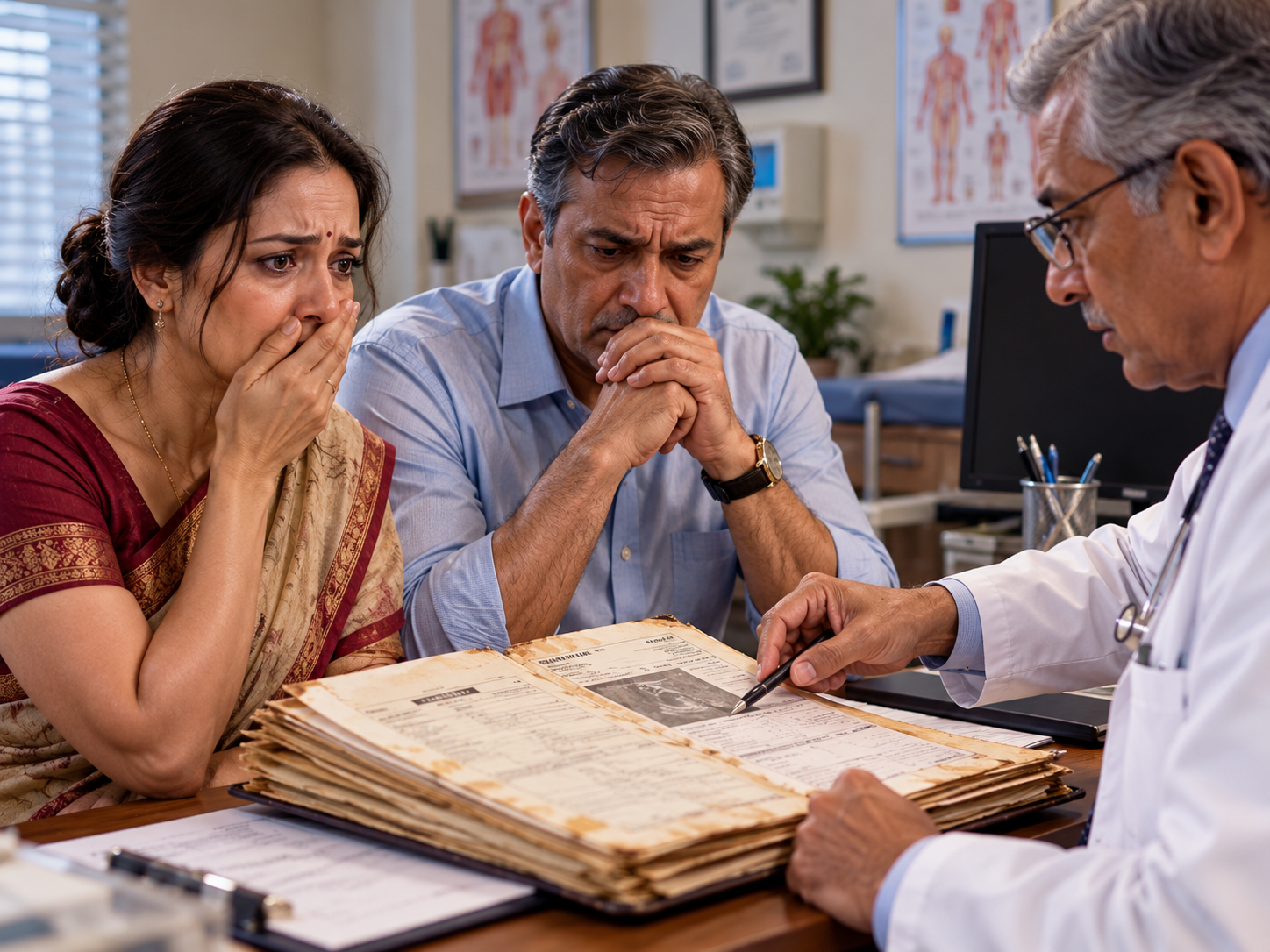
The old medical file on the doctor’s desk carried a date I recognized, and suddenly the eighteen years of silence in our bedroom felt different
Part 7 of 20