The jasmine flowered the following spring.
The first white blossom opened on a warm morning.
Arvind called me from the balcony.
“Naina.”
I came outside.
He pointed.
“There.”
I smiled.
“It survived.”
“So did we.”
I looked at him.
He smiled.
The flower was small.
Its scent was faint.
But it was there.
I touched one petal.
“Beautiful.”
“Yes.”
We stood together.
Then Arvind said, “There is something I never told you about that old file.”
My hand stopped.
“What?”
“The last page.”
I remembered the doctor's words.
The document.
The hidden note.
The warning.
“What about it?”
Arvind went inside.
He returned with a photocopy.
He placed it on the table.
“I kept this all these years.”
I sat down.
He remained standing.
“I wrote this after I refused the biopsy.”
I read the first line.
My throat tightened.
It said:
“I don't know whether I will ever forgive Naina. But I know I still love her, and that frightens me more than the diagnosis.”
I looked up.
“You wrote this?”
“Yes.”
“Why didn't you ever show me?”
“Because I was ashamed.”
I continued reading.
He had written about the night I confessed.
About his anger.
About the humiliation.
About wanting to leave.
Then another sentence.
“I want her to suffer because I am suffering.”
My eyes filled.
Arvind sat beside me.
“I wrote that.”
“Yes.”
“And later?”
He pointed lower.
“I wrote this after I didn't return for the second follow-up.”
I read.
“If I keep the anger, I won't have to admit I am afraid. If I forgive her, I have to decide what kind of man I want to be. I don't know how to be that man yet.”
I put the paper down.
“Why show me now?”
“Because I don't want the truth to die with me.”
I looked at him.
“You thought you might die.”
“Yes.”
“And you thought I would never know.”
“Yes.”
I took his hand.
“You should have shown me eighteen years ago.”
“I know.”
“Everything might have been different.”
“I know.”
“But we cannot know how different.”
“No.”
The old file had become a strange object in our lives.
It had contained illness.
Anger.
Fear.
Shame.
A decision.
And now, finally, honesty.
I folded the photocopy carefully.
“What should we do with it?”
“Keep it.”
“Why?”
“Because it tells the truth.”
I nodded.
That afternoon, Meera and Rohan came over.
We told them about the letter.
Meera read it.
Her eyes filled.
Rohan sat quietly.
Afterward, Meera said, “Dad, you were so afraid.”
Arvind nodded.
“Yes.”
“And Mom, you were so ashamed.”
I nodded.
She looked at both of us.
“You were both hurting and neither of you knew how to stop.”
“That is fair,” I said.
Rohan leaned back.
“Did you ever talk about getting divorced?”
“Yes.”
“Why didn't you?”
Arvind looked at me.
“Because we still loved each other.”
Rohan frowned.
“Even then?”
“Yes.”
“That's complicated.”
“Marriage often is.”
He nodded.
Meera looked at me.
“Do you forgive Dad?”
I thought about it.
“Yes.”
Arvind looked at me.
“I forgive him for punishing me.”
He nodded.
Then I added, “But forgiveness doesn't mean I pretend it didn't happen.”
“I know.”
Meera looked at her father.
“Do you forgive Mom?”
Arvind answered without hesitation.
“Yes.”
I looked at him.
He continued.
“But forgiveness doesn't mean what she did was acceptable.”
I nodded.
The room became quiet.
Then Rohan smiled.
“You two are finally adults.”
We laughed.
It was the first time anyone had joked about our marriage in years.
The tension broke.
That evening, after the children left, Arvind and I sat on the balcony.
The jasmine smelled stronger now.
He said, “I don't want our children to remember us as the couple who betrayed each other.”
“What should they remember?”
“That we eventually learned how to stop hurting each other.”
I thought about it.
“I'd like that.”
The next month marked nineteen years since the rainy night.
We did not celebrate it.
We simply remembered.
I stood at the balcony watching the rain.
The same smell came from the road.
Wet dust.
Diesel.
Fried snacks from the corner stall.
For a moment, I was back in 2007.
Young.
Guilty.
Terrified.
Then Arvind came beside me.
He didn't ask what I was thinking.
He simply stood there.
I reached for his hand.
He held it.
The memory remained.
But it no longer swallowed the present.
That was the difference.
Later that evening, we opened the old box.
Inside were the documents.
The medical reports.
The photocopy of Arvind's statement.
A photograph from our wedding.
A photograph of our children.
I looked at them together.
The past had become an archive.
Not a prison.
Arvind closed the box.
“Do you want to throw any of it away?”
“No.”
“Why?”
“Because I don't want to erase our mistakes.”
He nodded.
“But I don't want them displayed either.”
“Agreed.”
We put the box away.
Then we went to bed.
There was no pillow.
The distance between us was smaller now.
Not because eighteen years had disappeared.
Because we had stopped using distance as punishment.
Arvind turned toward me.
“Good night.”
“Good night.”
He hesitated.
Then he touched my hand.
I closed my fingers around his.
We stayed that way.
No promises.
No speeches.
No demand that tomorrow would be perfect.
Only two people who finally understood that love was not proved by suffering.
It was proved by what you did after the suffering had been acknowledged.
In the morning, Arvind woke before me.
I found him in the kitchen making tea.
Two cups.
Two spoons of sugar in mine.
He placed mine on the table.
I smiled.
“You remembered.”
“I always remembered.”
I looked at him.
“Then why did you stop?”
He thought for a moment.
“Because I was angry enough to pretend I didn't.”
I nodded.
“Don't pretend anymore.”
“I won't.”
He sat beside me.
Outside, the jasmine moved gently in the morning breeze.
Our children would come that evening.
There would be food.
Noise.
Questions.
Laughter.
The ordinary disorder of family life.
I looked at Arvind.
He looked back.
There were scars between us.
Some would never disappear.
There were years we could never recover.
There were words we wished we had spoken sooner.
But the truth had finally replaced the punishment.
And that was enough.
I had once believed I would spend the rest of my life paying for one terrible afternoon.
Arvind had believed he would spend the rest of his life making me pay.
Neither of us had understood that punishment does not repair love.
Truth can.
Accountability can.
Time can.
Choice can.
And sometimes, after two people have hurt each other deeply, the most courageous thing they can do is stop asking the past to keep hurting them.
That morning, Arvind reached for my hand.
There was no pillow between us.
There was no hidden file.
There was no secret left waiting behind the next page.
Only the life we had.
Imperfect.
Scarred.
Still ours.
Click here to continue reading: PART 9: Years after the white pillow disappeared, Arvind’s health scare returned in a quieter form, forcing us to decide whether our new peace could survive another season of fear
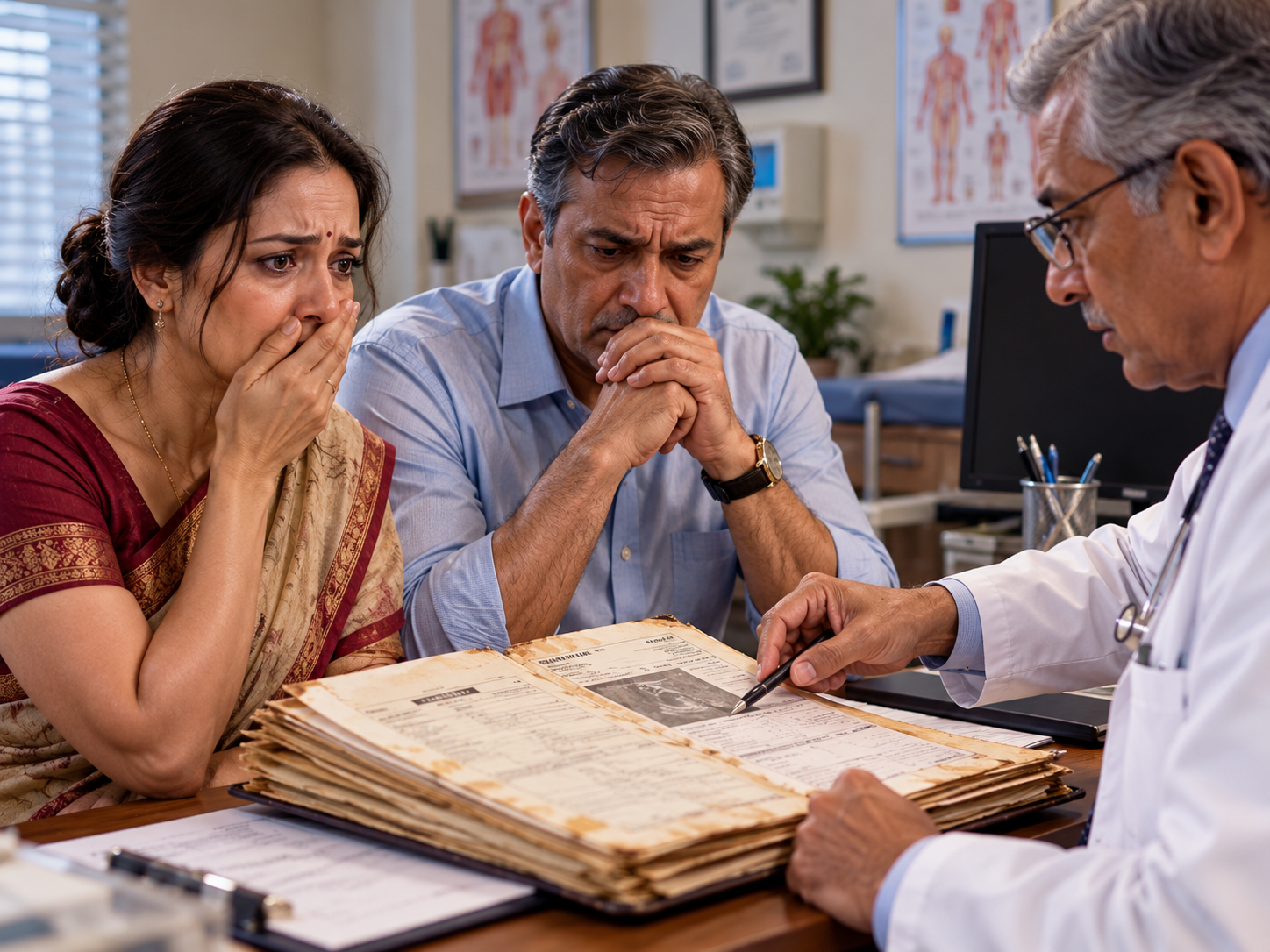
The old medical file on the doctor’s desk carried a date I recognized, and suddenly the eighteen years of silence in our bedroom felt different
Part 8 of 20