The next few years did not become perfect.
That surprised me.
I had once imagined that if Arvind and I finally spoke honestly, everything afterward would settle into some permanent peace.
It did not.
We still argued.
Sometimes over money.
Sometimes over the children.
Sometimes over small things that had nothing to do with our past but somehow touched old nerves.
The difference was that arguments ended.
Neither of us carried them silently into the bedroom.
Neither of us used affection as punishment.
And when one of us became afraid, we tried to say so.
That took practice.
For Arvind, perhaps more than for me.
He had spent eighteen years believing silence was strength.
Now he was learning that silence could also be avoidance.
His medical condition remained controlled for a long time.
Every few months, we went to the hospital.
He hated the waiting room.
I hated the smell of antiseptic.
But we went together.
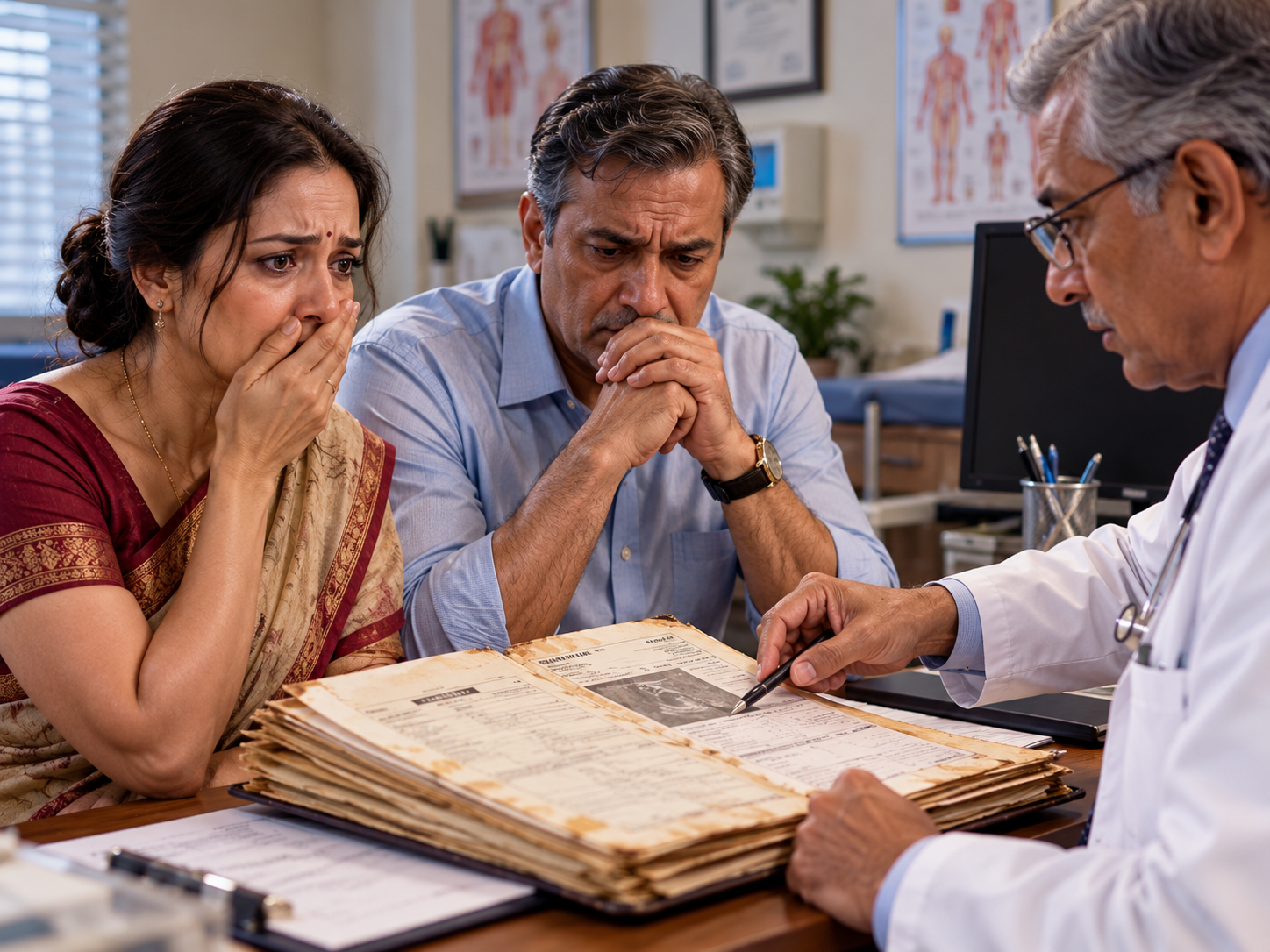
One Tuesday morning, however, Dr. Mehta called us before our scheduled appointment.
“Please come in tomorrow.”
Arvind listened quietly.
Then he asked, “Is something wrong?”
“There has been a change in your latest blood results.”
My stomach tightened.
“What kind of change?” I asked.
“I would rather explain when you're here.”
After the call ended, Arvind placed the phone on the table.
Neither of us spoke.
The old fear had returned.
Not dramatically.
It simply entered the room and sat down between us.
That evening, Arvind ate almost nothing.
I watched him push rice around his plate.
“You should eat.”
“I know.”
“You're thinking too much.”
“So are you.”
“That is true.”
He smiled faintly.
Then he put down his spoon.
“I don't want to go through what we went through before.”
I understood immediately.
“You mean hiding things.”
“Yes.”
“Then don't.”
He looked at me.
“If the results are bad, I want you to know everything.”
“You don't have to promise that anymore.”
“I want to.”
I reached across the table.
He took my hand.
The next morning, we returned to Dr. Mehta's clinic.
The doctor studied the latest results.
Arvind sat very still.
I held my bag in my lap.
Finally, Dr. Mehta spoke.
“There has been a fluctuation.”
“How serious?” Arvind asked.
“Not an emergency.”
I exhaled.
“But it needs attention.”
Arvind nodded.
“What do we do?”
“We adjust the medication and repeat the tests in six weeks.”
“That is all?”
“For now.”
I looked at the doctor.
“Could it become serious?”
“Yes.”
Arvind's fingers tightened around mine.
“But we are not at that point,” Dr. Mehta added.
Outside the clinic, neither of us spoke until we reached the car.
Then Arvind laughed.
“What?”
“I was expecting the end.”
“So was I.”
“And instead we got six weeks of waiting.”
“That's life.”
He looked at me.
“You've become very philosophical.”
“No. I'm tired.”
He laughed.
That evening, we told the children.
Meera arrived first.
She listened carefully.
“Dad, what did the doctor say?”
“That we need to monitor it.”
“Are you going to be okay?”
“I hope so.”
Rohan sat beside him.
“You'll follow the treatment?”
“Yes.”
“Properly?”
Arvind looked offended.
“I know how to take medicine.”
Rohan smiled.
“Just checking.”
We laughed.
The conversation was surprisingly normal.
No one whispered.
No one pretended everything was fine.
No one behaved as though saying the word “illness” would cause something terrible to happen.
That was one of the changes I was most grateful for.
Our family had learned to speak.
Six weeks later, the numbers improved.
The doctor was pleased.
“Keep doing what you're doing.”
Arvind looked at me.
“I have an excellent supervisor.”
I raised an eyebrow.
“I am your wife, not your supervisor.”
“Sometimes the distinction is unclear.”
Dr. Mehta laughed.
I did too.
On the drive home, Arvind reached over and touched my shoulder.
“You know what I realized?”
“What?”
“I used to think the worst thing that could happen to me was losing you.”
I looked at him.
“And now?”
“Now I think the worst thing was having you beside me and refusing to let you be beside me.”
I did not answer immediately.
Because there was nothing clever to say.
He continued driving.
After a while, I said, “We can't recover those years.”
“I know.”
“But we can stop losing more.”
He nodded.
That became our quiet agreement.
We stopped measuring our marriage against the one we might have had.
Instead, we measured it against the one we were building.
A few months later, Meera announced that she was moving to another city for work.
The news should have been happy.
It was.
But I cried.
Arvind laughed.
“You're behaving as though she is moving to another country.”
“It feels like another country.”
Meera hugged me.
“I'll visit.”
“When?”
“Soon.”
“You said that last time.”
She laughed.
“Mom.”
Arvind stood behind her.
“Let her go.”
I turned toward him.
“You're not helping.”
“She has to live her own life.”
I stared at him.
Those words would once have sounded impossible from the man who had spent years trying to control what our marriage should become.
Now he understood.
Children had to be allowed to leave.
Love did not mean holding someone in place.
Meera left three weeks later.
The house became quieter.
I missed her voice.
Arvind missed her arguments.
One evening, he found me looking at an old photograph of our children.
“You miss them.”
“Yes.”
“Me too.”
He sat beside me.
“We did okay.”
I smiled.
“We made mistakes.”
“Yes.”
“But we did okay.”
I leaned against his shoulder.
He did not move away.
The next morning, I received a message from Meera.
“Dad sent me a recipe.”
I laughed.
“What recipe?”
“His poha.”
“Did you ask for it?”
“No.”
“That sounds like your father.”
She sent another message.
“He said I need to learn to cook.”
I laughed again.
“Tell him you can order.”
“I did.”
“He'll be offended.”
“He already is.”
I showed Arvind.
He shook his head.
“These children.”
I smiled.
“They're adults.”
“I know.”
“And they're allowed to make their own choices.”
He looked at me.
“You really like reminding me of that.”
“Yes.”
He smiled.
“I deserve it.”
That night, we sat on the balcony.
The jasmine plant had grown taller.
Its branches reached toward the railing.
There were more flowers now.
Arvind watered it.
I watched.
“Do you remember when we planted this?”
“Yes.”
“You said we were planting something new.”
“I was optimistic.”
“You were.”
He smiled.
“And?”
I touched one of the flowers.
“It grew.”
He nodded.
“So did we.”
I leaned against the railing.
The city lights flickered below.
For years, I had feared growing old.
Now I found myself less afraid of age than of wasting it.
The future was no longer something we could control.
Neither of us knew how long Arvind's health would remain stable.
Neither of us knew where our children would live.
Neither of us knew what other losses life might bring.
But we knew one thing.
We would not meet uncertainty with silence again.
That mattered.
One night, before bed, Arvind asked, “Are you happy?”
I looked at him.
The question was simple.
The answer wasn't.
“Yes.”
He smiled.
“Even after everything?”
“Because of everything and despite everything.”
He considered that.
“I think I understand.”
I touched his hand.
“We don't need to make our past beautiful.”
“No.”
“We only need to stop letting it decide our future.”
He nodded.
Then he turned off the light.
There was no pillow between us.
Only the ordinary darkness of a shared room.
And this time, neither of us was afraid of what the other might say when morning came.
Click here to continue reading: PART 10: When Meera returned with a question about the night I confessed, I realized our children were finally old enough to understand why silence had shaped our family
The old medical file on the doctor’s desk carried a date I recognized, and suddenly the eighteen years of silence in our bedroom felt different
Part 9 of 20