Treatment began the following month.
Arvind had regular blood tests.
Some days he felt almost normal.
Other days fatigue settled over him so heavily that he slept through the afternoon.
I learned his medication schedule.
He learned to tell me when he was afraid.
Neither of us pretended the past had disappeared.
That was important.
I had made a terrible choice eighteen years earlier.
I could not rewrite it.
Arvind had made his own terrible choices afterward.
He could not rewrite those either.
But we could stop adding new punishment to old pain.
The first real conversation about forgiveness happened on a rainy evening.
Mumbai rain tapped against the windows.
The smell of wet earth came through the balcony door.
Arvind sat at the table.
“I want to ask you something.”
“What?”
“Do you still feel guilty?”
I looked at him.
“Yes.”
He nodded.
“Every day?”
“Not every day.”
“That is progress.”
I smiled faintly.
“You?”
He thought.
“I feel ashamed.”
“Every day?”
“Less than before.”
We sat quietly.
Then he said, “I don't want you to spend the rest of your life apologizing.”
My eyes filled.
“I thought that was what you wanted.”
“I thought it was.”
“And now?”
“Now I know what eighteen years of punishment actually did.”
I looked at him.
“What?”
“It didn't make me faithful.”
“It didn't make me happier.”
“It didn't make you understand me.”
“No.”
“It didn't repair our marriage.”
“No.”
He lowered his eyes.
“It only made two people old.”
The sentence hurt because it was true.
We had lost years.
Not all of them.
Our children had grown.
We had shared festivals.
Meals.
Family weddings.
Illness.
Birthdays.
There had been kindness between us, even inside the coldness.
But there had also been eighteen years of touch withheld.
Words swallowed.
Questions avoided.
Two people sleeping beneath the same fan and pretending loneliness was a form of justice.
I reached across the table.
“Arvind.”
He looked at me.
“I can't promise I can forget.”
“I don't want you to.”
“I can't promise everything will return to how it was.”
“I don't expect that.”
“But I can promise I won't use your mistake to punish you anymore.”
He nodded.
“I can promise the same.”
That was the beginning.
Not romance.
Not a miracle.
A decision.
Our children noticed the difference.
Meera visited one Sunday.
She looked from me to her father.
“You two seem different.”
Arvind smiled.
“We are.”
“How?”
I looked at him.
He answered.
“We finally started talking.”
Meera laughed.
“After thirty years?”
“Better late than never.”
She shook her head.
“I don't know what happened while I was growing up, but I'm glad you're talking now.”
Rohan visited the following week.
He noticed the missing pillow immediately.
“Where is it?”
Arvind laughed.
“Gone.”
Rohan looked at me.
“What pillow?”
I smiled.
“An old family story.”
He looked confused.
“Should I ask?”
“No,” Arvind said.
“Not today.”
Rohan shrugged.
“Fine.”
Some truths belonged to the people who had lived them.
But I knew one day we would tell our children.
Not to make them judge us.
Not to turn them against either parent.
Only because silence had already taken too much from our family.
Months passed.
Arvind's treatment began working.
His blood counts improved.
The specialist remained cautious, but the worst possibility receded.
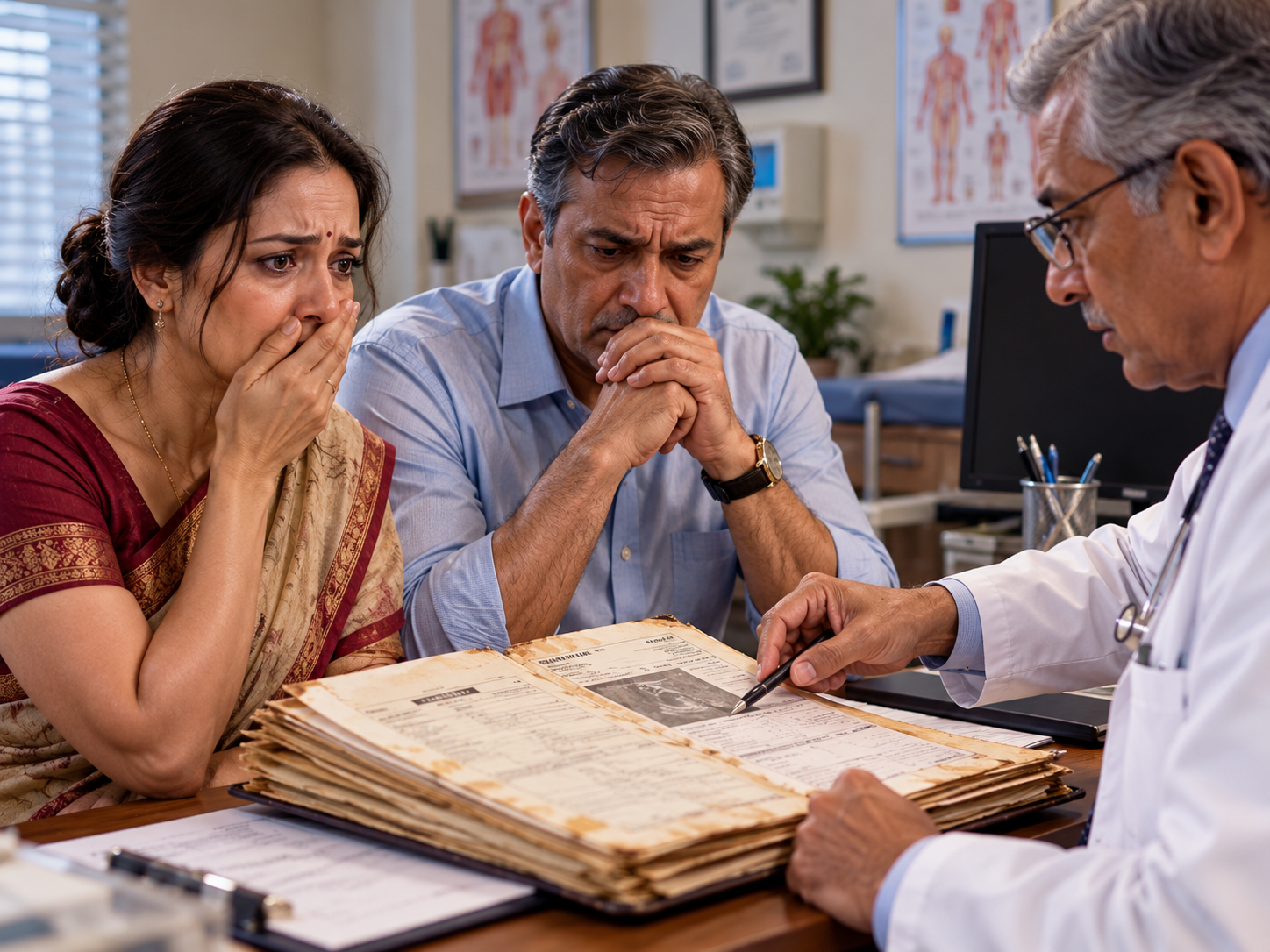
One afternoon, Dr. Mehta reviewed the latest results.
“You are responding well.”
Arvind smiled.
“So I'm not dying tomorrow?”
“No.”
“Good.”
I laughed.
Dr. Mehta looked at me.
“He has a long road of monitoring ahead.”
“I know.”
Arvind looked at me.
“She knows everything now.”
The doctor smiled.
“That is probably a good thing.”
On the drive home, Arvind reached for my hand.
He stopped halfway.
The old hesitation returned.
I turned my palm upward.
He took it.
Neither of us spoke.
The gesture was small.
It meant more than an apology.
More than a promise.
It meant we were no longer pretending that touch itself was dangerous.
One evening, months after the diagnosis, I found the white pillow in the cupboard.
I took it out.
The fabric was yellowed.
I carried it downstairs.
Arvind saw me.
“What are you doing?”
“I found our old wall.”
He smiled sadly.
“What will you do with it?”
“I don't know.”
We stood together in the kitchen.
Then he took the pillow from my hands.
He looked at it for a long time.
“This thing saw more of our marriage than most people did.”
I laughed softly.
“Unfortunately.”
He carried it outside.
There was an old storage box near the balcony.
He opened it.
“Should we throw it away?”
I looked at him.
“Do you want to?”
“Yes.”
“Then do it.”
He placed the pillow inside a garbage bag.
Then stopped.
“Are you sure?”
“Yes.”
He tied the bag.
The pillow disappeared.
I watched him.
Something inside me loosened.
Not because a pillow was gone.
Because the symbol of punishment no longer belonged in our bedroom.
That night, we slept without it.
There was still space between us.
But it was no longer a border.
It was simply space.
In the morning, Arvind made tea.
He brought mine without asking how much sugar I wanted.
He remembered.
Two spoons.
I smiled.
“What?”
“Nothing.”
“You're smiling.”
“I am.”
He sat across from me.
“I have something to tell you.”
“What?”
“I should have forgiven you sooner.”
I looked at him.
“And I should never have betrayed you.”
He nodded.
“Both can be true.”
“Yes.”
That became the sentence we carried forward.
Both can be true.
My betrayal was real.
His punishment was real.
My guilt was real.
His fear was real.
The damage was real.
So was the possibility of something better.
We did not call our marriage perfect.
We did not pretend eighteen years could be returned.
We simply stopped trying to make the past hurt us every morning.
A year after Arvind's retirement, his health was stable.
Our children came for dinner.
Meera brought sweets.
Rohan brought his wife.
The table was crowded again.
Arvind sat beside me.
At one point, Meera reached across the table for the vegetables.
Her hand brushed mine.
She smiled.
“Mom, pass that.”
I passed the bowl.
Nothing dramatic happened.
Nobody noticed.
But I did.
For years, I had believed touch was something I had lost forever.
Now my family was around me.
Hands crossed the table.
Plates moved.
Someone laughed.
Someone complained about the food being too spicy.
Arvind poured water into my glass.
He did it without hesitation.
Our children continued talking.
I looked at him.
He looked back.
There was no apology in his eyes.
No accusation.
Only recognition.
We had both done things that could not be undone.
But we had finally stopped making those things the only story about us.
Later that night, after everyone left, Arvind and I stood on the balcony.
The city was wet from another brief shower.
He leaned against the railing.
“Naina.”
“Yes?”
“Do you remember what the doctor said that first day?”
I smiled.
“Yes.”
“He asked whether I had told you what I signed.”
“You hadn't.”
“No.”
He looked toward the lights below.
“I spent eighteen years thinking that document was proof that I could control what happened next.”
“And?”
“It was proof that I was afraid.”
I nodded.
He turned toward me.
“I wish I had understood that sooner.”
“So do I.”
He took my hand.
This time, neither of us hesitated.
We stood together.
Not as the young couple we had been.
Not as the perfect couple our relatives believed we were.
As two older people who had finally learned that love could not survive on punishment, silence, or debt.
It needed truth.
It needed boundaries.
It needed accountability.
And sometimes, after enormous damage, it needed the humility to admit that neither person could repair everything alone.
I thought about the woman I had been on that monsoon night.
I still remembered the lodge.
The lie.
The empty place where my mangalsutra had been.
I would never call that mistake small.
It had hurt someone I loved.
It had changed our family.
I would always regret it.
But I no longer believed regret required a lifetime sentence.
And I thought about Arvind.
The man who had spent eighteen years placing a white pillow between us.
He had been wounded.
He had been frightened.
He had been cruel.
He had also been ill.
None of those truths canceled the others.
The doctor had not given us a magic answer that day.
He had given us something harder.
A chance to stop lying.
The illness was treated.
The old records were preserved.
The truth about 2007 was finally spoken.
The pillow was gone.
And our marriage became something neither of us expected.
Not a return to the past.
A new agreement.
We would not pretend.
We would not punish.
We would not hide.
And we would not waste whatever time remained.
That night, I turned off the bedroom light.
There was no white pillow between us.
Arvind reached across the darkness.
His fingers found mine.
He did not say he forgave me.
I did not say I had forgotten.
We didn't need those words.
For the first time in eighteen years, we simply held hands and let the night pass.
And when morning came, I understood what the old file had really given us.
Not another reason to feel guilty.
Not another punishment.
The truth.
Sometimes the most painful sentence is not, “You were wrong.”
It is realizing that two people have spent years suffering after the moment when suffering stopped serving any purpose.
I had betrayed my husband once.
He had punished me for eighteen years.
Neither fact could be changed.
But the rest of our lives did not have to become another eighteen years.
That was the choice we finally made.
Together.
Click here to continue reading: PART 5: After the pillow disappeared, our home became strangely quiet, and I discovered that rebuilding a marriage required more courage than surviving its punishment
The old medical file on the doctor’s desk carried a date I recognized, and suddenly the eighteen years of silence in our bedroom felt different
Part 4 of 20