The morning after their anniversary, Naina woke to the sound of Arvind coughing in the next room.
For one frightened second, her body reacted before her mind did.
She sat upright.
Then she heard him clear his throat and mutter something about the newspaper.
She relaxed.
“Arvind?”
“I’m here.”
“You scared me.”
“I only coughed.”
“You coughed like an eighty-year-old man.”
“I am not eighty.”
“You sound eighty.”
He appeared in the doorway holding two cups of tea.
“You are becoming rude.”
“You married me.”
He smiled.
“That was my first mistake.”
Naina stared at him.
He laughed.
She threw a cushion at him.
He caught it.
They both stopped.
The cushion landed in his hands, soft and harmless.
Naina looked at it.
Arvind looked at her.
Then he placed it on the chair.
Neither needed to mention the old pillow.
Some memories no longer required explanation.
Their lives gradually became smaller in ways that were not sad.
They stopped attending every social event.
They preferred evenings at home.
They took shorter walks.
Arvind complained about his knees.
Naina complained about his complaining.
They argued about television programs.
They shared fruit.
They sometimes sat without speaking.
And every few weeks, one of their children visited with grandchildren, groceries, or some problem that needed their opinion.
The apartment remained full.
Not with possessions.
With voices.
One afternoon, Meera arrived carrying a folder.
“Baba, I need your signature.”
“For what?”
“Some bank document.”
Arvind took the papers.
Naina watched him read each page carefully.
“You're checking everything?”
“Yes.”
“You trust your daughter?”
“I trust my daughter. I don't trust paperwork.”
Meera laughed.
“That is exactly why I brought it to you.”
Naina smiled from the kitchen.
The scene was so ordinary that she almost missed what it meant.
Years earlier, family life had been built around things nobody said.
Now people brought papers into the living room and asked questions openly.
Nothing had to be hidden.
That evening, Meera stayed for dinner.
Afterward, she and Naina washed dishes while Arvind sat in the balcony.
“Ma,” Meera said.
“Yes?”
“Do you ever think about what your life would have been like if you had left Baba?”
Naina continued drying the plate.
“Sometimes.”
“What do you imagine?”
“Nothing specific.”
“Why?”
“Because I don't think there is only one alternate life.”
Meera nodded.
“There could have been many.”
“Yes.”
“Do you regret staying?”
Naina placed the plate away.
“I regret many things.”
Meera waited.
“But staying isn't one of them.”
Meera smiled.
“I wanted to hear that.”
“Why?”
“Because when I was younger, I thought staying meant you had no choice.”
Naina looked at her.
“And now?”
“Now I understand that you made a choice.”
Naina nodded.
“Yes.”
“But Baba had to make one too.”
“He did.”
“Was it difficult?”
Naina smiled faintly.
“Every day.”
Meera dried her hands.
“That's probably what people don't understand about marriage.”
“What?”
“That forgiveness isn't a single conversation.”
“No.”
“It is what comes after.”
Naina looked toward the balcony.
Arvind was asleep in his chair.
His newspaper had slipped onto his lap.
She smiled.
“Yes,” she said. “It is what comes after.”
A few weeks later, Arvind had another medical appointment.
Naina offered to accompany him.
He shook his head.
“I can go myself.”
She nodded.
“Call me afterward.”
“I will.”
She watched him leave.
The old Naina would have followed him emotionally even when she stayed physically behind.
Now she trusted him to manage his appointment.
Trust had become something they practiced rather than something they demanded.
Three hours later, her phone rang.
“Hello?”
“It’s me.”
“How did it go?”
“Fine.”
“Fine?”
“Dr. Mehta said the numbers are stable.”
Naina closed her eyes.
“Thank God.”
“I knew you'd worry.”
“Of course I worry.”
“I know.”
She heard him smile.
Then he said, “I bought something.”
“What?”
“You'll see.”
When he came home, he was carrying a small paper bag.
Naina opened it.
Inside was a new teacup.
Two matching cups.
She looked at him.
“We already have cups.”
“These are ours.”
She laughed.
“You bought cups after a medical appointment?”
“I needed a reward.”
“For what?”
“Surviving your interrogation.”
She shook her head.
But she placed the cups on the shelf.
They became their morning cups.
The children noticed.
The grandchildren noticed.
Nobody knew why they mattered.
That was fine.
Some symbols belonged only to the people who had lived them.
Years continued to pass.
The jasmine plant grew too large for its original pot.
One afternoon, Arvind said, “We need to move it.”
“Where?”
“Somewhere with more space.”
They worked together.
Naina held the plant while Arvind loosened the soil.
The roots had tangled around themselves.
“Careful,” she said.
“I am.”
“Not like that.”
“I know what I'm doing.”
“You always say that before making a mess.”
He looked at her.
“Some things never change.”
They both laughed.
They replanted the jasmine in a larger container.
For several days, it looked unhappy.
The leaves drooped.
Naina became worried.
“Maybe we damaged it.”
Arvind touched the soil.
“Give it time.”
She frowned.
“You're suddenly an expert?”
“I learned.”
“From where?”
“From us.”
She looked at him.
He shrugged.
“Things can look worse before they grow stronger.”
The plant recovered.
New leaves appeared.
Then, weeks later, flowers.
Naina stood in the balcony one morning and counted them.
There were more than before.
She called Arvind.
“Come.”
He joined her.
“Look.”
He smiled.
“Beautiful.”
She nodded.
Neither said anything else.
They didn't need to.
The plant had become part of their marriage in a way neither had planned.
It had witnessed arguments.
Apologies.
Family gatherings.
Illness.
Laughter.
Rain.
Silence.
And somehow it had kept growing.
One evening, Rohan visited alone.
His children were older now.
He sat with his father in the balcony.
“Baba.”
“Yes?”
“Can I ask you something?”
“Of course.”
“Do you ever wish you had handled things differently?”
Arvind looked toward the street.
“Yes.”
Rohan waited.
“I wish I had spoken sooner.”
“About the medical problem?”
“That too.”
“But also about everything else.”
Arvind rubbed his hands together.
“I thought silence gave me control.”
“Did it?”
“No.”
Rohan nodded.
“I think a lot of men learn that too late.”
Arvind looked at him.
“Then don't wait.”
Rohan smiled.
“I won't.”
Inside, Naina heard only the last sentence.
She did not need to hear the rest.
That night, she and Arvind ate dinner together.
He told her about his conversation with Rohan.
She listened.
“Did you tell him everything?”
“No.”
“Why?”
“Some things belong between us.”
Naina nodded.
That boundary mattered.
Their children knew the truth.
But the truth did not need to become family entertainment.
The past was theirs to carry responsibly.
Not theirs to perform.
As they prepared for bed, Arvind paused.
“Naina.”
“Yes?”
“Do you remember when I used to place the pillow there?”
She looked at the empty space beside him.
“Yes.”
“I sometimes wonder how I convinced myself that was love.”
“It wasn't.”
“I know.”
He sat down.
“I think I was afraid that if I forgave you, what happened would become meaningless.”
Naina sat beside him.
“And now?”
“Now I know forgiveness didn't make it meaningless.”
“What did it do?”
“It let us make something after it.”
She leaned against his shoulder.
He rested his head lightly against hers.
Outside, the jasmine moved in the night breeze.
They remained that way for several minutes.
Nothing dramatic happened.
No revelation.
No apology.
No crisis.
Only two people sitting together after many years.
And Naina realized that this was the part nobody had warned her about.
After the great forgiveness came ordinary life.
The dishes.
The medicine.
The appointments.
The grandchildren.
The arguments.
The jokes.
The mornings.
The nights.
The countless opportunities to choose whether an old wound would control a new day.
She had once believed healing would feel like freedom.
Now she understood.
Healing felt like having choices again.
Click here to continue reading: PART 18: When Their Children Began Building Lives Of Their Own, Arvind And Naina Faced The Quiet Question Of Who They Were Without Their Old Pain
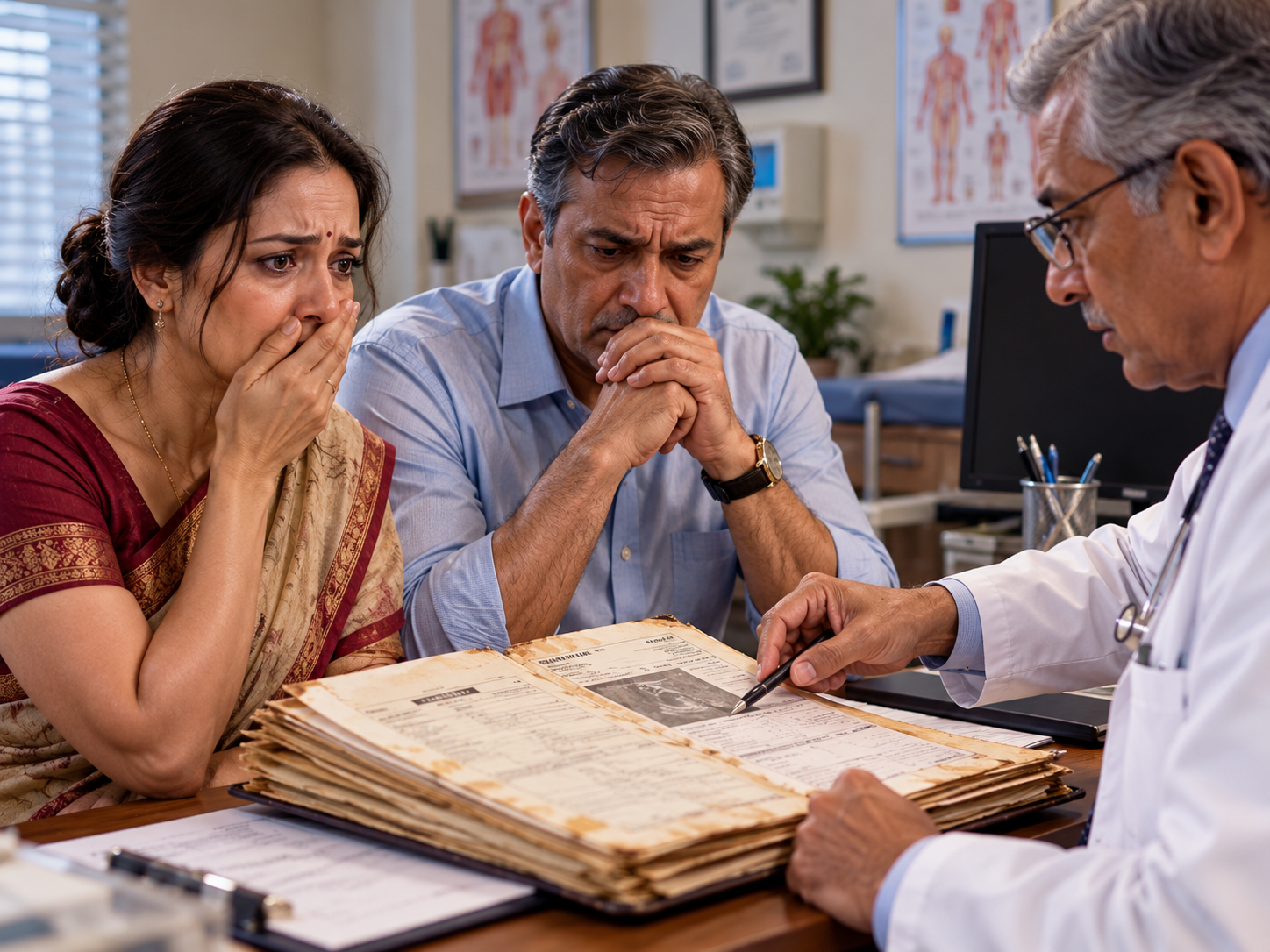
The old medical file on the doctor’s desk carried a date I recognized, and suddenly the eighteen years of silence in our bedroom felt different
Part 17 of 20