
Dad began asking the question in different ways.
Sometimes he asked whether he had forgotten to pick us up from school. Sometimes he wanted to know if he had missed a train that was waiting for him. On one particularly difficult morning, he stood beside the front door in his slippers and insisted that he needed to report to his supervisor because he had let the crew down.
I helped him sit down and explained that he was home, that work was finished, and that he was safe. He listened for a moment, then looked at me with a worried expression.
“Did I do something wrong?”
“No, Dad.”
“Someone's upset.”
I took his hand. “You're all right. Nobody is asking you to go anywhere.”
He seemed reassured, but the question stayed with me throughout the day. Dementia had taken so much from him that I sometimes forgot how sensitive he remained to the emotions around him. He could no longer follow every conversation, but he still noticed tension. He knew when voices became sharp and when people stopped speaking as he entered a room.
I wanted to protect him from the consequences of Hugh's actions, but I also knew that the family could not function if we pretended those actions had never happened. The challenge was to maintain the safeguards and boundaries without turning Dad's remaining years into a permanent courtroom.
That evening, Hugh arrived for his scheduled visit. He brought a small bag of groceries and asked whether Dad had eaten. I told him Dad had finished his dinner and was resting in the living room. Hugh put the groceries away, then sat beside our father.
Dad was watching an old railway program. The narrator was describing a locomotive traveling through the mountains, and Dad followed the images with surprising concentration.
“That's a good engine,” he said.
Hugh smiled. “It is.”
“Needs a strong crew.”
“Definitely.”
They watched in silence for a while. I remained in the kitchen, preparing Dad's medication and checking the next day's schedule. I could hear their voices, low and steady, and for a moment the house felt peaceful.
Then Dad asked, “Did I give you enough?”
Hugh turned toward him. “What do you mean, Dad?”
“Money. School. Everything.” Dad frowned, searching for the right words. “I worked hard. Did I do right?”
Hugh looked toward the kitchen. I stopped moving.
Dad was not asking about the pension. He was reaching back into his life, trying to understand whether he had been a good father. Perhaps he remembered the long shifts, the lunches packed in napkins, the shoes he had bought for us, or the sacrifices he had made so Hugh could study. Perhaps he was simply feeling uncertain and wanted reassurance.
Hugh took his hand.
“You did more than enough,” he said.
Dad looked at him carefully. “You sure?”
“Yes, Dad. You worked hard for us. You took care of us.”
Dad's face softened. He leaned back against the chair and returned his attention to the television.
Hugh remained still for several seconds, holding his father's hand. When he finally looked toward the kitchen, his eyes were wet.
I went into the living room and checked whether Dad needed anything. He shook his head and asked for a blanket. I covered his knees, adjusted the cushion behind his back, and made sure his water was within reach.
Hugh waited until Dad had settled before following me into the kitchen.
“I don't think I understood how much he did for us,” he said.
I placed the medication organizer on the counter. “You knew he worked hard.”
“I knew that. I didn't think about what it cost him.”
I looked at my brother. For once, he was not trying to defend himself. He was looking at the floor, his hands clasped together, as though he had finally allowed a memory to become something more than a story about his childhood.
“He never asked us to pay him back,” Hugh continued. “He just kept working.”
“No, he didn't.”
“And I took money from him when he couldn't even understand what was happening.”
I did not answer immediately. I wanted him to continue if he was ready, but I would not help him arrive at the truth by supplying all the words himself.
“I told myself I would put it back,” he said. “I told myself I deserved some help because I was struggling. But I knew the pension was for his care.”
“Yes,” I said. “You knew.”
He pressed his lips together. “I don't expect you to forgive me.”
That was different from his earlier demands that I stop treating him like a criminal. He was no longer asking me to erase the consequences or promise that everything would return to normal.
“I appreciate you saying that,” I replied. “But the most important thing is what you do from here.”
“I know.”
“You have to keep Dad's needs first. The account remains protected. Any contributions or expenses need to be recorded. If you want to help, you can do that without controlling the money.”
He nodded.
“And you need to stop telling people that I did this to you,” I added. “I didn't create the situation. I responded to it.”
He looked at me. “I've said things I shouldn't have.”
“Yes.”
“I was angry.”
“I know.”
“I wanted someone else to be responsible for what happened.”
I leaned against the counter. “You can be angry. You can be ashamed. You can regret what you did. But you can't make me carry it for you.”
He closed his eyes briefly, then nodded.
We did not hug. I did not tell him everything was forgiven. I did not want a moment of emotion to become a substitute for the work of rebuilding trust. But I felt something shift in the conversation. Hugh had finally named his actions without hiding them behind his status as the oldest son or his claim that Dad had given him permission.
It was a beginning, not a conclusion.
Over the next few weeks, he continued visiting. He took Dad for short walks when the weather allowed, helped with meals, and accompanied him to an appointment. He still became impatient occasionally, but he was more willing to listen when I explained why Dad needed extra time. When he could not make a scheduled visit, he told me in advance and helped arrange coverage.
The changes were not dramatic. They were the sort of changes that made the days more manageable.
I also continued arranging support for myself. The caregiver consultation helped me identify respite services and understand what assistance might be available as Dad's needs increased. I learned that accepting help was not a failure of love. It was a way of making sure I could keep caring for him without exhausting myself to the point that I became unable to function.
I began taking one evening off each week when another caregiver could stay with Dad. At first, I spent those hours doing errands and catching up on household tasks. Eventually, I allowed myself to sit at a café with a book or take a walk without checking my phone every few minutes.
The first time I returned home after a full evening away, I found Dad asleep in his chair and Hugh sitting at the table with a cup of tea.
“He ate well,” Hugh said quietly. “We watched the train program. He asked about work a few times, but he settled down.”
I checked Dad's blanket and listened to his breathing. Everything was fine.
“Thank you for staying,” I told Hugh.
He shrugged, but he did not dismiss the gratitude.
“I should have done more before.”
“Yes,” I said. “You should have.”
He looked at me, then nodded. The acknowledgment no longer felt like a challenge he needed to win. It was simply a fact he was learning to live with.
A month later, the care team recommended further adjustments to Dad's routine. His ability to move safely had declined, and he needed more supervision during certain parts of the day. We reviewed the options together, including increased home care and the possibility of a more supported setting if his needs eventually exceeded what we could safely provide at home.
Hugh initially looked stricken.
“We can't move him out of his house,” he said.
“We don't have to decide that today,” I replied. “But we have to plan for what he might need.”
“He belongs here.”
“I want him here as long as it's safe and appropriate. But if that changes, we can't let guilt make the decision for us.”
Hugh stared at the care plan. I could see him struggling with the same fear I had felt: that the father who had once been strong enough to carry us on his shoulders might eventually need more care than either of us could provide alone.
“We'll work it out,” he said at last.
We divided the immediate tasks. I would coordinate with the care team and manage the financial arrangements. Hugh would help with home modifications, attend future meetings when possible, and continue his scheduled visits. We agreed to review the plan regularly instead of waiting for a crisis.
The pension remained under the safeguards established by the guardianship order. Every payment was recorded, and Hugh's contributions were tracked separately. I had no intention of returning to the days when I wondered whether the money would still be there when Dad needed it.
One afternoon, I found an old envelope in a drawer while searching for Dad's insurance papers. It contained a photograph of Hugh and me as children, standing beside our father in his railroad uniform. Dad's hand rested on each of our shoulders. His face was sunburned, and his work shirt was wrinkled, but he was smiling broadly.
I carried the photograph into the living room.
“Do you remember this?” I asked Hugh, who had come to help Dad with lunch.
He took the picture and studied it.
“Dad took us to the depot,” he said. “I wanted to climb into the engine, but he said we had to wait until the supervisor finished.”
“You were furious.”
“I remember.”
He smiled faintly, then looked at Dad, who was carefully lifting a spoon toward his mouth.
“He looks so young.”
“He was.”
Hugh handed the photograph back. “He did everything for us.”
I put it in a frame and placed it on the shelf beside the other family pictures. It was not an attempt to pretend that we had become a perfect family again. It was a reminder that the past contained more than the bank, the withdrawals, and the arguments. Dad had loved us. He had worked hard for us. Hugh's actions had not erased that love, though they had damaged the trust between us.
I could acknowledge the good without using it to excuse the harm.
That evening, Dad became confused and asked whether he needed to catch a train. Hugh and I helped him settle into his chair. I spoke calmly, telling him he was home and did not need to go anywhere. Hugh brought him water and sat nearby until the worry passed.
When Dad finally relaxed, he looked from Hugh to me.
“My children,” he murmured.
“Yes, Dad,” I said.
Hugh reached for Dad's hand. I rested mine over Dad's other hand, and for a moment we sat together without arguing about the past or trying to force a promise about the future.
Dad did not know about the bank investigation. He did not know how much paperwork had been required to protect his pension or how many difficult conversations had followed. He only knew that his children were there.
I wanted him to have that comfort for as long as possible.
Later, when Hugh was leaving, he paused at the door.
“I can't change what I did,” he said.
“No.”
“But I can keep showing up.”
“Yes,” I replied. “You can.”
He nodded and walked to his car.
I watched him leave, then returned to Dad's room to check that he was comfortable for the night. I straightened his blanket and placed his water on the bedside table. He opened his eyes briefly and smiled at me.
“Good girl,” he whispered.
I bent down and kissed his forehead.
For years, I had believed that protecting Dad meant carrying every burden myself. I now understood that it meant making decisions that kept him safe, even when those decisions were difficult, and allowing other people to share the work only when they were willing to do so responsibly.
Hugh might continue changing. He might fall back into old habits. I could not guarantee what kind of brother he would be next month or next year.
But Dad's safety no longer depended on that uncertainty.
His pension was protected. His care was being reviewed as his needs changed. The people involved knew their responsibilities, and the records showed where the money went.
I turned off the bedroom light and left the door slightly open.
The house was quiet, and for once I did not feel that I had to stay awake waiting for another crisis.
There would be difficult days ahead. Dad's illness would continue to take things from him, and our family would have to keep making decisions none of us wanted to face. But we would face them with the facts in front of us, not with excuses standing in their place.
That was the kind of protection my father deserved.
And it was the kind I intended to keep giving him.
Click here to continue reading: PART 9: The Promise Hugh Made at the Care Meeting Began to Cost Him More Than Money, and Neither of Us Knew Whether He Would Keep It
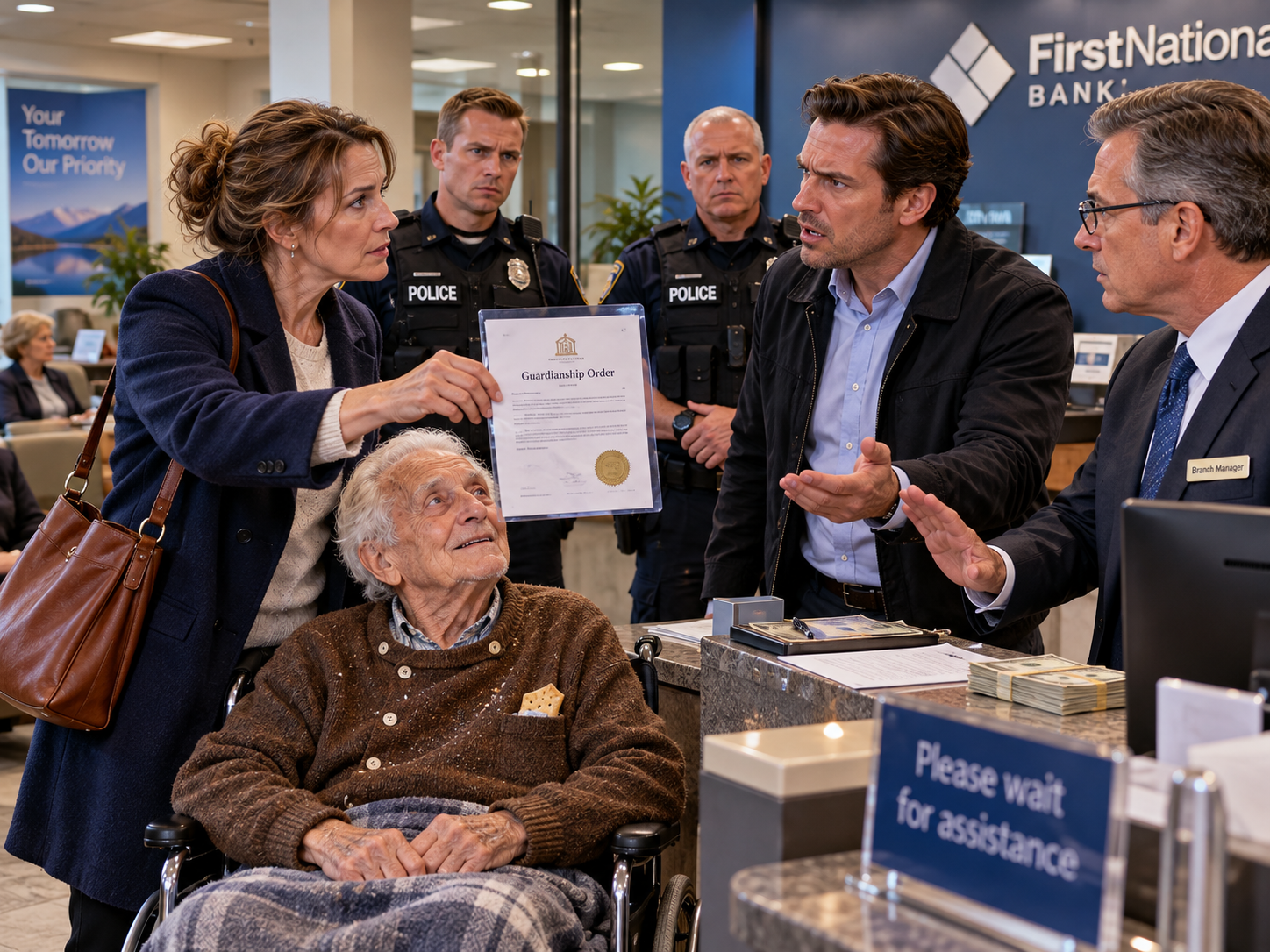
My Brother Thought Our Father’s Memory Loss Had Made Him Easy to Rob, Until the Bank Manager Read the Papers I Had Brought
Part 8 of 20

