The evening began with rain.
Not the violent monsoon rain of eighteen years earlier.
Just a soft shower against the windows.
Arvind sat in the living room reading.
I was sorting old photographs.
The children had gone home.
The house was quiet.
I found the wedding photograph again.
I placed it beside the newest family picture.
Young us.
Old us.
Two versions of the same marriage.
I called Arvind.
“Come look.”
He stood beside me.
For a while, neither of us spoke.
Then he said, “We look happy there.”
“We were.”
“Were we ready?”
“No.”
He laughed.
“Definitely not.”
I looked at the younger woman in the photograph.
“She had no idea what was coming.”
“Neither did I.”
I turned toward him.
“If you could speak to him now, what would you tell him?”
He thought.
“I'd tell him not to confuse anger with strength.”
I nodded.
“What else?”
“I'd tell him to get the biopsy.”
I laughed softly.
“Definitely.”
“And I'd tell him to talk to his wife.”
“That too.”
He looked at me.
“What would you tell her?”
I looked at myself in the photograph.
“I'd tell her not to make one terrible decision and then spend the rest of her life believing she had become a terrible person.”
Arvind nodded.
“That is important.”
We sat together.
The rain continued.
Then he asked, “Would you do it differently?”
“Yes.”
“I would too.”
“Even knowing everything that came after?”
“Yes.”
He looked at me.
“Still?”
“Still.”
That was the honest answer.
There was no reason to romanticize our suffering.
The eighteen years had contained lessons.
But lessons did not make the suffering necessary.
We had learned because we had survived what we did to each other.
That was different.
I put the photographs away.
Arvind stood.
“Tea?”
“Of course.”
He went to the kitchen.
I watched him prepare two cups.
He knew exactly how I liked mine.
Two spoons.
A little milk.
He brought it to me.
I took the cup.
“Thank you.”
“You're welcome.”
He sat down.
For a moment, we simply drank tea.
Then he said, “Do you remember the first night without the pillow?”
“Yes.”
“You looked at the empty space.”
“So did you.”
“I was terrified.”
“Of what?”
“That you would realize you didn't need me anymore.”
I looked at him.
“I was terrified you would put it back.”
He smiled sadly.
“We were both afraid.”
“Yes.”
“And neither of us said it.”
“No.”
He took my hand.
“We should have.”
“We didn't know how.”
“Now we do.”
I smiled.
“Yes.”
A few weeks later, our children organized another family dinner.
Everyone came.
The grandchildren ran around the house.
Meera brought dessert.
Rohan brought vegetables.
Someone played old music.
Arvind sat beside me.
At one point, our granddaughter climbed onto my lap.
“Grandma.”
“Yes?”
“Were you and Grandpa always married?”
I smiled.
“For a very long time.”
“Did you always like each other?”
Everyone laughed.
Arvind looked at me.
“What do we tell her?”
“The truth.”
He nodded.
“We didn't always agree.”
Our granddaughter frowned.
“Why?”
“Because people don't always agree.”
“But you love each other.”
I looked at Arvind.
“Yes.”
She smiled.
“Okay.”
Then she ran away.
The answer was enough for her.
Perhaps it was enough for us too.
Later that evening, Meera stood beside me in the kitchen.
“Mom.”
“Yes?”
“I've been thinking about what you told us.”
“What about it?”
“I used to think a strong marriage meant never hurting each other.”
I listened.
“Now I think it's more complicated.”
“It is.”
“You hurt each other.”
“Yes.”
“But you also learned.”
“Yes.”
“And you stayed because you wanted to, not because you were trapped.”
I looked at her.
“That is important.”
She smiled.
“I think I understand.”
She hugged me.
“I love you.”
“I love you too.”
After she left, I found Arvind in the living room.
He was looking at the old family photograph.
“She understands,” he said.
“I think so.”
“Good.”
He sat down.
“I don't want our children to repeat our mistakes.”
“They won't be perfect.”
“No.”
“But they know they can talk.”
“Yes.”
“And they know love doesn't give anyone permission to punish another person forever.”
He nodded.
That was enough.
Years continued to pass.
Our grandchildren grew.
Meera's work changed.
Rohan moved closer.
Arvind's health remained stable with treatment.
The jasmine plant grew until we had to replace the railing around it.
The house changed slowly.
Furniture was replaced.
Walls were painted.
Photographs multiplied.
But one thing remained constant.
There was no white pillow.
One afternoon, I found the old pillowcase at the back of a cupboard.
I held it.
The fabric was thin.
The once-bright white had turned gray.
I showed Arvind.
He laughed.
“You kept it?”
“Apparently.”
“Why?”
“I don't know.”
He took it from me.
We stood together for a moment.
Then he tore the pillowcase into pieces.
I stared.
“What are you doing?”
“Getting rid of it properly.”
I laughed.
“You could have thrown it away.”
“This felt better.”
We put the pieces in the trash.
Then we washed our hands.
It was almost ridiculous.
A piece of cloth could not carry eighteen years.
We had carried those years ourselves.
The pillow had only been a symbol.
The real wall had always been inside us.
And that wall had finally come down.
That evening, Arvind and I went for a walk.
The sky was clear after the rain.
Streetlights reflected in puddles.
He held my hand.
I held his.
No one paid attention.
We walked slowly.
At the corner, he stopped.
“I'm tired.”
“Let's sit.”
We found a bench.
He leaned back.
“I used to think growing old was frightening.”
“And now?”
“Now I think growing old with someone you can finally speak to is a privilege.”
I smiled.
“You're getting sentimental again.”
“Probably.”
I leaned against him.
“We lost eighteen years.”
“Yes.”
“But we didn't lose everything.”
“No.”
“We still have time.”
“Yes.”
He squeezed my hand.
“Enough time?”
I looked at him.
“Enough for tomorrow.”
He smiled.
That answer was enough.
When we returned home, the children were waiting.
The grandchildren ran toward us.
Someone shouted that dinner was ready.
Someone else complained that the rice was getting cold.
Arvind laughed.
I looked around.
This was the life that remained.
Not perfect.
Not untouched.
But real.
The betrayal was real.
The punishment was real.
The illness was real.
The lost years were real.
So were the apologies.
The treatment.
The conversations.
The children.
The grandchildren.
The jasmine.
The tea.
The hands that now reached for each other without fear.
All of it belonged to the same story.
That night, I stood in our bedroom.
The bed looked ordinary.
Two pillows.
Side by side.
Nothing between them.
Arvind came in.
He looked at the bed.
Then at me.
“Do you remember?”
“Yes.”
He smiled.
“I don't.”
“What?”
“I don't want to remember the pillow anymore.”
I understood.
Neither did I.
Some memories deserved to remain history rather than become daily furniture.
We turned off the light.
He reached for my hand.
I held his.
There was no promise that tomorrow would be easy.
There was no guarantee that illness would never return.
There was no way to recover the years we had wasted.
But there was no wall between us.
And after eighteen years, that was not a small thing.
I closed my eyes.
For so long, I had believed my punishment would last until death.
Instead, it ended while we were still alive.
Not because my betrayal became unimportant.
Not because Arvind forgot what happened.
It ended because eventually we understood that guilt and punishment were not the same as accountability, and pain was not proof of love.
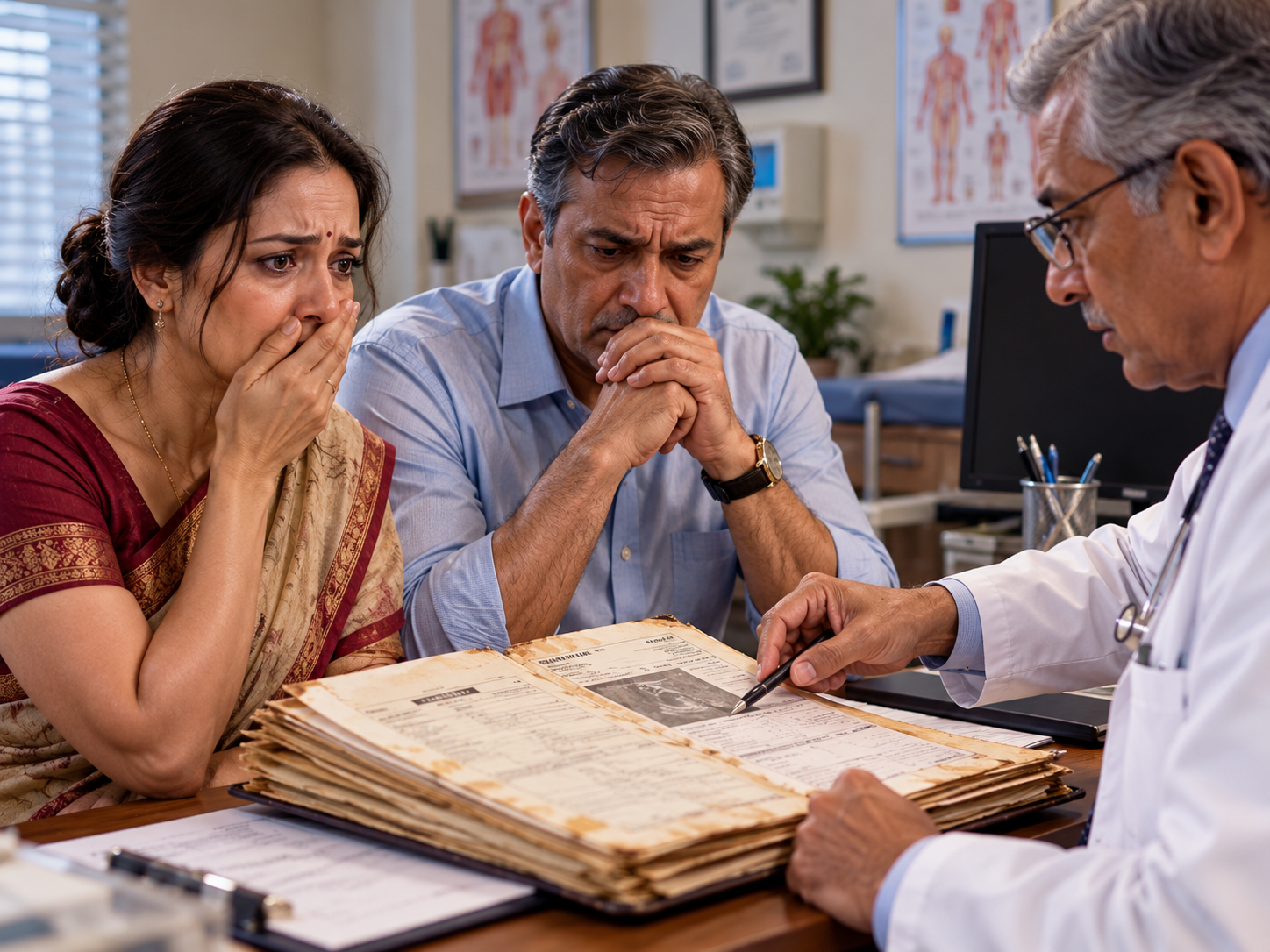
The doctor had opened an old file and forced a truth into the light.
But the final healing did not come from that file.
It came from what we chose after reading it.
We chose to speak.
We chose to listen.
We chose treatment instead of denial.
We chose accountability instead of revenge.
We chose each other again—not as the young couple in the wedding photograph, but as two older people who knew exactly how fragile love could become when fear was allowed to govern it.
Arvind's fingers tightened around mine.
“Naina?”
“Yes?”
“Good night.”
I smiled.
“Good night.”
And this time, when the room went dark, there was no white pillow between us.
There was only the quiet space of a shared bed, the sound of rain beginning again beyond the window, and two people finally allowing the night to pass without turning it into a punishment.
Click here to continue reading: PART 13: The Morning Arvind Finally Admitted That Staying Together Had Never Meant He Was Entitled To Keep Punishing Her
The old medical file on the doctor’s desk carried a date I recognized, and suddenly the eighteen years of silence in our bedroom felt different
Part 12 of 20