The morning after they had slept holding hands, Naina woke before the alarm.
For a few seconds, she remained completely still. Pale sunlight had begun slipping through the curtains, touching the edge of the wardrobe and the framed photograph on the opposite wall. Beside her, Arvind was breathing evenly. There was no white pillow between them.
The absence still felt strange.
For eighteen years, that pillow had been the first thing she noticed when she opened her eyes and the last thing she saw before sleep. It had been washed, dried, folded, and returned to the bed with almost ceremonial consistency. Even after they had begun speaking honestly again, Naina had sometimes expected to find it there by instinct.
Now there was only a small crease in the bedsheet where it had once rested.
She turned her head toward Arvind.
His hair had become almost completely silver. The lines around his eyes had deepened. His hand lay open on the mattress between them, close enough that she could reach it without moving more than a few inches.
Naina did not touch him immediately.
She watched him sleep and thought about how strange it was that forgiveness had not arrived like a door opening. It had come quietly, almost invisibly, through hundreds of small moments that would have looked meaningless to anyone else.
A cup of tea left beside her chair.
A question asked without suspicion.
A hand held during a hospital appointment.
A joke that did not contain an accusation.
A night without the pillow.
She finally reached over and placed her fingers against his hand.
Arvind stirred.
His eyes opened slowly, and when he saw her, he did not pull away.
“Morning,” he whispered.
“Morning.”
He looked at their hands and smiled faintly.
“I thought I was dreaming.”
“So did I.”
Neither laughed loudly. The moment was too fragile for that.
From the kitchen came the familiar sound of water running through the tap. Naina withdrew her hand and sat up.
“I’ll make tea.”
“I’ll come.”
“You should rest.”
“I have been resting for eighteen years.”
She stopped.
Arvind immediately regretted the sentence.
Naina looked back at him.
He sighed. “That came out wrong.”
“No,” she said quietly. “It came out honestly.”
He sat on the edge of the bed.
“I don't want to make jokes about it anymore,” he said. “Not even small ones.”
Naina nodded.
That was one of the changes she had begun noticing in him. Before, every reference to those eighteen years had carried a blade hidden beneath it. Now, when he mentioned them, there was sadness instead of satisfaction.
They went into the kitchen together.
Their ordinary morning had become something precious.
Naina poured tea while Arvind sliced fruit. He complained that she had bought bananas that were too ripe. She told him he had no authority over bananas. He insisted that retirement had given him new expertise.
She smiled.
For the first time in years, the kitchen sounded like a home rather than a place where two people happened to prepare meals.
After breakfast, Arvind opened the newspaper.
Naina sat across from him with her own cup.
“Meera is coming Sunday,” she said.
“And Rohan?”
“He said he will bring the children.”
Arvind lowered the newspaper.
“Then we should buy more sweets.”
“We already have sweets.”
“Not enough.”
“You always say that.”
“Because you always underestimate grandchildren.”
She looked at him.
He looked back.
They both smiled.
It was almost painfully ordinary.
And that was exactly why Naina treasured it.
Later that afternoon, Meera called.
“Ma, Baba?”
“Yes?”
“Are you both free Sunday?”
“Why?”
“I want to talk about something.”
Naina heard the hesitation in her daughter's voice.
“What happened?”
“Nothing bad. I just want to talk when everyone is there.”
After the call ended, Naina told Arvind.
He became quiet.
“Do you think she knows something else?” Naina asked.
“Maybe.”
“Are you worried?”
He folded the newspaper.
“Yes.”
“About what?”
“That the truth will hurt them more than it helped us.”
Naina sat beside him.
“The truth didn't help us because it was pleasant. It helped because we stopped carrying different versions of it.”
Arvind looked down.
“I still don't know if they should have to carry it.”
“They already did.”
He raised his eyes.
“They grew up inside our silence,” she continued. “Children notice things. They don't always know the names for them, but they notice.”
Arvind rubbed his thumb against the edge of his wedding ring.
“I don't want them to think marriage means staying trapped.”
“Then tell them that.”
He nodded.
Sunday arrived with the noise of family.
Rohan came first with his wife and two children. Meera arrived twenty minutes later carrying a bag of fruit and a box of sweets. Within half an hour, the quiet apartment had transformed.
Shoes were scattered near the entrance.
Children argued over a toy.
Someone had turned the television on too loudly.
Naina stood in the kitchen and listened.
She remembered another version of family life, years earlier, when Meera had been three and Rohan had not yet been born.
She remembered being young.
She remembered being reckless.
She remembered believing that one terrible decision could remain hidden if she buried it deeply enough.
She knew better now.
After lunch, Meera asked everyone to sit together.
The children were sent into the other room with coloring books.
Arvind looked at his daughter.
“What is it?”
Meera took a breath.
“I've been thinking about something for a long time.”
Rohan leaned back.
“Sounds serious.”
“It is.”
Naina's stomach tightened.
Meera looked at both parents.
“I used to think Baba was the patient one and Ma was the difficult one.”
No one spoke.
“That's what everyone seemed to think,” Meera continued. “People praised Baba for staying. They said he was generous. They said Ma should be grateful.”
Naina lowered her eyes.
Meera noticed.
“But when I got older, I realized I didn't actually understand what was happening between you.”
Arvind's jaw tightened.
“I don't want you to explain everything,” Meera said quickly. “I don't need details. I just want to know one thing.”
“What?” Arvind asked.
“Did you both choose this marriage again?”
The question landed differently from anything Naina expected.
Arvind looked at her.
Naina looked at him.
Then he reached across the space between them.
His fingers found hers.
“Yes,” he said.
Naina's throat tightened.
“Yes,” she repeated.
Meera's eyes filled.
“Then I can stop worrying.”
Rohan looked at them quietly.
“About what?”
“That we were all pretending.”
Arvind squeezed Naina's hand.
“We were,” he admitted. “For too long.”
Rohan leaned forward.
“Did you both hurt each other?”
Naina answered.
“Yes.”
Arvind nodded.
“We did.”
“Did you forgive each other?”
Naina looked at Arvind.
He answered carefully.
“We are still learning what forgiveness means.”
Meera smiled through her tears.
“That sounds more honest.”
The conversation lasted nearly two hours.
They did not describe every detail.
They did not make the children judges.
Naina acknowledged what she had done without asking anyone to excuse it.
Arvind acknowledged what he had done afterward without using her betrayal as a permanent justification.
They spoke about the old medical file.
They spoke about the fear he had hidden.
They spoke about how anger had sometimes been easier for him than admitting that he was frightened.
And they spoke about the white pillow.
Rohan shook his head when he heard how long it had remained between them.
“Eighteen years?”
Arvind nodded.
Rohan stared at the floor.
“I don't know what to say.”
“You don't have to,” Arvind replied.
Meera wiped her eyes.
“I think I do.”
Everyone looked at her.
“You both made terrible choices,” she said. “But I don't want to inherit them.”
Arvind's face changed.
“You shouldn't.”
“I don't want to believe love means keeping score forever.”
Naina felt tears rise.
Neither parent answered immediately.
Then Arvind said, “Neither do I.”
That evening, after everyone left, the apartment became quiet again.
Naina stood by the balcony.
Arvind joined her.
“She said something I needed to hear,” he said.
“What?”
“That children shouldn't inherit our punishments.”
Naina looked toward the street below.
“They shouldn't.”
He leaned against the railing.
“I think I finally understand something.”
“What?”
“Staying wasn't the same as forgiving.”
Naina waited.
“And punishing you wasn't the same as healing myself.”
She turned toward him.
“That may be the most honest thing you've ever said.”
He gave a tired smile.
“I should have said it eighteen years ago.”
“Yes.”
There was no accusation in her voice.
That almost made it harder for him.
“I am sorry,” he said.
Naina looked at him.
“I know.”
“No. I don't mean the apology I've already given.”
He swallowed.
“I am sorry for every morning I made you wake up believing you deserved to be lonely.”
Naina's eyes filled.
“And I am sorry for giving you the reason to believe I couldn't be trusted.”
They stood silently.
Neither apology erased anything.
But neither needed to.
Arvind reached for her hand.
This time, Naina took it immediately.
They remained there until the sky turned dark.
And when they went to bed that night, the space between them was not occupied by a pillow.
It was occupied by the difficult, imperfect choice they had finally learned to make together.
Click here to continue reading: PART 14: When Arvind’s Body Suddenly Reminded Them That Forgiveness Could Not Wait for a Perfect Tomorrow
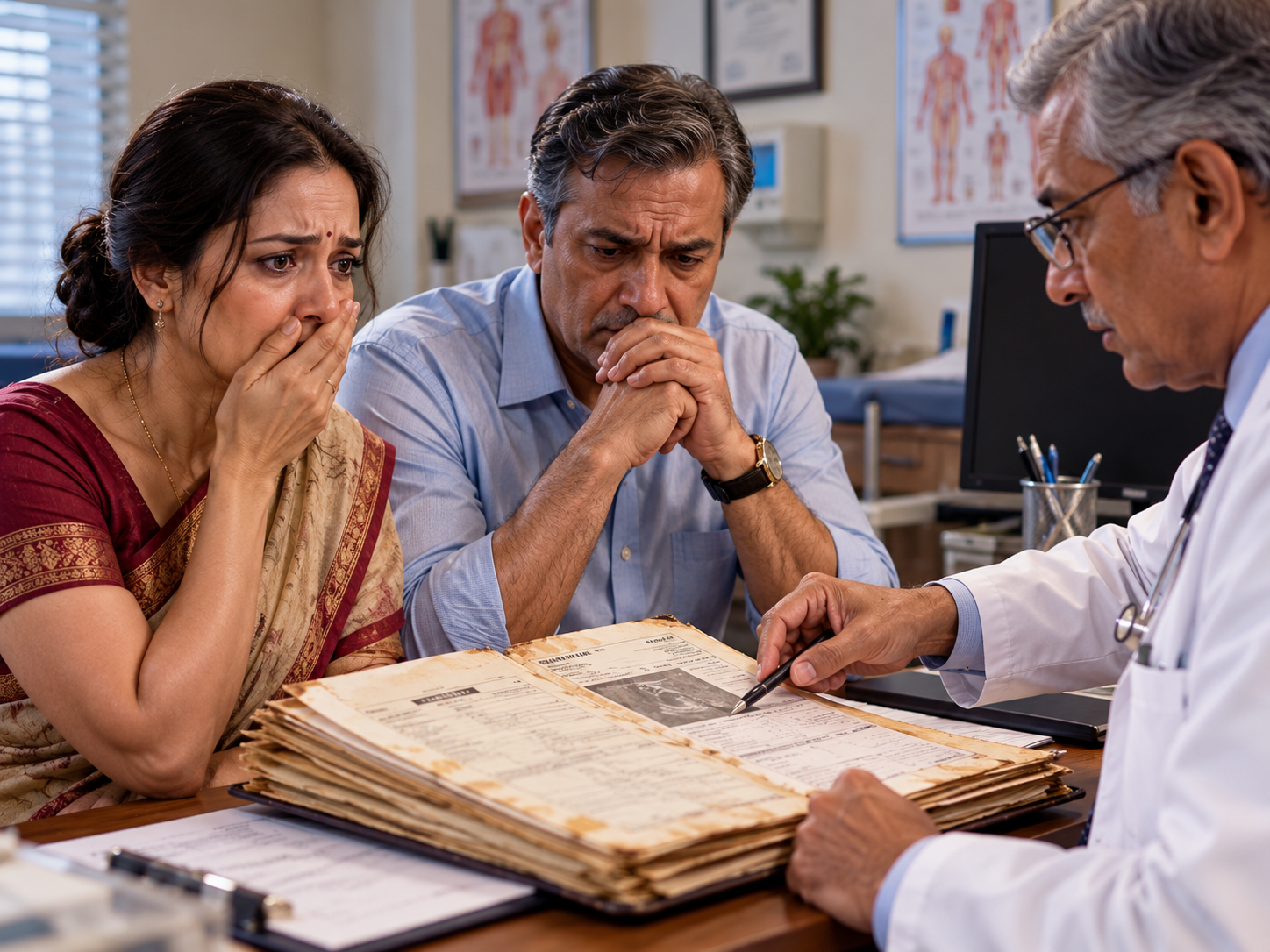
The old medical file on the doctor’s desk carried a date I recognized, and suddenly the eighteen years of silence in our bedroom felt different
Part 13 of 20