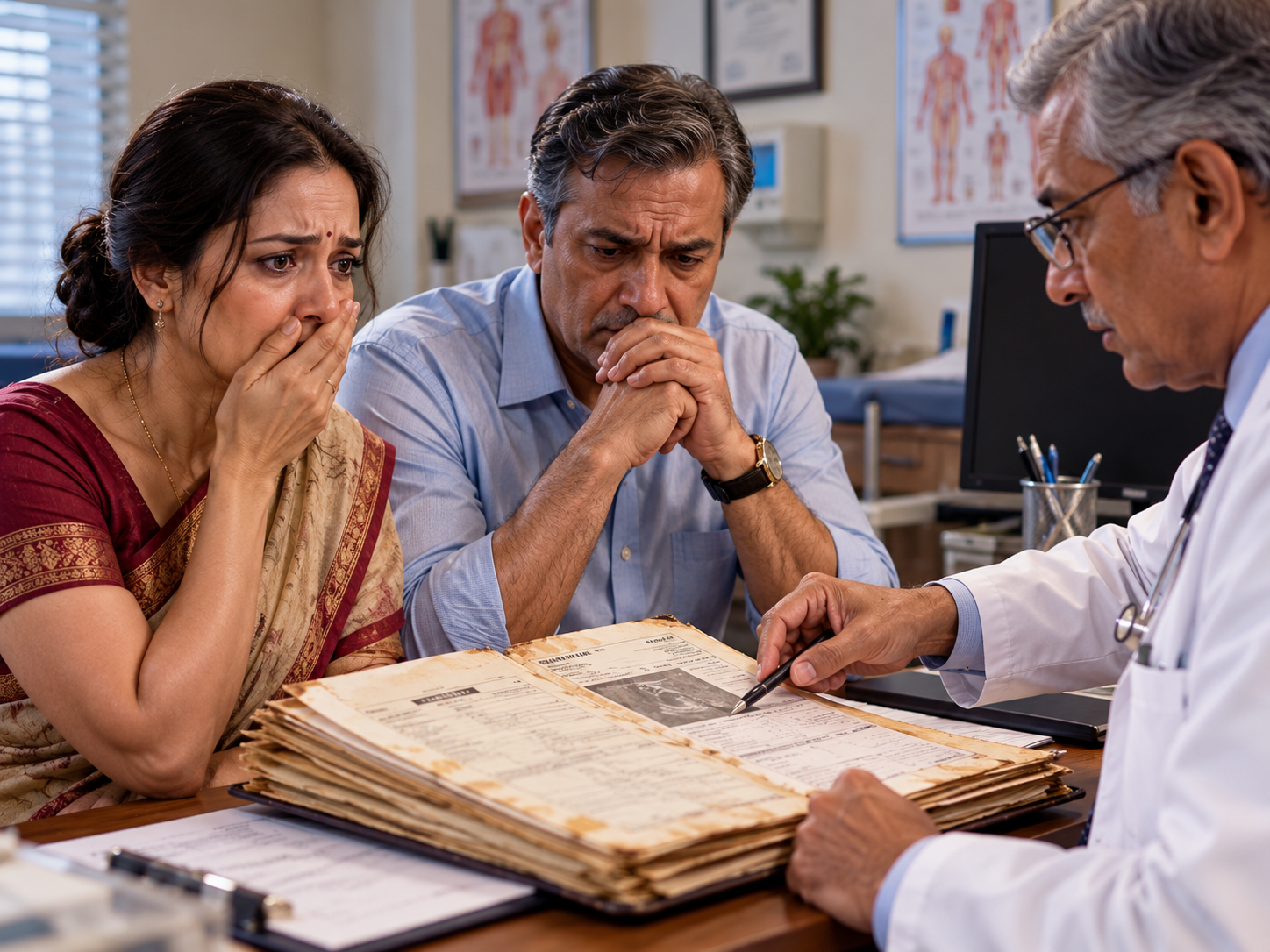
The final page was folded in half.
The paper was brittle along the crease, as though someone had opened and closed it many times.
Arvind stood near the doorway.
“Please,” he said.
The doctor looked at him.
“You know she has a right to understand what happened.”
Arvind's shoulders dropped.
“I know.”
The doctor unfolded the paper.
I expected another laboratory report.
Instead, it was a handwritten statement.
The ink had faded.
At the bottom was Arvind's signature.
I recognized it immediately.
The doctor's voice was quiet.
“‘I, Arvind Deshmukh, acknowledge that the findings have been explained to me. I understand that further investigation is recommended. I also request that my wife not be informed until I decide how to proceed.’”
My eyes stayed on the signature.
“That's all?”
The doctor turned the page.
“No.”
There was another paragraph.
He read it silently first.
Then he looked at Arvind.
“Do you want to tell her?”
Arvind shook his head.
The doctor looked at me.
“Your husband was also informed that he should avoid delaying treatment if symptoms worsened.”
I turned toward Arvind.
“You knew.”
“Yes.”
“You knew you were ill.”
“I knew something was wrong.”
“And you still came home and treated me like I was the only person who had done something unforgivable.”
He looked at me.
“I wasn't thinking clearly.”
“Were you thinking clearly when you stopped touching me?”
“No.”
“When you refused to look at me?”
“No.”
“When you let everyone believe you were some saint who had nobly stayed with an unfaithful wife?”
His expression changed.
“I never told them that.”
“You didn't have to.”
I could feel anger rising inside me.
For years I had believed I was the villain in a story everyone else had already judged.
Now I was discovering that the man who punished me had been carrying a secret illness and a decision he had never explained.
That did not erase what I had done.
But it changed the shape of the marriage.
The doctor closed the page.
“There is more.”
Arvind looked at him sharply.
“Doctor.”
The doctor continued.
“The original physician noted that Mr. Deshmukh's condition could have implications for future treatment.”
“What implications?”
“He was advised to undergo a procedure.”
“What procedure?”
The doctor hesitated.
“A tissue examination.”
I frowned.
“Why would that matter eighteen years later?”
“Because the current blood abnormalities may be connected.”
Arvind sat down again.
His hands were shaking.
The doctor noticed.
“We should not assume the worst.”
I looked at my husband.
“You knew this could happen.”
He nodded.
“I knew there was a possibility.”
“Then why didn't you go back?”
“I was angry.”
“At me?”
“At everything.”
He looked toward the window.
“I thought if I stayed angry, I wouldn't have to be afraid.”
The sentence stayed between us.
I sat quietly.
It was the first explanation he had ever given me that sounded like the truth.
The doctor ordered additional blood tests.
While the nurse prepared the forms, I followed Arvind into the corridor.
He walked slowly.
I caught up.
“Why didn't you leave me?”
He stopped.
I almost wished I hadn't asked.
After eighteen years, the answer mattered.
“I wanted to.”
My heart tightened.
“But?”
“But I couldn't.”
“Because of the children?”
“At first.”
“And later?”
He looked at me.
“Later, I realized I didn't know how to live without you.”
I stared at him.
“You had a strange way of showing it.”
“I know.”
“You made me feel disgusting.”
“I know.”
“You made me feel as if I had to spend the rest of my life paying for one terrible decision.”
His eyes dropped.
“I thought if I forgave you, what you did would become meaningless.”
I whispered, “Forgiveness doesn't erase betrayal.”
“No.”
“It only means you stop using it as a weapon.”
He nodded.
“I understand that now.”
A nurse called him for the blood draw.
I stayed outside.
The waiting room was full.
An old man was arguing about his appointment time.
A woman was feeding her husband biscuits.
Two children were playing with a plastic chair.
Life continued around me while my own life seemed to be rearranging itself.
When Arvind came back, a small cotton pad was taped to his arm.
He sat beside me.
Neither of us spoke.
Then he said, “There is something else.”
I looked at him.
“In 2007, before you came home that night, I had already received the first report.”
I swallowed.
“What did it say?”
“That I needed further investigation.”
“And you didn't tell me.”
“No.”
“Why?”
He looked at the floor.
“Because I had decided that if our marriage was already dead, I would deal with my own death alone.”
My eyes burned.
“You thought you were going to die?”
“I didn't know.”
“But you thought you might.”
“Yes.”
“And you still punished me.”
“Yes.”
“Why?”
His answer came after a long silence.
“Because anger was easier than grief.”
I turned away.
The doctor eventually called us back.
He had new results from the preliminary tests.
His expression was serious.
“There are signs that the blood disorder has progressed.”
Arvind's face went blank.
“What does that mean?”
“We need specialist testing.”
“Is it cancer?”
“Not necessarily.”
The doctor paused.
“But we need to rule out a serious marrow disorder.”
I felt Arvind's hand tighten around the chair.
The doctor continued.
“There is no point guessing before the tests.”
Arvind nodded.
I looked at him.
“I'm coming with you.”
He started to object.
Then stopped.
“Okay.”
That single word was strange.
For eighteen years, he had never allowed me to stand beside him when something was wrong.
Now he was saying yes.
We left the clinic together.
Outside, the afternoon heat pressed down on the pavement.
Traffic crawled along the road.
A bus groaned at the intersection.
Arvind walked toward the car.
I followed.
Then he stopped.
“Naina.”
“Yes?”
“About Sameer.”
My stomach tightened.
“What about him?”
“I want to know whether you ever spoke to him again.”
“No.”
“Never?”
“Never.”
He nodded.
“Why?”
“Because after I came home that night, I understood what I had almost destroyed.”
He looked away.
“I wish I had understood that before.”
“So do I.”
We sat inside the car.
Neither of us started the engine.
After a minute, Arvind said, “Did you ever stop loving me?”
The question hurt more than anger would have.
“I don't know.”
He looked at me.
“I never stopped caring.”
“That isn't what I asked.”
“I know.”
I stared through the windshield.
“I was angry at you. I was ashamed. I was lonely. I hated the way you looked at me.”
I swallowed.
“But every time something happened to you, I was afraid.”
He closed his eyes.
“That is why you stayed.”
“Yes.”
“Even when I made you miserable.”
“Yes.”
He nodded.
“I don't deserve that.”
“No.”
He looked at me.
“I deserved to lose you.”
I answered softly.
“You deserved honesty.”
He nodded.
“And so did you.”
The drive home was quiet.
That evening, we ate dinner at the same table where our children had grown up.
Arvind barely touched his food.
I watched him.
The man sitting across from me looked smaller than he had that morning.
Not weaker.
Human.
After dinner, he stood to clear the plates.
“I'll do it,” I said.
He stopped.
“You always do.”
“So do you.”
He looked at me.
“Not anymore.”
“What do you mean?”
“I've spent eighteen years letting you carry everything.”
He took the plates.
I followed him into the kitchen.
We stood side by side at the sink.
Our shoulders almost touched.
Neither of us moved away.
It was such a small thing.
Yet my heart beat as though something enormous had happened.
Then Arvind whispered, “There was one more reason I never touched you.”
I looked at him.
“What?”
He stared at the running water.
“The doctor told me something that night.”
“What?”
He shut off the tap.
“I was afraid I might have a condition that could affect you.”
I frowned.
“What condition?”
“I didn't know yet.”
“So you decided not to touch me.”
“Yes.”
“But you told yourself it was punishment.”
His eyes filled.
“Yes.”
“Why?”
“Because if I admitted I was afraid of hurting you, I would have to admit I still loved you.”
I could not answer.
He dried his hands.
Then he walked toward the bedroom.
At the doorway, he stopped.
The white pillow was still there.
Eighteen years old.
Faded.
Its edges no longer perfectly white.
He picked it up.
For the first time, he looked at it not as a boundary, but as evidence of everything neither of us had known how to say.
He placed it on the chair.
Then he said, “Tomorrow we see the specialist.”
I nodded.
“Yes.”
He looked at me.
“Together?”
I took a breath.
“Yes.”
The word felt unfamiliar.
Together.
Not because the past had disappeared.
Because for the first time in eighteen years, we were facing something neither of us could control.
And this time, neither of us would face it alone.
Click here to continue reading: PART 3: The specialist’s examination uncovered why Arvind had hidden the truth, but the cruelest discovery was what his silence had cost both of us
The old medical file on the doctor’s desk carried a date I recognized, and suddenly the eighteen years of silence in our bedroom felt different
Part 2 of 20