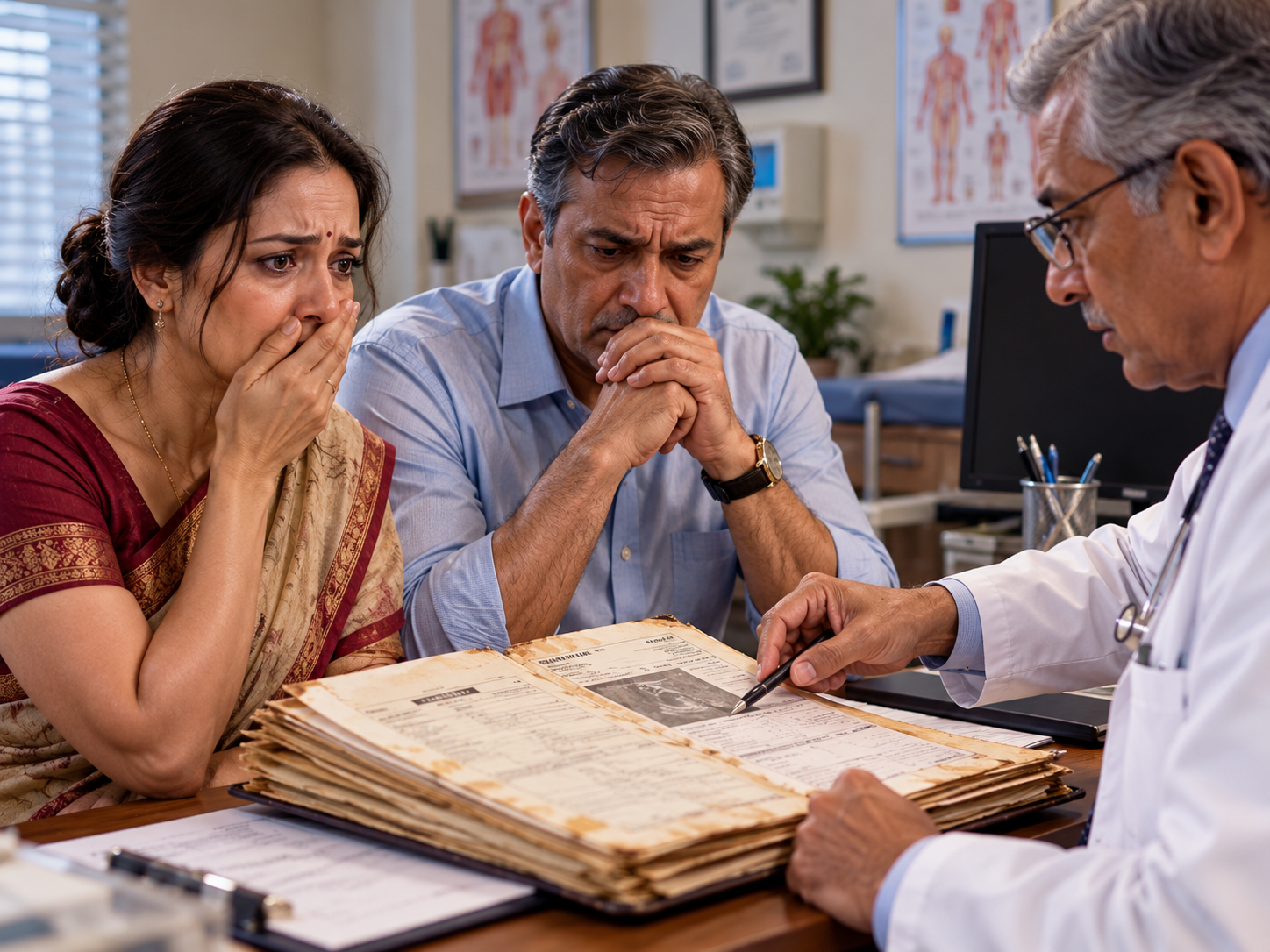
The specialist's office smelled of antiseptic and old paper.
Arvind sat beside me with a folder on his lap.
He had barely spoken during the drive.
Neither had I.
The specialist, Dr. Mehta, studied the new blood reports before looking at the old records.
“You were first evaluated in 2007?”
“Yes.”
“Why did you stop follow-up?”
Arvind looked at me.
Then he answered.
“I made a bad decision.”
Dr. Mehta did not press him.
He reviewed the reports again.
“There are changes here that concern me.”
“What changes?” I asked.
“His blood counts have been abnormal for some time.”
“How long?”
“Possibly years.”
I looked at Arvind.
He lowered his eyes.
Dr. Mehta continued.
“We need a marrow examination.”
Arvind nodded.
I felt my stomach tighten.
“When?”
“As soon as possible.”
The appointment was scheduled for the following week.
We went home with instructions, medication, and another folder.
At home, Arvind placed everything on the dining table.
Then he sat down.
“I should tell you the rest.”
I pulled out the chair opposite him.
“Yes.”
“In 2007, I was told there was a possibility that my condition could become serious.”
“You never knew for certain?”
“No.”
“Why didn't you get the biopsy?”
“Because I was angry.”
“At me.”
“Yes.”
He looked ashamed.
“I wanted you to feel what I felt.”
I stared at him.
“So the pillow was deliberate.”
“Yes.”
“The silence.”
“Yes.”
“The pretending everything was normal in front of everyone.”
“Yes.”
“And you knew I was suffering.”
“Yes.”
“Did you ever think I might leave?”
“Every day.”
“Then why didn't you stop me?”
“Because I thought you deserved the choice.”
I laughed bitterly.
“You never gave me a choice.”
His face fell.
“I know.”
I looked down.
That sentence contained eighteen years.
The doctor's appointment.
The pillow.
The separate worlds under one roof.
Everything.
“You punished me because you thought I should suffer,” I said.
“Yes.”
“But you also punished yourself.”
He nodded.
“I didn't know how to forgive either of us.”
The next morning, we went for the marrow examination.
The hospital room was cold.
Arvind lay still while the nurse prepared him.
He looked at me.
“Stay.”
“I will.”
The procedure was painful.
His hand searched for something.
I hesitated.
Then I held it.
His fingers closed around mine.
Neither of us mentioned the eighteen years.
We didn't need to.
When it was over, he looked exhausted.
“Thank you.”
“For holding your hand?”
“Yes.”
“You don't have to thank me.”
“I do.”
The results took several days.
Those days were strange.
We continued living in the same house.
But something had changed.
Arvind began talking.
Small things at first.
He complained about the newspaper.
He asked whether there was enough sugar.
He told me the neighbor's dog had been barking.
Ordinary conversation.
I realized how much I had missed ordinary conversation with my own husband.
One evening, he found me folding clothes.
“You don't have to do that.”
“I've done it for thirty years.”
He smiled faintly.
“That's true.”
I handed him a shirt.
“Fold.”
He looked surprised.
“Me?”
“Yes.”
He tried.
The result was terrible.
I laughed.
He laughed too.
The sound startled both of us.
It had been years since I had heard him laugh at home.
Then the laughter disappeared.
He looked at me.
“Naina.”
“Yes?”
“If the result is bad…”
He couldn't finish.
I understood.
“You mean if you're seriously ill.”
He nodded.
“What will you do?”
“Nothing.”
“You'll continue living.”
“I'll try.”
He looked at me.
“And us?”
I didn't answer immediately.
“I don't know.”
He nodded.
“That is fair.”
The specialist called two days later.
“Come tomorrow morning.”
Nothing more.
That night, neither of us slept properly.
At three in the morning, I woke.
The pillow was gone.
For eighteen years, there had always been a pillow between us.
Now there was empty space.
Arvind was awake, staring at the ceiling.
“Are you scared?”
“Yes.”
“So am I.”
He turned toward me.
“I never thought I'd hear you say that.”
“I've been scared for eighteen years.”
He looked at me.
“Of me?”
“Of losing you.”
His eyes closed.
A tear moved toward his temple.
“I am sorry.”
I didn't say it was okay.
It wasn't.
But I reached across the empty space.
My hand rested on the sheet between us.
He looked at it.
Then he placed his hand over mine.
No dramatic promise.
No sudden healing.
Just warmth.
The next morning, we returned to the specialist.
Dr. Mehta closed the door.
He sat across from us.
“I have the results.”
Arvind's hand tightened around mine.
Dr. Mehta spoke carefully.
“The condition is serious, but it is treatable.”
I exhaled.
Arvind stared at him.
“What exactly do I have?”
“A chronic marrow disorder.”
“Cancer?”
“No.”
The relief was immediate.
Then the doctor continued.
“But it has progressed.”
“What happens now?”
“Treatment and monitoring.”
“How long?”
“That depends on how he responds.”
Arvind nodded.
I asked the question he couldn't.
“Did this begin eighteen years ago?”
Dr. Mehta looked at the old records.
“The evidence suggests the early abnormalities were already present.”
Arvind closed his eyes.
“So I did this to myself.”
“No,” the doctor said firmly.
Arvind looked at him.
“You made a decision that delayed care. That is not the same as causing the disease.”
Silence filled the room.
Then Dr. Mehta opened the old file.
“There is something else.”
I felt my stomach tighten.
He removed another document.
“This is the original recommendation from 2007.”
He placed it on the desk.
Arvind looked at it.
I read it.
The specialist had recommended follow-up every six months.
Arvind had never returned.
But beneath the recommendation was another note.
My eyes caught the handwriting.
“Patient believes wife should not be informed due to marital conflict.”
I looked at Arvind.
“You wrote that?”
“Yes.”
My throat tightened.
The doctor continued.
“The previous physician also wrote something unusual.”
He turned the page.
“‘Patient appears more concerned about punishing himself than preserving his health.’”
Arvind looked away.
I felt something inside me break.
Not because I suddenly forgot what I had done.
Because I finally understood that his punishment had never been as simple as revenge.
He had built a prison and locked himself inside it with me.
The doctor gave us privacy.
We sat there without speaking.
Finally Arvind said, “I thought if I suffered enough, the betrayal would have a proper ending.”
I looked at him.
“There was never going to be an ending like that.”
“I know.”
“You could have forgiven me.”
“I didn't know how.”
“You could have left.”
“I couldn't.”
“You could have told me you were sick.”
“I was ashamed.”
“You could have asked for help.”
“I thought I didn't deserve it.”
I wiped my eyes.
“That is what hurts.”
“What?”
“You thought suffering was the only thing you deserved.”
He looked at me.
“And you believed you deserved the same.”
I couldn't answer.
Because he was right.
For eighteen years, we had both mistaken punishment for justice.
That afternoon, we went home.
Arvind placed the white pillow on the bed.
He stared at it.
Then he opened the cupboard.
He folded the pillowcase.
He placed it inside.
I watched.
“Are you sure?”
He nodded.
“I don't want it anymore.”
He turned toward me.
“But I know removing it doesn't fix what I did.”
“No.”
“I know I have to earn back whatever I can.”
“Yes.”
“Will you let me try?”
I looked at him.
“I don't know what our marriage will become.”
“I understand.”
“But I don't want another eighteen years of silence.”
He nodded.
“Neither do I.”
That night, we sat at the dining table and talked until midnight.
Not about the betrayal alone.
Not about the illness alone.
About our children.
Our parents.
The years we had wasted.
The things we still feared.
The things we had never asked each other.
At one point, Arvind looked at me.
“I loved you even when I was angry.”
I looked down.
“I loved you even when I hated what you had done.”
Neither of us called that forgiveness.
It wasn't.
It was simply the truth.
And after eighteen years, truth was enough for one night.
Click here to continue reading: PART 4: The final truth forced me to choose between carrying eighteen years of guilt and allowing two wounded people to build something honest from what remained
The old medical file on the doctor’s desk carried a date I recognized, and suddenly the eighteen years of silence in our bedroom felt different
Part 3 of 20