
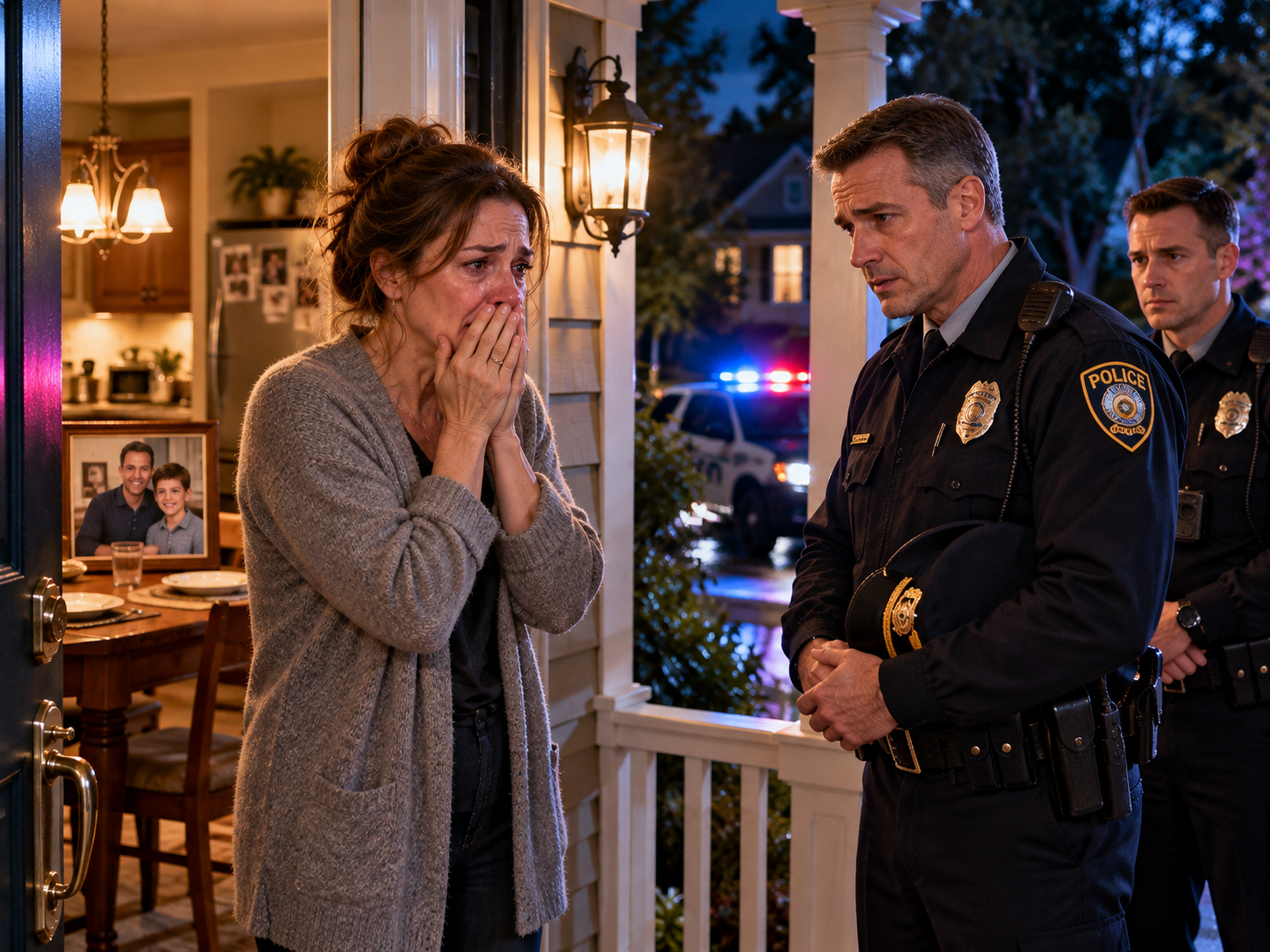
“Your husband is dead. Your son is alive, but he is in surgery, and we cannot tell you what will happen next.”
The officer stood in my doorway with his hat tucked beneath one arm, speaking carefully, as though the right arrangement of words might make the sentence easier to survive. Behind him, another officer waited beside the porch railing. I could smell the coffee burning on the kitchen counter, and somewhere inside the house, the refrigerator hummed with the same ordinary indifference it had shown every morning of my life.
My name is Angela Harris. I was thirty-eight years old, and until that Saturday night, I believed I understood what mattered. I had a husband who loved me, a twelve-year-old son who made our house noisy and warm, and a family I supported because I thought that was what a good daughter and sister did. I believed people could disappoint one another without abandoning one another. I believed that when something truly terrible happened, even the most selfish person would recognize the moment and put everything else aside.
I was about to discover how much damage a belief could do when the people around you had learned to depend on it.
Jack had taken Matthew fishing at Lake Michigan that morning. They left a little after eight, with Jack carrying a thermos of strong coffee and Matthew balancing a plastic bag of snacks that looked big enough for an entire baseball team. My son had been planning the outing for days, carefully checking the weather and asking his father whether they could stay until sunset if the fish were biting.
“You know you’re supposed to catch fish, not eat everything before we get there,” Jack teased him.
Matthew rolled his eyes. “Dad, the snacks are for emergencies.”
“What kind of emergency requires six granola bars?”
“Fishing emergencies.”
I laughed from the doorway as Jack shook his head and reached for the truck keys. He wore his faded plaid shirt, the blue one I had been telling him to replace for nearly a year. He insisted it was comfortable, and I had long since learned that no argument about clothing was worth spoiling a good morning.
Jack worked at a bank in Chicago. He was dependable without being rigid, kind without needing an audience, and happiest when he was doing something simple with Matthew. He liked fishing, strong coffee, and fixing small things around the house that I would have hired someone to repair. He was the sort of man who noticed when a person was having a difficult day and quietly made room for them to speak.
Matthew had inherited his father's patience for fishing and my habit of worrying about details. He earned straight A's, played baseball, and complained about homework as if it were an international injustice. He still let me fix his hair before school, although he pretended every time that I was ruining his life.
“Six o'clock,” I reminded them as they climbed into the truck.
“Six o'clock,” Jack promised.
Matthew leaned out the window. “Mom, don't eat my leftover pizza.”
“Then come home and defend it.”
He grinned, and the truck rolled down the street.
That was the last ordinary morning I would ever have with them.
At six, I warmed dinner. At seven, I called Jack, assuming they had lost track of time beside the lake. The call went straight to voicemail. I tried again twenty minutes later, then sent a message asking whether they were on their way home.
By eight, the food had gone cold. I walked from the kitchen to the living room and back again, checking the windows whenever headlights passed outside. I told myself that Jack's phone battery had died, that the traffic was bad, that Matthew had begged for one more hour by the water. There were dozens of harmless explanations, and I chose each one in turn.
At 8:47, someone knocked.
I remember the time because I looked at the clock before opening the door. Two uniformed officers stood on the porch, their expressions serious in a way I had never wanted to see directed at me. One asked whether I was Angela Harris. I said yes, and then I noticed the second officer was holding a small notebook but had stopped writing.
My body understood before my mind did.
The officer explained that a drunk driver had run a stop sign and struck Jack's truck on the driver's side. The impact had been severe. Jack had died at the scene. Matthew had survived the initial crash and had been taken to the hospital for emergency surgery.
“Just tell me if my son is alive,” I said.
“He is alive, ma'am. The doctors are working on him now.”
I barely remember finding my purse. I remember the officer offering to drive me and my hands shaking so badly that I could not fasten my coat. I remember looking at the dinner table, where three plates were still arranged neatly beneath the light. One of Matthew's baseball cards lay beside his chair, left there from the previous evening.
The house seemed to have been prepared for a life that no longer existed.
At the hospital, a nurse led me through corridors that smelled of disinfectant and overheated air. Dr. Miller met me outside the surgical unit. She explained that Matthew had sustained severe head trauma and significant brain swelling. He had been placed in a medically induced coma while the team worked to stabilize him.
I asked whether he would recover.
She did not offer a promise. She explained what they were doing, what they needed to watch, and why the next several hours mattered. I listened, nodded, and asked her to repeat the parts I could not understand. It was the only way I could keep from falling apart in front of her.
When I finally saw Matthew, I almost did not recognize him. His face was swollen, his head was bandaged, and machines surrounded his bed. His small hand lay beside the blanket, motionless except for the faint movements I imagined I could feel when I held it.
I bent close to him.
“It's Mom, sweetheart. I'm here.”
I told him that his father was gone, though I could not bring myself to say the words as clearly as I had heard them. I told him the doctors were helping him and that I would stay. I talked about baseball, about the schoolwork he had left unfinished, and about the fishing trip he had been so excited to take.
I promised that when he woke up, we would talk about everything.
I promised him things I could not control because I was his mother, and he was twelve years old, and there had to be something I could still do for him.
The funeral arrangements for Jack began while Matthew remained in intensive care. Sarah, my best friend, came to the hospital with clean clothes and a paper bag containing sandwiches I did not eat. She contacted Jack's workplace, helped me answer questions from the funeral home, and sat beside me when the paperwork became too difficult to read.
My parents arrived the next day.
Robert and Dolores Harris had never been particularly demonstrative people. My father showed affection through practical advice, while my mother often treated emotion as something that should be handled privately and quickly. I had spent my adult life trying to understand them generously. I told myself they had been raised differently, that their distance did not mean they lacked love, and that their shortcomings were not deliberate.
They stayed at Matthew's bedside for about an hour. My mother touched his blanket and said he looked peaceful, though he was connected to machines and unable to respond. My father asked what the doctors expected. I explained that nobody could tell us when he might wake up or what recovery would look like.
Then they began discussing Veronica.
My younger sister was pregnant, and she and her husband, Ruben, had been struggling to settle into the apartment Jack and I had allowed them to use. My parents had been helping them arrange furniture, organize their belongings, and prepare for the baby. Veronica had always received more attention than I did, partly because she was younger and partly because I had become the family member everyone trusted to manage without help.
When I asked my mother whether she could stay with me while I arranged Jack's funeral, she sighed and looked at her watch.
“We've already committed to helping Veronica this week, Angela.”
I stared at her. “Jack just died.”
“I know, sweetheart. But you are strong. You always know how to handle things.”
I wanted to ask whether strength was the reason people could leave me alone when I needed them most. Instead, I looked toward Matthew's bed and said nothing. My mother kissed my cheek, promised to call, and left with my father.
They attended Jack's funeral, but they arrived late and sat near the back. Veronica and Ruben came too. Veronica wore a dark dress and kept checking her phone. Ruben shook my hand, murmured that he was sorry, and then stepped away to take a call. They stayed long enough to be seen and left before I had finished speaking with Jack's coworkers.
Sarah remained beside me. She stood close enough that I could lean against her when the priest began the service. Jack's colleagues spoke about his kindness and the quiet ways he had helped them. One man cried while describing how Jack had stayed late to help him through a difficult financial problem. Their grief was genuine, and their presence reminded me that my husband had been loved by people who did not share his last name.
Matthew did not wake.
The first week passed in hospital rooms, phone calls, and hours spent listening to machines. Dr. Miller explained that the swelling in his brain remained a serious concern. The team was monitoring his condition and adjusting treatment as needed. Every time a nurse entered, I lifted my head. Every time a doctor asked to speak with me, my stomach tightened.
I read to Matthew from his favorite books and described the baseball games he had missed. I told him what his classmates had sent and how Mrs. Moore, his teacher, had called to ask whether the school could do anything useful. I told him about his father's funeral, though I kept the details gentle. I could not bear the thought of him waking into a world where Jack was gone without someone preparing him for the truth.
My family visited three times during those early weeks.
My mother usually arrived with a small bag of groceries or a question about whether I was eating properly. My father stood near the window and asked about the medical bills. Veronica came once, looked at Matthew, and said the hospital made her feel faint. She did not stay long enough for me to ask her to sit beside him.
I stopped asking them to come.
Six months passed. The seasons changed outside the hospital windows, but my days continued to revolve around Matthew's bed. I learned the nurses' names, the rhythm of the medical equipment, and the small signs that indicated whether a doctor was about to deliver encouraging news or explain another setback. I became skilled at speaking calmly while my mind raced through possibilities.
I also learned how lonely a person could become while surrounded by professionals who were doing everything they could. The nurses were compassionate, and Sarah visited whenever she could. But there were evenings when I sat beside Matthew, held his hand, and wished someone from my own family would stay without looking at the clock.
I never stopped believing he might wake.
Then, one July morning, my phone rang while I was beside his bed.
Dr. Miller asked me to come to the hospital immediately. Her voice was controlled, but something in it made my fingers go cold. I looked at Matthew, still beneath the blankets, and told him I would be right back.
In the hallway, Dr. Miller stood waiting with her hands folded. She looked at me with the expression I had seen on the faces of the officers who came to my door months earlier.
Matthew had died an hour before I arrived.
For several seconds, I could not understand the words. I asked her to repeat them, and she did, gently. She explained that his condition had deteriorated and that the team had been unable to reverse it. She told me how sorry she was.
I went back into his room and sat beside him. His hand was warm beneath mine, and I could not reconcile that warmth with what the doctor had said. I touched his hair, kissed his forehead, and waited for the familiar rise of his chest that I had watched for half a year.
There would be no more fishing stories, no more homework complaints, no more baseball games.
I had lost my husband, and now I had lost my child.
That afternoon, I called my mother. I was trembling so badly that I had to hold the phone against my ear with both hands.
“Mom, Matthew died this morning,” I said. “I need help arranging his funeral. I can't do all of this alone.”
The silence lasted long enough for me to hear the faint sound of a television in the background.
Then my mother said, “Angela, we have a problem. We fly to Cancun tomorrow with Veronica and Ruben.”
I waited, believing she was about to say she would cancel.
Instead, she explained that the trip had already been paid for. Eight thousand dollars, she said. She could not justify losing that much money, and the others were depending on her to go.
I pressed my free hand against the hospital wall.
“Mom, your grandson is dead.”
“I know, and I am very sorry. But you can manage the funeral. You have always managed everything.”
The words were familiar. I had heard them whenever I needed help and the family had something more enjoyable to do. But never before had the cost of their convenience been my child's funeral.
“Are you seriously choosing a vacation over burying Matthew?”
“Don't make this harder than it needs to be,” she replied. “You have Sarah. You will get through it.”
Then she ended the call.
I stood in the hallway with the phone still pressed against my ear. I could hear footsteps and the distant ring of another telephone. A nurse passed, glanced at me, and slowed as if she wanted to ask whether I needed anything.
Before I could collect myself, Veronica called.
“Mom says you're upset about Cancun,” she began. There was no greeting, no question about Matthew, and no acknowledgment that I had just lost my only child.
“I need you to come home for the funeral,” I said. “I need my family.”
“Angela, I'm pregnant. I need some time to relax before the baby comes. The trip is paid for, and we have been planning it for months.”
“He was your nephew.”
She exhaled sharply. “I know that. I'm sorry he's gone, but I can't put my entire life on hold because something terrible happened to you.”
Something terrible happened to you.
I looked through the open doorway toward Matthew's room. The hospital staff had covered him carefully, and his baseball cap lay on the chair beside my bag.
“Don't speak about him like he was an inconvenience,” I said.
“I'm not doing that. You're making this into a fight when everyone is already upset.”
“No, Veronica. I'm asking you to help bury a twelve-year-old boy.”
“And I'm telling you I can't cancel my life because you need everyone to come running.”
I did not shout. I did not argue. I ended the call, put the phone into my bag, and stood in the hallway until my breathing steadied.
That was when something inside me changed. It was not a sudden burst of courage, and it was not revenge. It was the end of a long, exhausting effort to interpret neglect as love.
For years, I had given my family money, time, and practical help because I believed their comfort mattered to me. I had thought that if I continued being generous, they would eventually understand what it meant to stand beside someone when life became unbearable.
Now my son was dead, and they were discussing the cost of a vacation.
I returned to Matthew's room and sat beside his bed. I held his hand and whispered that I was sorry. I was sorry I could not protect him from the crash. I was sorry his last months had been filled with machines instead of the life he deserved. And I was sorry that the people who should have been standing beside us had chosen to leave.
“I've got you, sweetheart,” I whispered. “I'll take care of what comes next.”
Outside the room, the hospital continued with its ordinary business. Inside, I made the first decision I had made in years without asking myself whether my family would approve.
I would bury my son.
And after that, I would stop paying for people who could not be bothered to stand beside me while I did it.
Click here to continue reading: PART 2: While My Son’s Casket Waited for Thursday Morning, I Began Counting Every Favor My Family Had Mistaken for a Permanent Right
The Night I Learned My Family Had Chosen a Vacation Over My Son’s Funeral, Something Inside Me Went Quiet, and Nothing Would Ever Be the Same
Part 1 of 20

