
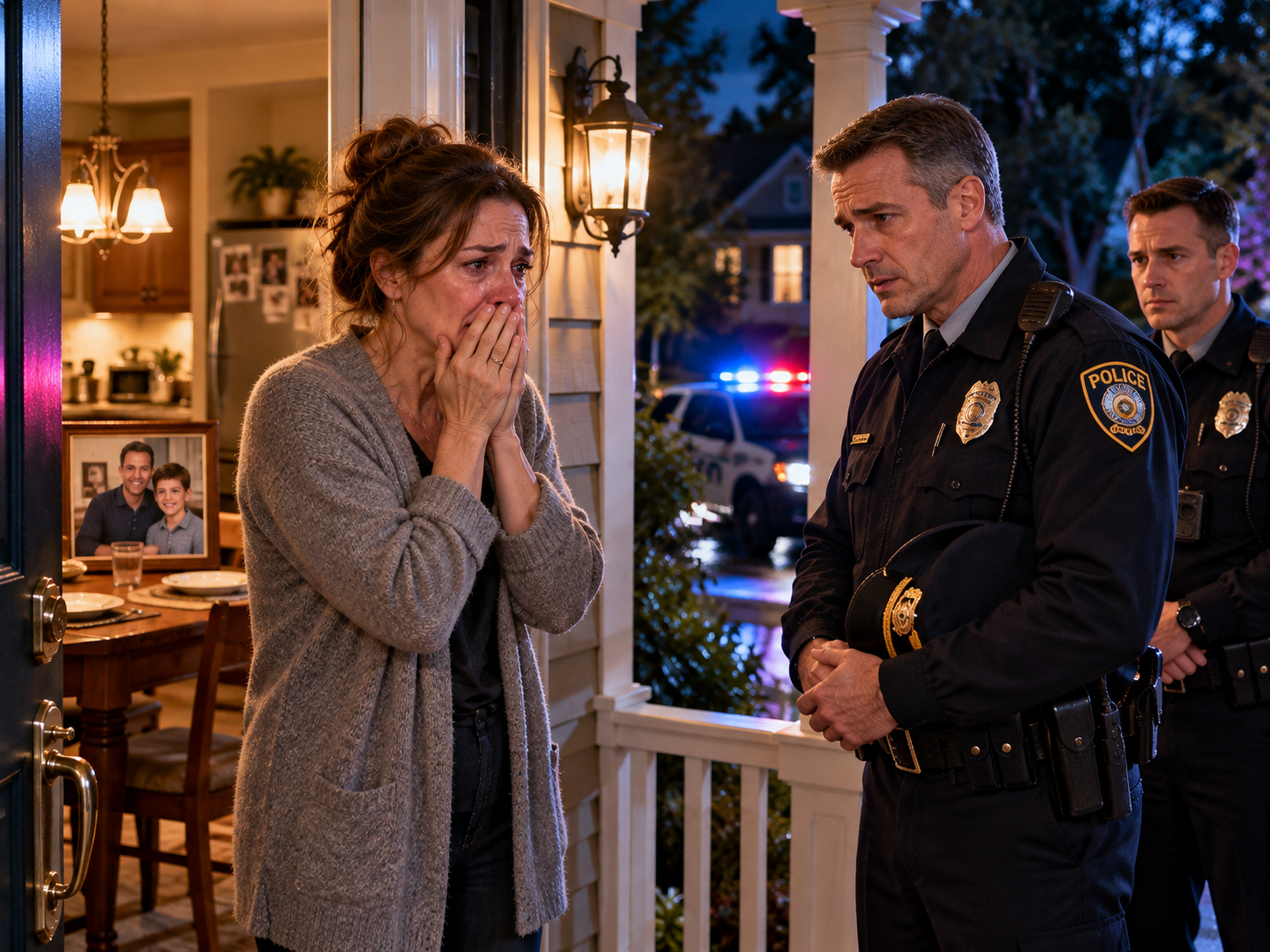
My father called on a Friday evening, shortly after I returned from work. He did not begin with a complaint about the apartment or a request for money. He asked whether I could come by the following afternoon because he wanted to speak to me privately. His voice sounded unusually measured, as though he had rehearsed the words before dialing. I asked whether something was wrong with his health. He said no, then added that he wanted to discuss what had happened since the funeral. I agreed to visit, but I made it clear that I was not coming to reconsider the apartment or the canceled payments.
The following afternoon, I drove to my parents’ house with a nervousness I could not explain. I had been there many times to deliver groceries, help with paperwork, or repair something that had been left undone. I had rarely visited simply to sit and talk. Their house looked the same as always, with my mother’s plants beside the front steps and my father’s old truck parked near the garage. Seeing it reminded me of how many small expenses I had quietly covered. It also reminded me that their lives had existed long before I began helping and would continue after I stopped.
My mother opened the door but did not invite herself into the conversation. She said my father was in the living room and had made coffee. I followed her inside, noticing that the house was unusually tidy. My father sat in his usual chair, holding a mug between both hands. On the table beside him lay a folder containing insurance documents and household bills. For a moment, I assumed he had brought them out because he intended to ask for financial assistance. Then he pushed the folder aside and motioned for me to sit.
He began by saying that the family had been under pressure since the apartment arrangement ended. Veronica and Ruben had needed to move, my parents had been adjusting to managing their expenses without my regular contributions, and everyone had been upset by the confrontation after Cancun. He described each difficulty in a practical tone, as though he were explaining a complicated household problem. I let him finish. When he stopped, I asked why he had invited me if he only wanted to discuss the consequences of my decision.
He looked down at his coffee. “I wanted you to understand that this has been hard on all of us,” he said. I told him I understood that moving had been difficult and that changing a household budget could be stressful. Then I asked whether he understood what had been hard for me. He did not answer immediately. I reminded him that Jack had died, that Matthew had spent six months in a coma, and that when my son finally died, I had called my mother asking for help with his funeral. My parents had told me they were leaving for Cancun.
My father shifted in his chair. He said the trip had been paid for months earlier and that everyone had believed I would be able to manage the funeral arrangements. I had heard the explanation before, but hearing it from him made something painfully clear. Even now, he was describing their choice as a reasonable calculation that had simply gone wrong. The problem, in his version, was not that they had left me alone at the worst moment of my life. It was that they had underestimated how deeply I would be hurt.
“I did manage it,” I said. “I arranged the funeral. I made the calls. I chose the service and stood beside Matthew’s casket. Sarah was there. His teacher was there. His classmates sent notes. You were not there.” My father opened his mouth, then closed it again. I did not raise my voice. I had spent too many nights wishing I could say those words without breaking apart. Now that I could say them, I did not want to use anger to make them stronger.
He admitted that he had thought my mother would call me after they returned from the trip and that the family could make things right then. I asked him what he believed could be made right after a child’s funeral. He looked away. I told him that the photographs from Cancun had not created my grief, but they had shown me how little my family understood the difference between being available when convenient and showing up when it mattered. My father rubbed his forehead and said he had not thought of it that way.
For a moment, I wanted to believe that this was the apology I had been waiting for. He was quieter than usual, and he had finally acknowledged that he had not considered my perspective. But then he said, “You know your mother doesn’t handle emotional situations well. We thought you had Sarah.” The old explanation had returned, dressed in gentler language. They had assumed someone else would take care of me, and that assumption had allowed them to leave without facing what I needed.
I told him Sarah’s presence did not excuse theirs. Sarah had been my friend, not a substitute for my parents. She had not owed me the support she gave, yet she had sat beside me while my family celebrated elsewhere. My father listened, but I could see him struggling to accept a version of events in which he was not simply misunderstood. I had no way to make him feel what I had felt. I could only refuse to pretend that his discomfort was the same as my loss.
He asked whether I planned to keep the family at a distance forever. I said I did not know what our relationship would look like in a year, but I knew it could not return to the way it had been. I would not resume paying their bills to prevent arguments, and I would not give Veronica and Ruben another home because the first arrangement had become inconvenient to end. If we were going to remain close, we would have to learn how to speak to each other without turning every disagreement into a demand for money.
My father leaned back and stared at the ceiling. He said he had always believed that family should help one another. I agreed. Family should help when it could, I told him, but help was not the same as a permanent obligation imposed on one person. I had helped because I loved them. Over time, they had begun to treat that love as a budget category, something they could count on without asking whether I had the capacity to continue. The difference mattered to me now more than ever.
After a long silence, he admitted that he had grown used to my payments. He said he had not realized how much they added up to each month. I told him the amount was not the only issue. If he had called me before the trip and honestly said he could not help with the funeral, I would still have been devastated, but at least I would have known he understood that I needed him. Instead, the family had made plans, posted photographs, and expected me to accept their absence as something I should be strong enough to endure.
He did not apologize outright. He said he was sorry that everything had become so painful. I heard the limitation in the words, and I decided not to force him into a sentence he was not ready to mean. “I appreciate you listening,” I said. “But I need you to understand that I am not changing my decisions because we had this conversation.” He nodded once. It was not reconciliation, but it was the first time we had spoken about the funeral without him immediately telling me what I should do next.
Before I left, he asked if I could look over a new insurance notice because he was unsure which date mattered. I agreed to explain the paperwork, but I also told him that he would need to make the payment himself and contact the insurer if he had questions. He seemed disappointed for a second, then brought the notice over. We sat at the table and read it together. I explained the deadline and showed him where the monthly amount was listed. When we finished, he thanked me. I left without transferring money or promising to take care of the next bill.
My mother followed me to the front door. She asked whether the conversation had helped. I told her it had helped me understand that my father was beginning to recognize the consequences of his choices, but that I was not ready to call everything repaired. She looked sad, and for once I did not rush to reassure her that she had done nothing wrong. She had made a choice that hurt me. I could care about her feelings without making them the first thing I needed to fix.
On the drive home, I kept thinking about how little had changed on the surface. My parents still lived in the same house. My father still drove the same truck. The apartment was still rented to someone else, and Veronica and Ruben were still learning to manage their own expenses. No one had returned to the family I remembered before Jack’s accident. Yet something inside me had shifted. I no longer needed every conversation to end with a confession, because I could decide what I would do even when another person refused to fully acknowledge why I was doing it.
That evening, I opened the small box containing Matthew’s classmates’ notes. I read one from a boy who had written that Matthew always passed the baseball even when he wanted to keep it for himself. The simplicity of the sentence brought back Matthew’s competitive grin and the way he used to argue about the rules. I wondered what he would have become, what subjects he might have loved in high school, and whether he would have continued fishing with his father if the accident had never happened. Those questions had no answers, and I allowed them to remain unanswered.
I put the note back and sat beside the window until the sky darkened. I had spent months wanting my family to understand the full weight of my grief, as though understanding would somehow restore what had been taken. I still wanted them to understand. But I was beginning to see that my life could not wait for their realization. An apology might matter if it came honestly, but it could not be the condition for my healing. My father had taken one small step toward listening. I could acknowledge that step without pretending it was the entire journey.
Click here to continue reading: PART 11: When My Mother Came to See Matthew’s Things, She Finally Faced the Quiet She Had Left Me to Carry, but Her Tears Could Not Decide What Forgiveness Meant
The Night I Learned My Family Had Chosen a Vacation Over My Son’s Funeral, Something Inside Me Went Quiet, and Nothing Would Ever Be the Same
Part 10 of 20

