
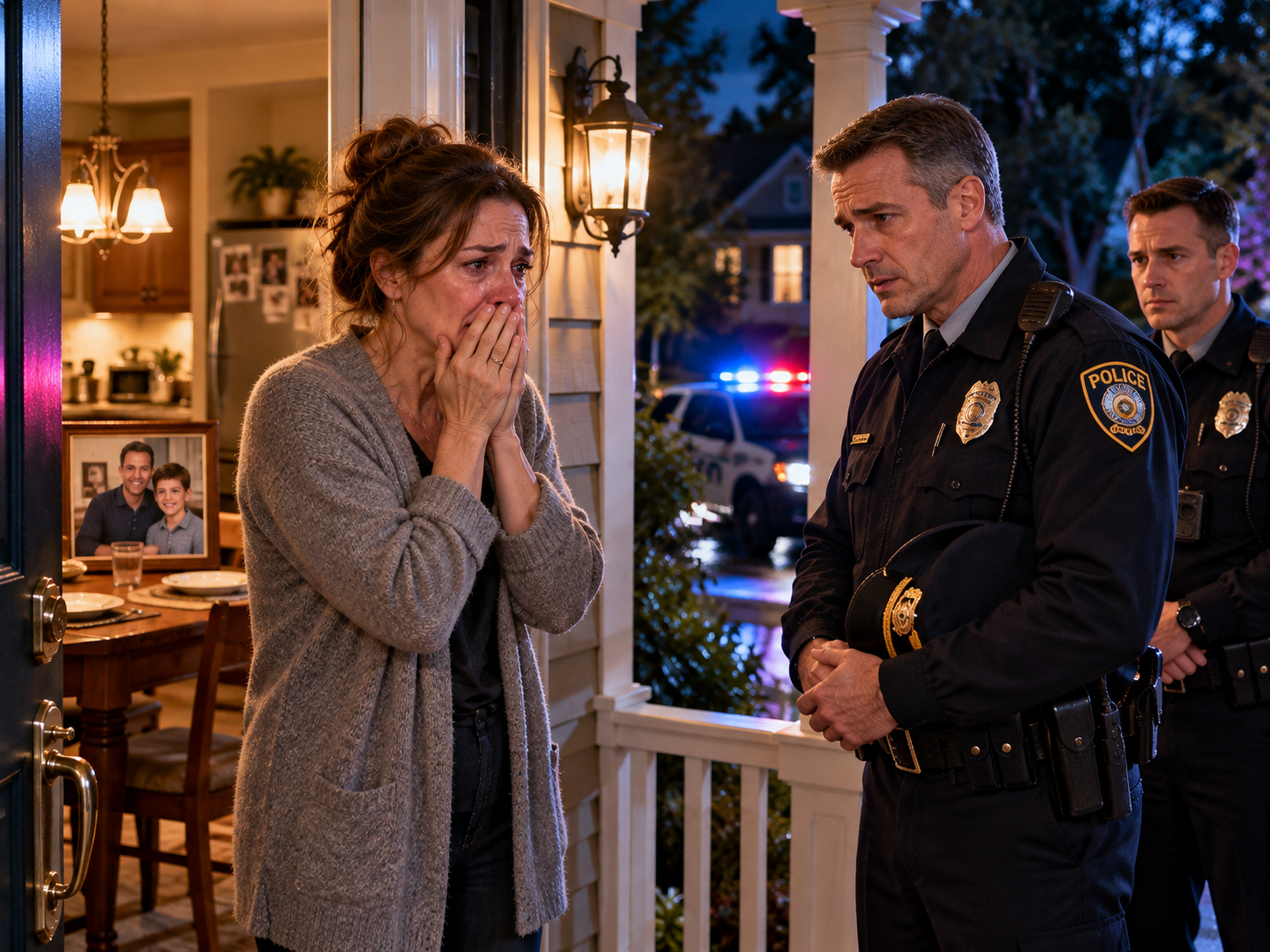
My mother chose a restaurant near the shopping district, one we had visited many times when I was younger. She arrived early and had already ordered tea when I walked in. Her purse sat on the chair beside her, and she kept smoothing the edge of a paper napkin while looking toward the door.
For a moment, I remembered being a child who had waited for her to finish work before asking for help with school assignments. I used to watch her face carefully, trying to judge whether she was tired enough that I should postpone the question. Even then, I had learned to consider her mood before deciding whether my needs were worth mentioning.
I sat opposite her and ordered coffee.
“Thank you for coming,” she said.
I nodded. I wanted to hear what she had to say before offering any explanation of my own.
She began by saying that the last few weeks had been painful for everyone. My father was stressed, Veronica was worried about the baby, and Ruben was struggling to find a place they could afford. She said the apartment situation had made everything worse and that the family needed to stop fighting.
I listened until she finished.
“Do you understand why I ended the arrangement?” I asked.
She looked at me. “I understand that you were angry.”
“That isn't what I asked.”
My mother pressed her lips together. She said the vacation had been planned long before Matthew died and that the money had already been spent. She repeated that they had believed I could manage the funeral with Sarah's help.
I asked whether she remembered what I had said on the phone.
“I remember you were upset.”
“I told you my son had died. I asked you to help me bury him. You told me that the vacation cost eight thousand dollars.”
She looked down at the table. “I was trying to explain the situation.”
“You explained the cost. You didn't explain why it mattered more than being there.”
She began to cry quietly. I felt a familiar urge to reach across the table and comfort her, but I stayed where I was. I could feel compassion for her distress without allowing it to replace the conversation we were having.
“I didn't think you would take it this hard,” she said.
I stared at her. “Mom, Matthew was twelve. I had spent six months watching him lie in a hospital bed. When he died, I was alone. I wasn't asking you to fix anything. I was asking you to stand beside me while I buried him.”
She wiped her face with the napkin and said she had believed I would be stronger than everyone else. I told her that being able to handle a crisis did not mean I should have to handle it alone. Strength had become the explanation my family used whenever they wanted to leave me with the hardest part.
She said she had not understood it that way.
I wanted to believe her, but I had heard similar explanations before. Whenever I raised a concern, she told me she had not intended to hurt me. Whenever I asked for help, she said she assumed I could manage. Her intentions mattered, but so did the consequences. I could not continue pretending that repeated neglect became harmless simply because nobody admitted to planning it.
We sat quietly for a moment. Then my mother asked whether I would consider allowing Veronica and Ruben to return to the apartment temporarily while they looked for a new place.
There it was.
The conversation had begun with repairing the family, but the first practical request was to restore the arrangement that had benefited them. She had acknowledged my pain only long enough to make another appeal for the family's comfort.
I told her I would not reopen the arrangement. I had reviewed the matter with an attorney and would continue handling the property according to the proper process. Veronica and Ruben had their belongings, and they were staying with my parents while they made other arrangements. I hoped they would find a suitable home, but I would not provide the apartment again.
My mother's expression tightened. She said the family would remember my decision for a long time.
“I expect you to remember the funeral, too,” I replied.
She looked away.
I did not stay to argue. I paid for my coffee, thanked her for meeting me, and left. As I walked toward my car, I felt sadness rather than satisfaction. I had hoped the conversation would be different. I had wanted my mother to recognize that her choice had changed something fundamental between us. Instead, she had returned to the practical consequences for Veronica before she had fully acknowledged the loss of Matthew.
At home, I wrote down the main points of the conversation while they were still clear in my mind. I did not write insults or conclusions about her character. I recorded what she had said, what I had answered, and what remained unresolved. I wanted to stop replaying the meeting in my head, and writing gave the facts a place outside my thoughts.
Later that afternoon, Veronica called. She had heard that our mother and I had met and wanted to know whether I had agreed to restore the apartment.
“No,” I said.
“You didn't even consider it?”
“I considered it before we met. My decision has not changed.”
She said she was struggling to understand how I could be so rigid when she was pregnant. I reminded her that the apartment had been provided without rent for years, and that she and Ruben had been told they needed to make their own housing plans eventually. I had allowed the arrangement to continue because I wanted to help, but it had never meant that they owned the property.
She said she had believed I would always be there for her.
“I was there for you,” I replied. “I helped with the wedding, the apartment, the phone bill, and other expenses. I asked you to be there for me when Matthew died, and you told me his death was my problem.”
She said she had been overwhelmed and that I was holding on to the worst thing she had ever said.
“I am holding on to what happened,” I answered. “You can decide what it means for you. I have to decide what it means for me.”
She hung up.
The call left me shaken, but I did not chase her with another message. I had learned that a conversation could end without agreement and that I did not need to keep speaking until the other person accepted my point of view.
The next day, Sarah invited me to spend the afternoon with her. We sat in her backyard while she worked on a small garden bed. She talked about ordinary things, then asked whether the family meetings were making me feel worse.
“They make me feel like I have to keep proving that what happened mattered,” I said.
“You don't,” she replied.
I knew she was right, but knowing did not erase the habit. I had spent years explaining my choices to my family because I hoped they would see me as generous rather than difficult. I was still learning that my decisions did not become legitimate only after they approved them.
Sarah asked whether I had thought about what I wanted from the relationship with my mother going forward. I told her I wanted to be able to speak honestly without every conversation turning into a request for money or a demand that I forgive someone immediately. I wanted to see whether my family could respect a boundary even when they did not like it.
“Then let that be what you look for,” she said. “Not whether they say the right thing once, but whether they behave differently afterward.”
I carried that advice with me.
A few days later, my father called to ask whether I would contribute toward the cost of a repair on his truck. He explained that the repair was necessary and that the expense had arrived at a difficult time. I listened, asked whether he had received an estimate, and suggested that he compare the price with another mechanic before agreeing to the work.
He was quiet, then asked whether I was going to help pay for it.
I told him I was not. I was managing my own expenses and would not resume the payments I had ended. He said I was choosing to punish my parents for one decision. I replied that I was choosing not to continue the financial arrangement. He could disagree with the choice, but it was mine to make.
He ended the call without thanking me for the suggestion.
That evening, I reviewed my monthly budget. With the recurring payments removed, I had more money available for my own needs and a clearer picture of my financial obligations. I set aside funds for the apartment's maintenance, checked the insurance and property expenses, and made a list of the repairs that would be needed before renting it again. I was careful not to treat the property as a source of quick revenge or a way to prove anything to the family. It was an asset that needed responsible management.
I also reviewed my personal spending. There were things I had postponed because I had been covering family expenses. I did not immediately buy anything expensive or make grand plans. Instead, I began building a reserve for emergencies and allowing myself a small amount for ordinary pleasures. I wanted to be secure, not reckless.
The first time I used some of that money for myself, I bought a book I had wanted to read. It was a simple purchase, but I felt an odd pang of guilt as I paid. I imagined my mother asking why I could afford a book while refusing to pay her grocery credit card. Then I reminded myself that the two decisions were unrelated. My ability to buy something for myself did not create an obligation to pay another person's bill.
I went home and read for an hour.
For the first time in months, I spent an evening doing something that had no connection to the accident, the funeral, the apartment, or my family's reaction. I still missed Jack and Matthew, but I did not spend the entire night trying to solve a problem. The grief remained, and so did the ordinary parts of life around it.
At the end of the week, Mrs. Moore sent me a message. She had been collecting notes from Matthew's classmates and wanted to know whether I would like the originals. I said yes and arranged to meet her. When she arrived, she carried a folder filled with handwritten pages and small drawings.
The children had written about Matthew's humor, his love of baseball, and the way he shared his lunch when someone forgot theirs. One student remembered that Matthew had helped him understand a math problem before a test. Another wrote that he always tried to make new students feel welcome.
I read every note slowly. Some made me laugh through my tears. One student had drawn a fishing boat with two figures, one tall and one small, and written that Matthew would always be remembered as a good friend.
I placed the notes in a box with his school papers. The children had not known him for all twelve years of his life, but they had seen parts of him that mattered. Their care reminded me that people could show up in different ways, and that genuine affection did not always come from the people who shared your name.
When Mrs. Moore left, I sat at the table with the folder open. I thought about the photograph from Cancun and the caption claiming that my family always showed up. I no longer needed to look at the screenshot to know what it represented. It was one moment in a much longer pattern, but it had made the pattern impossible to ignore.
I had been the dependable daughter, the helpful sister, and the person who could manage everything. My family had treated those qualities as reasons not to help me. I was beginning to see that being dependable should not mean being endlessly available, and being generous should not mean accepting every demand.
A few days later, my mother sent a message saying she hoped I was feeling better and asked whether I could help her review some insurance paperwork. I agreed to look at the documents, but I made it clear that I would not pay the premiums. She accepted the boundary without arguing. We spent half an hour reviewing the paperwork over the phone, and I helped her identify a question she needed to ask the insurer.
When the call ended, I felt cautiously encouraged. It was a small interaction, but it was different. She had asked for help with a specific task, and I had been able to offer it without taking over the financial responsibility. I did not assume that one conversation had repaired our relationship. I simply noted that we had managed to do something useful without fighting.
I wanted more interactions like that: honest, limited, and respectful. I did not need to become indifferent to my family. I needed to stop allowing care to become an automatic transfer of responsibility from them to me.
That weekend, I returned to the apartment and met the building manager. We discussed the condition of the property, the maintenance schedule, and the steps required before it could be rented again. The rooms were empty, the locks were secure, and the property was ready for repairs. I stood in the living room and remembered how comfortable Veronica and Ruben had been there, surrounded by belongings they had accumulated while paying no rent.
I felt no desire to make the apartment unpleasant for them in retrospect. I simply accepted that the arrangement had ended. The rooms were no longer theirs to use, and I would manage the property according to my own plans.
As I locked the door and walked toward the elevator, my phone buzzed with a message from Veronica. She asked whether I could meet her because she wanted to discuss something important about the baby.
I looked at the message, then at the new key in my hand.
I would meet her if the conversation was respectful. I would listen to what she needed to say. But I would not allow the word family to become a shortcut back to the old arrangement.
Click here to continue reading: PART 7: Veronica Arrived With an Apology That Sounded Almost Convincing, Until She Asked for One More Favor and Revealed What She Still Expected From Me
The Night I Learned My Family Had Chosen a Vacation Over My Son’s Funeral, Something Inside Me Went Quiet, and Nothing Would Ever Be the Same
Part 6 of 20

