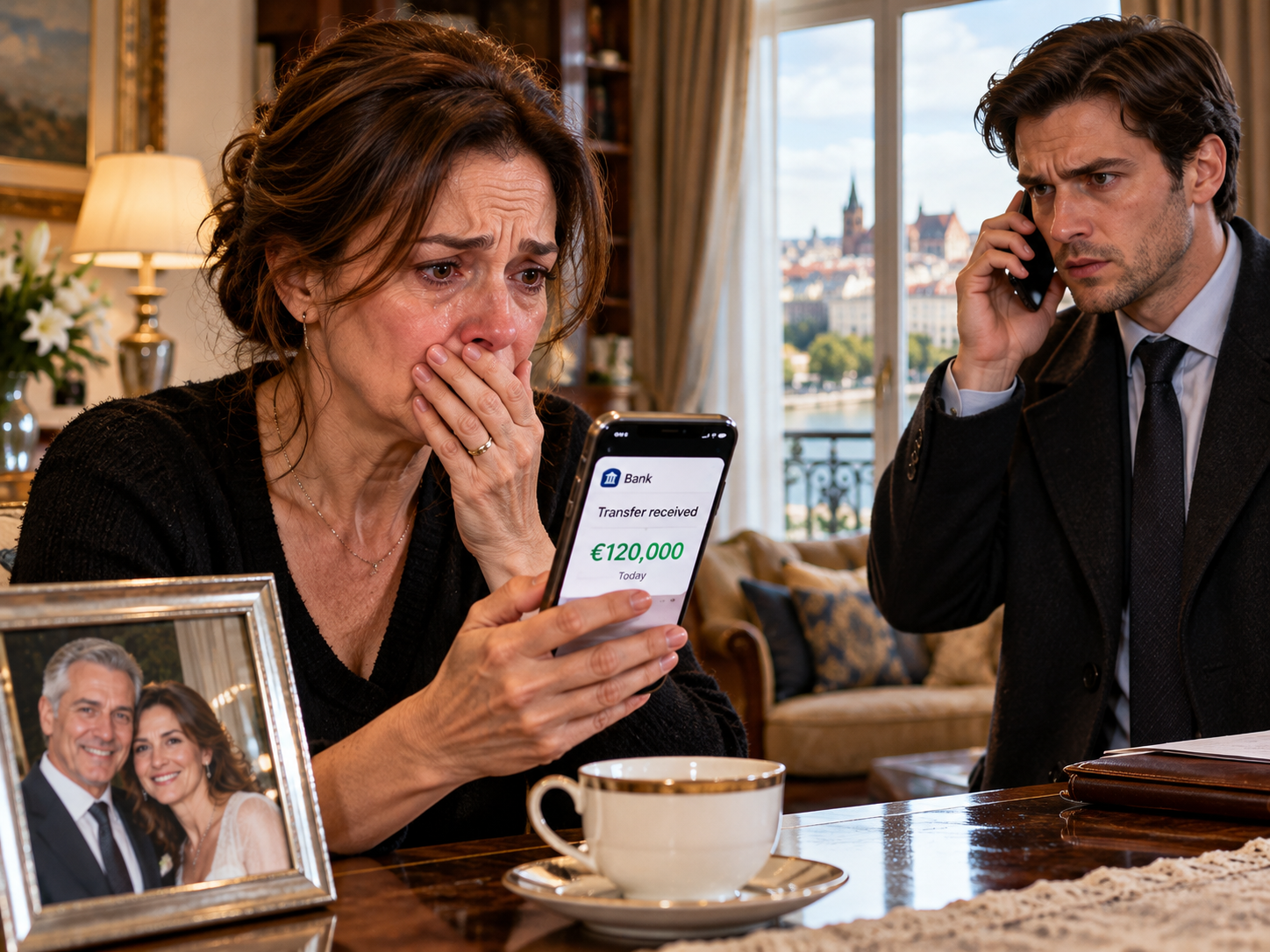
The decision to close the last personal file relating to Gérard’s estate came on a quiet morning in early autumn. Claire had confirmed that the necessary documents were stored securely, the bank’s administrative record had been updated, and there were no outstanding requests requiring my response. The company continued to preserve the historical review materials, and its newer financial procedures were operating as intended. There was nothing dramatic left to do. I needed only to confirm that my own records were complete and decide how I wanted to keep them.
I spread the documents across my dining table: the will, the confirmation of the €120,000 transfer, the final review findings, the bank’s correspondence, and Gérard’s handwritten letter. Each document represented a different part of the past year. The will had changed my financial circumstances. The transfer had frightened me before its purpose was clarified. The acknowledgment had forced me to defend my position without accusing anyone beyond the evidence. The review had established what could be known and what could not. The letter had given me a personal acknowledgment of the cost of Gérard’s secrecy.
I read the inventory once more and checked that every original was accounted for. I did not reopen the old questions. I did not compare the disputed signature with other documents or reread the same emails in search of a clue that the reviewers had missed. The evidence had been examined by people qualified to assess it, and the conclusions had been documented. If new information ever emerged, I would respond appropriately. I would not keep myself suspended in anticipation of a revelation that might never come.
I called Claire and confirmed that the estate file could be marked complete from my side. She explained that certain records would remain retained for legal and administrative purposes, but there were no further steps I needed to take. I thanked her for guiding me through the process. She had helped me distinguish what required action from what required patience, and she had never encouraged me to make accusations simply to satisfy my desire for certainty.
After the call, I placed the legal and financial documents in a secure folder. Gérard’s letter went into a separate section with personal correspondence. I wanted to preserve it, but I did not want it buried among bank statements and review notes. It belonged to a different part of my life. The records documented what had happened; the letter reminded me that the person involved had begun to recognize the harm caused by his silence. Neither could replace the years we had shared, but each had its own place.
I carried the folder to the cabinet in the study and put it away. Then I stood for a moment, looking at the shelves. They held books, photographs, and small objects collected over many years. For months, the cabinet had felt like a place where danger might be waiting. Now it was simply a cabinet. I closed the door and returned to the kitchen to prepare lunch.
The following week, I met with my financial adviser to review the estate’s long-term arrangements. We discussed the income from the remaining property, the maintenance costs for the villa, and the investments that had formed part of Gérard’s estate. I wanted the plan to support my life rather than dictate it. We agreed on a reserve for unexpected repairs, a measured investment approach, and an annual review of the properties. I kept enough flexibility to travel and pursue personal interests without compromising long-term security.
The €120,000 remained part of my financial resources, but I no longer treated it as a question waiting for an emotional answer. Its purpose had been clarified by the records: Gérard had authorized the transfer as a provision for my security, separate from the disputed obligation. I did not need to turn it into a symbol of everything he had failed to say. It was money that gave me choices, and I was entitled to use those choices thoughtfully.
I decided to retain the villa near Annecy for another year, with a maintenance schedule and a clear limit on what I would spend. The property still held memories of my marriage, but I had stopped asking whether keeping it meant that I was loyal to Gérard or selling it would mean I had moved on. It was a house, with costs and benefits, and I could make the decision when the time was right. My memories would remain whether the building belonged to me or someone else.
The Lyon apartment that I had chosen to keep felt increasingly like my own home. I rearranged the furniture, moved a reading chair closer to the window, and hung a few photographs from my childhood village. I bought plants for the balcony and began inviting friends over more often. The changes were modest, but they reflected the way I wanted to live. I was no longer preserving the apartment as a museum of the marriage or arranging it to suit the preferences of a family that no longer shared it with me.
One Saturday, I invited Mathieu and Jamie to lunch. I wanted to see them, and I wanted the invitation to be ordinary. I prepared a simple meal, and they arrived with bread and dessert. We talked about Jamie’s course, Mathieu’s new role, and a trip they were considering taking together. Nobody asked about the estate, and I did not bring it up. We were able to spend a few hours together without treating the past as a problem that had to be solved before we could enjoy one another’s company.
After lunch, Mathieu helped me carry the dishes to the kitchen. He asked whether I had heard anything further from the bank. I told him that the administrative matter was complete and that the acknowledgment remained disputed because the evidence did not establish my knowing consent. He said he understood. He did not ask me to change the wording or to reassure him about what the review might mean for his reputation. The conversation ended there.
Before leaving, he thanked me for inviting them. He said he appreciated that our relationship had become more comfortable, even if it was not the same as before. I told him I felt the same. We could be civil and caring without pretending that the painful months had never happened. He said he hoped we would continue to build on that. I replied that we could, provided we remained honest with one another.
Jamie hugged me at the door and promised to tell me how her next assessment went. I wished her luck and watched them walk toward the car. When I closed the door, I felt neither abandoned nor overwhelmed. I had enjoyed their company, and I was equally comfortable returning to my quiet afternoon. The ability to welcome people without needing them to stay, and to let them leave without feeling rejected, was new to me.
Brigitte and I continued to see each other occasionally. Our conversations were more respectful, though there were still moments when she slipped into the old habit of assuming that I would agree to whatever suited the family. The difference was that I could now decline without feeling compelled to justify myself at length. Sometimes she accepted my answer immediately; sometimes she needed time to adjust. I allowed her that time without surrendering my decision.
At the company, Daniel continued to send regular reports. The updated controls had become part of ordinary practice, and new staff were trained to document approvals and preserve supporting records. The remaining historical gaps were clearly marked, and no one was claiming that every old transaction had been explained. The company had learned to operate with a more accurate understanding of its own history. That was a more useful legacy than pretending that the past had been flawless.
I attended a shareholder meeting later that autumn. The agenda focused on the next year’s priorities, the service line’s performance, and the costs of maintaining existing properties. Daniel presented realistic projections, and the other shareholders discussed the risks and opportunities. I asked questions about the assumptions behind the expansion plan and supported a cautious approach. Nobody treated my questions as disloyal or implied that asking for evidence meant I distrusted the company. The process had become healthier because it no longer depended on everyone pretending to agree.
After the meeting, Daniel thanked me for supporting the procedural changes. He said the team had found it easier to work when responsibilities were clearly defined and decisions were documented. I told him that clarity protected everyone, especially when circumstances changed or someone was no longer available to explain a decision. I thought of Gérard, who had left behind papers that required months of examination because he had tried to manage too much privately. I hoped the company would remember the lesson without turning his mistakes into a permanent accusation against him.
As winter approached, I planned another visit to my childhood village. This time, I did not feel the need to return in order to recover a forgotten version of myself. I wanted to see the house, visit my parents’ graves, and spend a few days walking familiar roads. I arranged the trip, informed the property manager, and left Daniel with the usual instructions for routine matters. My life had room for both responsibility and rest, and I no longer believed that choosing one meant neglecting the other.
When I arrived in the village, the house was cold, and the garden had become quiet beneath the winter sky. I opened the shutters, made tea, and placed my bag beside the bed. The old photograph of my parents was still where I had left it during my previous visit. I looked at it and felt a calm affection for the woman I had been at twenty-three. She had left home believing that she could build a family through devotion and hard work. She had been brave, even if she had not understood how much she would need to learn about boundaries.
I spent the next day walking through the village and speaking with a few people I remembered from childhood. Nobody knew the details of the inheritance or the disputed acknowledgment. They knew me as the woman who had grown up there and returned occasionally to visit. Their ordinary recognition reminded me that my life was larger than the Delmas family’s history. I had existed before the marriage, and I would continue to exist beyond it.
On my final evening, I sat by the window and thought about Gérard’s letter. He had written that he hoped I would make my own decisions, even if they differed from his. I could not know whether he had fully understood the meaning of those words. But I could choose to take them seriously without treating them as permission I had been waiting to receive. I had already begun making those decisions. The letter simply confirmed that I was right not to stop.
I thought about Mathieu’s apology, Brigitte’s gradual change, and Jamie’s growing independence. None of them had become perfect, and neither had I. We were people trying to build more honest relationships after years of unspoken expectations. I could not guarantee that we would never hurt one another again. I could only continue to speak clearly, listen when I chose to listen, and refuse to confuse affection with the surrender of judgment.
When I returned to Lyon, I unpacked, watered the plants, and placed my parents’ photograph beside the others. I did not feel the need to compare the different stages of my life or decide which one had been the happiest. The village, the marriage, the inheritance, and the months of uncertainty all belonged to the same history. None of them had to erase the others.
A few days later, I took Gérard’s photograph from the shelf and dusted the frame. I looked at his face for a long time. I remembered his kindness and his stubbornness, his ability to make a room laugh, and his habit of keeping difficult information to himself. I missed him. I also accepted that I could not repair the parts of our marriage that had remained unresolved. His death had ended the possibility of new conversations, but it had not ended my responsibility to live honestly.
I returned the photograph to the shelf, not at the center of the room but among the other pictures of people and places that had shaped my life. I did not need to remove him from my memories in order to move forward. I needed to stop allowing those memories to decide what I was permitted to do.
The fortune Gérard left me changed my circumstances, but it did not define my value. The will gave me property and financial resources, but it could not measure the years I had spent caring for him and raising Mathieu. The disputed acknowledgment tested my willingness to stand by what I knew, and the review taught me to respect the limits of what could be proven. The letter gave me a glimpse of Gérard’s late understanding, but it did not require me to excuse every silence.
I had learned to preserve the facts without inventing certainty, to accept an apology without surrendering my boundaries, and to remain compassionate without becoming responsible for everyone else's choices. I had learned that family peace was not worth buying with unsupported statements or the quiet abandonment of my own judgment. Most importantly, I had learned that my life did not need a final verdict from the Delmas family.
The last estate file was closed, but my life was not. I still had plans to make, friends to see, work to do, and places I wanted to visit. I could keep the villa or sell it later. I could attend family gatherings or spend a weekend away. I could help when help was welcome and decline when a request crossed a boundary. Those decisions were no longer proof of my loyalty or a measure of my love.
On a clear morning, I opened the windows of my apartment and let the cool air move through the rooms. Lyon was waking below me, with buses moving through the streets and café owners arranging chairs outside their doors. I made coffee and sat down with my notebook. I wrote a short list of things I wanted to do in the coming year: travel, read more, spend time with friends, maintain the villa responsibly, and continue supporting the company without allowing it to consume my life.
There was no dramatic final promise. I did not need one. I had spent too many years believing that a good life depended on enduring more, giving more, and asking for less. Now I understood that a good life also required room for rest, choice, and truth. I could honor the years I had given to my family without giving away the years that remained.
I closed the notebook and finished my coffee. Gérard’s photograph caught the morning light, and for a moment I felt the familiar ache of missing him. I let the feeling remain. Love did not disappear simply because I had stopped making sacrifices in its name. Grief did not require me to remain trapped in the past.
The money was still there, the records were preserved, and the unanswered question about the signature remained unanswered. But none of those things could decide who I was. I had done what I could, respected what the evidence showed, and accepted what it could not tell me. The rest belonged to a past I could remember without continuing to live inside it.
For twenty-five years, I had helped build a home for the Delmas family. After Gérard’s death, I had spent months defending my right to stand within the life I had helped create. Now I no longer needed anyone to confirm that I had belonged. My place in those years was real, and my future was mine to shape.
I opened the window a little wider and turned toward the day ahead. I would remember Gérard, care for the people who treated me with respect, and continue making decisions with honesty and independence. I would not spend the rest of my life waiting for every question to be answered before allowing myself to be happy.
The estate had given me security. The truth had given me boundaries. And the life I chose after Gérard gave me something neither money nor a will could ever provide: the freedom to belong to myself.
The End
Read more original stories on Feel Every Story.
My Husband Left Me €120,000, but His Son’s Call Made Me Fear What That Money Was Really Meant to Hide
Part 20 of 20