
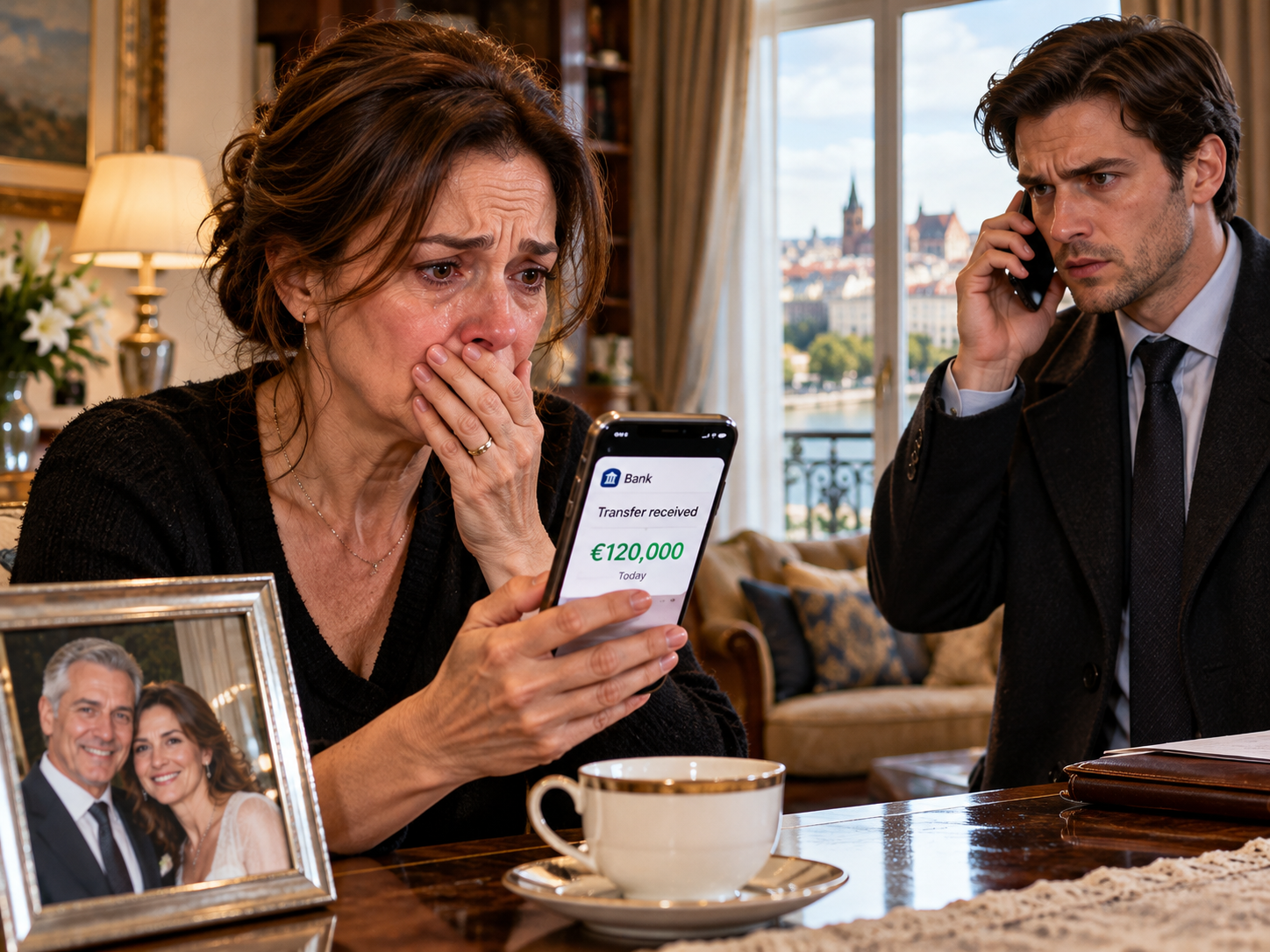
Claire asked me not to touch the financial acknowledgment again until we had established its origin. She placed it in a protective sleeve and arranged for the relevant records to be preserved. The original document, if it existed, would be more useful than the photocopy, and the signature would need to be examined by an appropriate professional before anyone could claim it was genuine or false.
I spent the next several days waiting for answers.
The uncertainty was exhausting in a way grief alone had not been. Grief had a shape: the empty side of the bed, Gérard's unused coffee cup, the silence that followed the closing of his study door. The financial questions were different. They followed me from room to room because every document seemed to open another possibility. I could not tell whether my husband had tried to protect me, whether he had concealed an obligation, or whether someone else had taken advantage of his illness.
Claire reminded me that I did not have to solve everything at once. We had asked the bank to preserve the transaction records, requested the original acknowledgment, and informed Maître Perrin that any estate decision involving the disputed document should wait until the facts were clearer. I followed her advice and left the €120,000 untouched.
Mathieu continued sending messages. At first, he asked for updates. Then he began insisting that the family could not remain suspended indefinitely while I examined every paper Gérard had left behind. When I explained that the lawyers were waiting for records, he accused me of treating his father's death as an opportunity to seize the estate.
I read the message several times before answering.
“I am following the legal process. I will not agree to anything until the documents have been verified.”
He called immediately.
“Do you understand what you're doing?” he demanded. “You're making everyone think Father did something wrong.”
“I have not accused your father of anything.”
“You hired a lawyer.”
“Yes, Mathieu. I am entitled to independent advice.”
He gave a bitter laugh. “After everything he did for you?”
The words struck an old wound, but they no longer controlled my response.
“Your father and I were married for twenty-five years. I do not need to prove my gratitude by accepting an unexplained financial obligation.”
He went silent.
Then he said, “You have no idea what he was trying to fix.”
“Then let the records explain it.”
He ended the call.
I forwarded the exchange to Claire and did not contact him again about the transfer.
A week later, Maître Perrin arranged a meeting with the bank's representative, Claire, and the professional responsible for reviewing the disputed signature. The bank had located the original transfer instruction and additional records connected to the investment account. The signature examiner had not yet issued a final opinion on the acknowledgment, but the preliminary comparison raised questions that required further investigation.
We gathered around the same conference table where I had first heard that Gérard intended to leave me his estate. This time, Brigitte and Mathieu were not present. Maître Perrin explained that the meeting concerned the financial records rather than the family's competing expectations.
The bank representative began with the transfer.
Gérard had authorized the €120,000 payment several weeks before his death. The money had come from an investment account held in his name, and the transaction reference matched the number on his handwritten note. The bank's records showed no instruction from me and no indication that I had requested the payment.
The transfer itself was genuine.
Its purpose, however, had been described differently in different documents. Gérard's personal letter referred to my security, while an internal note associated with the investment account indicated that the payment should be kept separate pending clarification of a disputed financial acknowledgment.
Claire asked whether the bank had treated the payment as a loan.
The representative said that the available records did not establish a loan agreement between the bank and me. Nor did they show that I had accepted a personal obligation connected to the account. The bank was still completing its review, but it had found no basis to demand that I return the money simply because a separate document was disputed.
I felt my shoulders loosen slightly.
“What about the acknowledgment bearing my signature?” I asked.
The representative explained that the document had been submitted as part of a request to recognize a financial undertaking associated with one of Gérard's business arrangements. It appeared to have been used to support the position that I had accepted responsibility for an amount connected to the investment account.
The signature examination was ongoing, and no definitive conclusion could yet be drawn. But the original acknowledgment had not been located in the bank's files. Only a copy had been provided, and the records identifying who submitted it were incomplete.
Claire asked for the precise date on which the copy had entered the bank's system.
The representative checked the file.
It had been submitted by Mathieu.
The room became very quiet.
Maître Perrin looked down at his notes. Claire did not react immediately. She simply asked whether the bank had evidence that Mathieu had created the document or altered my signature.
“No,” the representative replied. “The submission record identifies the person who provided the copy. It does not establish who prepared it, whether the signature is genuine, or whether the submitter understood the document's status.”
I appreciated the distinction. Mathieu's involvement was important, but it was not proof that he had forged anything. There could be explanations we had not yet uncovered. The document might have been supplied to him by someone else. He might have believed it was authentic. Or he might have known more than he had admitted. We could not decide which possibility was true merely because his name appeared in the record.
Claire asked that the bank preserve the submission history and all related communications. The representative agreed.
Then Maître Perrin opened a separate envelope.
“This is the remaining letter from Monsieur Delmas's estate-planning file,” he said. “It was intended to be provided once the financial records had been reviewed sufficiently to understand the context.”
I looked at the handwriting on the front.
Again, it was Gérard's.
Claire asked whether I wanted to read it privately first. I shook my head. I had spent too long being given fragments of information and told to wait for the next explanation. I wanted the letter read in the presence of the people responsible for establishing the facts.
Maître Perrin unfolded the page.
Gérard explained that he had become concerned about the way financial documents were being handled during the final year of his life. His health had begun to decline, and he had delegated more administrative tasks to Mathieu. He had expected his son to organize the records, communicate with the relevant institutions, and prepare information for the professionals managing his investments.
At first, Gérard had regarded the arrangement as a practical solution. Mathieu was his son, knew the family company, and had repeatedly insisted that he wanted to take on more responsibility. But Gérard later discovered inconsistencies between the documents he remembered authorizing and the copies being circulated in connection with certain financial arrangements.
He did not identify every inconsistency in the letter, and he did not declare that Mathieu had committed fraud. He wrote that he could not establish who was responsible for every discrepancy, but he had become concerned enough to request an independent review.
The letter then addressed the €120,000.
Gérard said he had arranged the transfer because he wanted me to have money under my direct control while the records were being examined. He knew that I had never been involved in the company's financial decisions and did not want me to become vulnerable to a claim based on documents I had not knowingly accepted.
He had deliberately used my existing personal account so that the money would not be mixed with the ordinary household accounts.
But he had made one serious mistake.
He had assumed that the transfer and the will would be enough to protect me without telling me what was happening while he was still alive.
I stopped listening for a moment and stared at the table.
Even in death, Gérard's decisions were still shaping my life without my participation. He had intended to protect me, yet he had left me to discover the problem through a bank notification, a hostile telephone call, and a disputed document bearing my name.
The letter continued.
Gérard wrote that he had considered telling me about the financial concerns several times but had postponed the conversation because he did not want to burden me during his illness. He had also feared that confronting Mathieu without complete evidence would damage their relationship. By the time he understood that his health might prevent him from resolving the matter himself, he had begun preparing the will and arranging the independent review.
He acknowledged that he had allowed his desire to keep the family together to become an excuse for silence.
The admission hurt more than I expected.
For years, I had believed that Gérard's decisions were based on confidence in his son and a desire to maintain the family's position. I had not understood how much he had concealed even from himself. He had expected loyalty to prevent conflict, just as he had expected my patience to prevent arguments at home. In both cases, the silence had allowed problems to grow.
The final paragraph was addressed directly to me.
He asked me not to let the family turn the transfer into a price for my marriage or a weapon in a dispute over his estate. He had intended the money to provide security, not to purchase my silence or settle the value of our life together. He also asked me to cooperate with the legal review rather than accept explanations from anyone who wanted the matter resolved before the records were complete.
When Maître Perrin finished reading, I folded my hands in my lap.
For the first time, I understood why the lawyer had looked afraid at the will reading. It was not necessarily fear of a crime or a single hidden act. He had known that the testament and the transfer were connected to unresolved financial questions, and he had understood that the family might react badly when the documents became public.
Brigitte's contempt had been genuine. Mathieu's certainty that the transfer represented my final settlement had not been supported by the will. And the document bearing my signature had introduced a question that could not be answered by family loyalty alone.
Claire summarized the next steps. The signature examination would continue. The bank would complete its review of the account and the disputed acknowledgment. The estate would be administered according to the will, subject to legitimate obligations and the appropriate legal process. If evidence of falsification or other wrongdoing emerged, the matter would be referred to the relevant authorities. No one would be declared responsible before the evidence justified it.
I agreed.
The following week, the examiner issued a report finding significant inconsistencies between the signature on the disputed acknowledgment and verified examples of my handwriting. The report did not, by itself, identify who had produced the signature or establish the full circumstances in which the document had been created. It recommended further investigation and comparison with the original records.
The bank accepted that the acknowledgment could not be relied upon as proof of my personal obligation without additional verification. It placed the disputed claim on hold while the relevant records were examined. I was not required to return the €120,000 merely because the copy existed, and no evidence established that I had knowingly agreed to assume the larger financial obligation described in the document.
Claire explained the outcome carefully. The review had not answered every question, and the signature report was not a criminal judgment. But it had established something important: the family could not use the disputed acknowledgment to demand money from me as though my responsibility were already proven.
The estate administration continued.
The will remained in force, and the properties, investments, and company shares were assessed according to the required procedures. Legitimate debts and taxes would be addressed before the final distribution. The financial review did not erase the rights of anyone who could establish a lawful claim, but neither did it permit Brigitte or Mathieu to replace the documents with their own expectations.
Brigitte called me after she learned that the acknowledgment could not be relied upon in its current form.
“You have made this family look terrible,” she said.
I was standing by the kitchen window, watching rain collect along the edge of the balcony.
“I did not create the document, Brigitte. I asked for it to be verified.”
“You could have trusted Mathieu.”
“I trusted him enough to let the lawyers examine the facts.”
“That isn't trust.”
“No,” I replied. “Trust does not mean pretending a question has no answer.”
She accused me of turning Gérard's death into a legal dispute, then hung up.
I did not call her back.
Mathieu remained silent for several days. When he finally contacted me, he said he had submitted the acknowledgment because he believed it belonged with the financial records his father had asked him to organize. He denied creating the signature or intending to make me responsible for a debt. He said he had thought the document was genuine.
I listened to his explanation without accepting it as proof. I told him that the relevant professionals would have to establish what had happened and that I would not discuss the matter privately while the review remained open.
He asked whether I believed he had deliberately tried to harm me.
I took a long breath.
“I believe the document was serious enough that it needed to be examined. I will not claim to know what happened until the evidence establishes it.”
He said nothing for several seconds.
Then he asked whether I intended to keep the inheritance.
“The will is being administered according to the law,” I replied. “That is the only answer I can give you.”
He ended the call without another word.
Months passed before the estate reached its final stage. The properties were valued, the investment records reconciled to the extent possible, and the necessary liabilities addressed. The unresolved financial questions were kept separate from the distribution rather than being used as an excuse to freeze everything indefinitely. The review did not produce a basis for treating me as personally responsible for the disputed obligation, and the estate was administered in accordance with Gérard's valid testament.
I received the assets left to me under the will, subject to the lawful costs and obligations of the estate. The €120,000 remained part of my financial security, not a price for twenty-five years of service and not a payment I had agreed to make on someone else's behalf.
I did not celebrate the inheritance.
The villa near Annecy, the apartments in Lyon, the investments, and the shares were substantial assets, but each came with practical responsibilities. I sought professional advice before deciding what to retain, what to sell, and how to manage the properties. I made no dramatic promises to the family and did not use the money to punish anyone. I wanted the estate handled carefully because it represented the final responsibilities left by a man I had loved, even as I came to understand the ways he had failed me.
I kept the apartment that had been our home while the legal arrangements were completed. I changed the locks where appropriate, organized the records, and made decisions about the rooms according to my own preferences. The black dress remained in my wardrobe. I wore it once to a quiet dinner with a friend who had stood by me throughout the ordeal, and I discovered that I no longer thought about Gérard's criticism when I looked in the mirror.
Brigitte did not apologize. Mathieu and I exchanged only the necessary communications concerning the estate and the family company. I did not know whether the disputed signature would eventually be attributed to a particular person or whether every detail of the financial arrangement would ever be explained. I stopped trying to force an answer out of silence. The records had established what they could establish, and any further findings would have to come through the appropriate process.
What I did know was that I had not accepted an obligation simply because someone placed my name on a page. I had not surrendered my inheritance because relatives were offended by the will. And I had not allowed the transfer to become a verdict on the worth of my marriage.
One evening, after the final estate documents had been placed in secure storage, I sat alone in the living room and looked at the photograph of Gérard above the fireplace. His smile was unchanged. For a long time, I had thought that loving him meant preserving the version of him I wanted to believe in. Now I could acknowledge both the tenderness and the failures. He had cared about my security, yet he had withheld information I deserved to know. He had tried to protect me, yet he had made decisions for me without giving me a voice. His final actions had helped me, but they did not erase the years in which I had learned to make myself smaller to keep his household peaceful.
I could grieve him without defending every choice he had made.
The €120,000 had arrived without explanation, and for a time I had feared it was a final insult—a sum intended to purchase my silence and close the account of a marriage that had mattered deeply to me. The will had seemed like an impossible reversal, and the disputed acknowledgment had made me question whether my husband's final gift concealed a burden I had never accepted.
The truth proved more complicated. Gérard had tried to secure my future while confronting financial records he no longer trusted. He had left me the means to seek independent advice, but he had also left questions that could not be resolved through affection or family loyalty. The legal process had separated the genuine transfer from the disputed document, the valid inheritance from unsupported assumptions, and what could be proven from what remained uncertain.
I would never know whether Gérard fully understood the consequences of leaving everything until after his death. I could only judge the choices he had made and decide what I would do with the life that followed.
I returned the photograph to its place and turned off the living room light.
The money remained in my account. The estate had been administered, the documents preserved, and the questions that required further examination left to the proper authorities. I was no longer waiting for Mathieu to explain my value or for Brigitte to acknowledge my place in the family. I did not need the inheritance to prove that I had belonged beside Gérard for twenty-five years.
I had loved him. I had cared for his son. I had built a life in Lyon, and I had earned the right to decide what came next.
The transfer had not purchased my years, and the will had not transformed the past into something perfect. But the final documents had given me something I had rarely possessed during my marriage: the ability to make decisions with the facts in front of me, without surrendering to another person's certainty.
For the first time since Gérard's death, I could look toward the future without waiting for someone else to tell me what I was worth.
Click here to continue reading: PART 5: I Thought the Inheritance Had Finally Closed the Door on My Husband’s Secrets, Until a Letter Arrived That Changed What I Believed About Our Last Year Together
My Husband Left Me €120,000, but His Son’s Call Made Me Fear What That Money Was Really Meant to Hide
Part 4 of 20

