
The inventory appointment was arranged for the following Tuesday. Claire sent a representative from her office, and Maître Perrin appointed a neutral professional to document the contents of the locked drawer at the villa. I drove to Annecy early that morning, carrying the estate paperwork in a folder on the passenger seat. The road was quiet, and the mountains were half hidden by low clouds. I had spent years visiting the villa as Gérard's wife, never imagining that I would one day return as the person responsible for deciding what happened to its contents.
The professional arrived shortly after ten. He examined the lock, recorded its condition, and opened it without damaging the cabinet. Inside were several folders, a small notebook, two envelopes, and a sealed plastic sleeve containing a memory device. Nothing looked particularly valuable. There were no bundles of cash or secret property deeds, no dramatic evidence that would immediately explain the estate's mysteries. Instead, the drawer held the sort of papers people accumulate when they believe they will eventually have time to organize everything properly.
We began with the folders. One contained maintenance records for the villa, another held old tax correspondence, and a third included documents from the family company. The notebook appeared to be Gérard's, filled with dates, short reminders, and figures written in his compact handwriting. Some entries referred to ordinary expenses. Others mentioned meetings with accountants and requests for copies of financial statements. I did not attempt to interpret every line. The inventory professional photographed the pages and recorded the documents before they were placed in protective sleeves.
The first envelope contained letters from a bank about investment account statements. The second held a printed email exchange between Gérard and an adviser. The correspondence was dated several months before his death and concerned discrepancies between two versions of a financial report. The adviser had asked for clarification about an amount that appeared in one version but not another. Gérard had replied that he wanted to review the underlying documents before approving the figures. There was no accusation in the exchange, only a clear request for the records supporting the amount.
Claire read the email later that afternoon. She explained that it was relevant because it showed Gérard had questioned the report before the disputed acknowledgment became part of the estate review. However, the email did not establish that the discrepancy was fraudulent or that Mathieu had created it. A report could contain errors for many reasons, and the underlying records would need to be compared before anyone reached a conclusion. She added the correspondence to the existing file and requested the related statements through the proper channels.
The memory device was the most unexpected item. It was sealed in a sleeve marked with the date of the last financial review Gérard had attended. The inventory professional recorded its serial number and arranged for a qualified technician to make a secure copy without altering the original. I watched the process with growing unease. I had never known Gérard to keep digital records at the villa, and I wondered whether the device contained something he had wanted to preserve away from the company office.
The technician returned several days later with a report identifying the files that could be accessed. Most were ordinary spreadsheets and scanned documents. A few were audio recordings, each labeled with a date and a short description. Claire advised that we should not listen to anything that might be confidential or unrelated to the estate until its relevance was established. We reviewed the file names first. One recording was labeled with the date of a meeting between Gérard and his financial adviser. Another referred to a discussion about the company accounts. A third had no description at all.
We arranged to listen to the relevant recordings with Claire and Maître Perrin present. The first contained Gérard's voice discussing investment statements and asking his adviser to explain a difference between two balances. The adviser replied that the records needed further checking and that the discrepancy might result from the timing of a transfer. Gérard said he did not want to sign any acknowledgment until he had received a complete explanation. The recording ended shortly afterward. It did not mention me or the disputed signature, but it confirmed that Gérard had been cautious about signing documents during that period.
The second recording was more personal. Gérard was speaking to someone whose voice I recognized as Mathieu's. The conversation was tense, though neither man shouted. Gérard asked why a financial report had been sent to an institution before the supporting records were complete. Mathieu replied that he had been trying to keep the process moving and believed the missing documents would arrive later. Gérard said that the report should not have been treated as final without the necessary verification. Mathieu insisted that he had followed the instructions he had been given.
Then Gérard asked a question that made my hands go cold.
“Did you include Rebecca's name because you believed she had agreed, or because you thought the institution would accept the document more quickly?”
There was a pause.
Mathieu answered that he had understood the document to be part of the family's arrangements and that he had not intended to place me in difficulty. He said his father had told him that I would be protected from any direct obligation. Gérard replied that protection was not the same as permission and that no one should use my name on a financial document unless I had knowingly agreed to it.
The recording ended before the argument was resolved.
I sat motionless as the technician confirmed that the file had played to its end. I wanted to ask whether the recording proved that Mathieu had submitted the disputed acknowledgment knowing it was invalid. Claire stopped me gently before I could turn the question into a conclusion.
“It shows that they discussed the use of your name and that Gérard objected to the way the document had been handled,” she said. “It does not establish every detail about the document's preparation or Mathieu's state of mind when he submitted the copy. We need the full context and any related records.”
I nodded, although it took effort. For months, I had wondered whether Mathieu had simply misunderstood the papers or whether he had knowingly tried to shift an obligation onto me. The recording made it impossible to dismiss the concern, but it still did not provide a complete answer. His own words suggested that he believed I would be protected, while Gérard's response showed that he had considered the use of my name unacceptable without my consent.
Maître Perrin arranged for the recording to be preserved as part of the estate file. Claire sent it to the professionals reviewing the disputed acknowledgment, along with a request that they examine the surrounding correspondence and the original transaction records. No one declared Mathieu guilty of wrongdoing. The recording became another piece of evidence that needed to be considered alongside the signature examination, the banking records, and the documents already collected.
I returned to Lyon with a copy of the inventory report and a feeling that the past had become both clearer and more painful. I had always believed that Gérard's financial decisions were beyond my understanding because he had experience and I did not. Now I saw that he himself had been uncertain about some of the arrangements. He had asked questions, delayed approvals, and tried to keep me separate from a dispute he did not fully understand. He had also failed to tell me enough for me to protect myself earlier.
That evening, I opened the notebook Claire had authorized me to review for personal relevance. Most of it contained dates and figures, but several pages were devoted to family matters. Gérard had written about Mathieu's future at the company, his own concerns about succession, and the need to establish clearer responsibilities before he became too ill to supervise the business. One entry mentioned that Mathieu was under pressure from debts connected to an earlier venture. Another said that he had promised to repay money borrowed from a business associate.
The entries were brief and did not identify the amounts with certainty. I did not know whether the debts were still outstanding or whether they had any connection to the disputed financial arrangement. I sent photographs of the relevant pages to Claire, who added them to the chronology. She cautioned me against assuming that personal debts automatically meant wrongdoing in the company. A person could be in financial difficulty without misusing funds, and the documents would need to establish whether the matters were connected.
A few days later, Mathieu asked to meet. He said he had learned that the recording from the villa had been preserved and wanted the opportunity to explain his side. Claire advised me that I could hear him out, provided I made no agreements about the estate or the disputed document and kept the conversation appropriately documented. I agreed to meet him at her office rather than at the apartment or the family home.
He arrived looking exhausted. His suit was wrinkled, and he had dark circles beneath his eyes. For the first time in years, he seemed less concerned with appearing successful than with finding a way to explain himself. He sat opposite me and began by saying that he had never intended to make me responsible for his father's financial problems.
“I thought the document was part of an arrangement Father had already discussed with the advisers,” he said. “I was trying to provide the records they asked for.”
“Did you see me sign it?”
He looked down at his hands.
“No. I didn't see you sign that copy.”
“Then why did you submit it?”
“Because I believed it was already in the file. I thought Father had arranged it. I didn't understand that the signature itself was in question.”
His explanation might have been true, partly true, or incomplete. I could not determine which simply by watching his face. I asked whether he knew where the original document was. He said he did not. I asked whether he had prepared the copy himself. He said he had not created the signature, but he had submitted the document because he believed it belonged with the records. He offered to provide his emails and any related correspondence to the professionals conducting the review.
I told him that was the appropriate next step. I would not decide the matter privately, and neither would he. If his explanation was accurate, the records should help establish it. If the records contradicted his account, the review would need to address that as well. He looked as though he wanted me to say that I believed him, but I could not offer certainty I did not possess.
“Do you think I wanted to hurt you?” he asked.
I remembered the child who had left apple tart beside my plate, the teenager who had once come to me after an argument with his father, and the adult who had described €120,000 as a fair price for my marriage.
“I think you made decisions involving my name without making sure I had agreed,” I replied. “Whether you intended to hurt me is a separate question.”
He swallowed and nodded. It was not the answer he had wanted, but it was the one I could honestly give.
After he left, Claire recorded the substance of the meeting and sent a request for the emails Mathieu had offered to provide. We made no private agreement, and I did not promise to withdraw any concern about the acknowledgment. I felt no satisfaction in his discomfort. I wanted the facts established, and I wanted to stop carrying the burden of trying to guess what everyone had intended.
The additional records arrived over the following weeks. Some supported Mathieu's explanation that he had believed the document belonged to an existing arrangement. Others showed that Gérard had repeatedly asked for verification before any financial undertaking was treated as final. The evidence did not resolve every question about who had prepared the disputed signature, but it strengthened the conclusion that the document could not safely be used to establish my personal obligation without further proof. The review remained careful and limited to what the records could support.
I began to see why Gérard had written that I should trust the documents rather than the explanations people offered. He had known how easily family relationships could turn uncertainty into pressure. He had watched me accept responsibility for keeping the household peaceful, and he had probably assumed I would continue doing so even after his death. His final instructions were an attempt to prevent that. They were also an admission that he had not protected me as well as he should have during our marriage.
The discovery at the villa did not give me the clean answer I had once wanted. It gave me a more complicated truth. Gérard had been concerned about financial records. Mathieu had handled documents that involved my name without confirming my consent. The disputed acknowledgment remained unproven, and no one had established every detail of its creation. The evidence justified continued examination, not a sweeping accusation.
I could live with that distinction.
For years, I had believed that uncertainty was something to eliminate by trusting the person who sounded most confident. Now I understood that uncertainty could be managed by preserving records, asking questions, and refusing to make decisions before the facts were ready. The process was slower than an argument and far less satisfying than a confession, but it protected me from turning fear into another mistake.
When I returned to the villa to approve the inventory's final report, I stood in Gérard's study for a few minutes after the professionals had left. The drawer was empty now, its contents documented and stored. Sunlight crossed the desk where he had once read business papers while I prepared dinner downstairs. I thought about how many conversations had taken place in that room without my knowing what was at stake. I also thought about how often I had been told that a good wife should not ask too many questions.
I no longer believed that.
The estate was mine to manage under the will, but it was not my responsibility to repair every decision Gérard had made. Mathieu would have to answer questions about his own actions, and the professionals would determine what the evidence supported. I could care about what happened to him without shielding him from legitimate scrutiny. I could honor the parts of my marriage that had been loving without defending the parts that had left me unprotected.
Before leaving, I closed the study door and locked the villa. I had not found a fortune in the drawer, nor a single page that explained every hidden arrangement. I had found a record of a family struggling to face a difficult financial truth and a husband who had tried, too late, to make sure that my name would not be used without my consent.
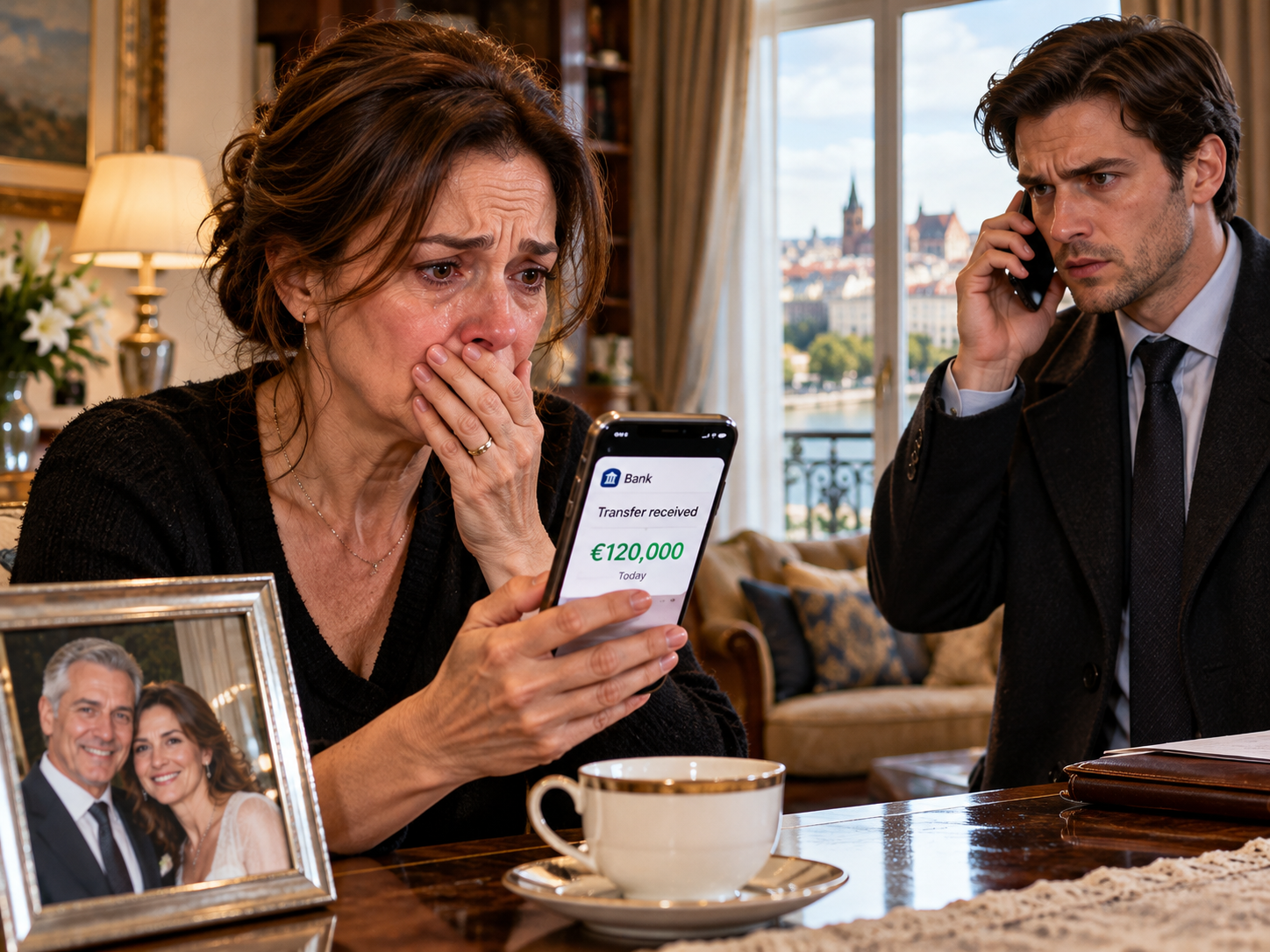
It was not the answer I had imagined when I first saw the €120,000 notification. But it was enough to guide my next decision.
Click here to continue reading: PART 7: Mathieu Asked Me to Protect His Future, but His Request Forced Me to Decide Whether Compassion Would Become Another Form of Silence
My Husband Left Me €120,000, but His Son’s Call Made Me Fear What That Money Was Really Meant to Hide
Part 6 of 20

