
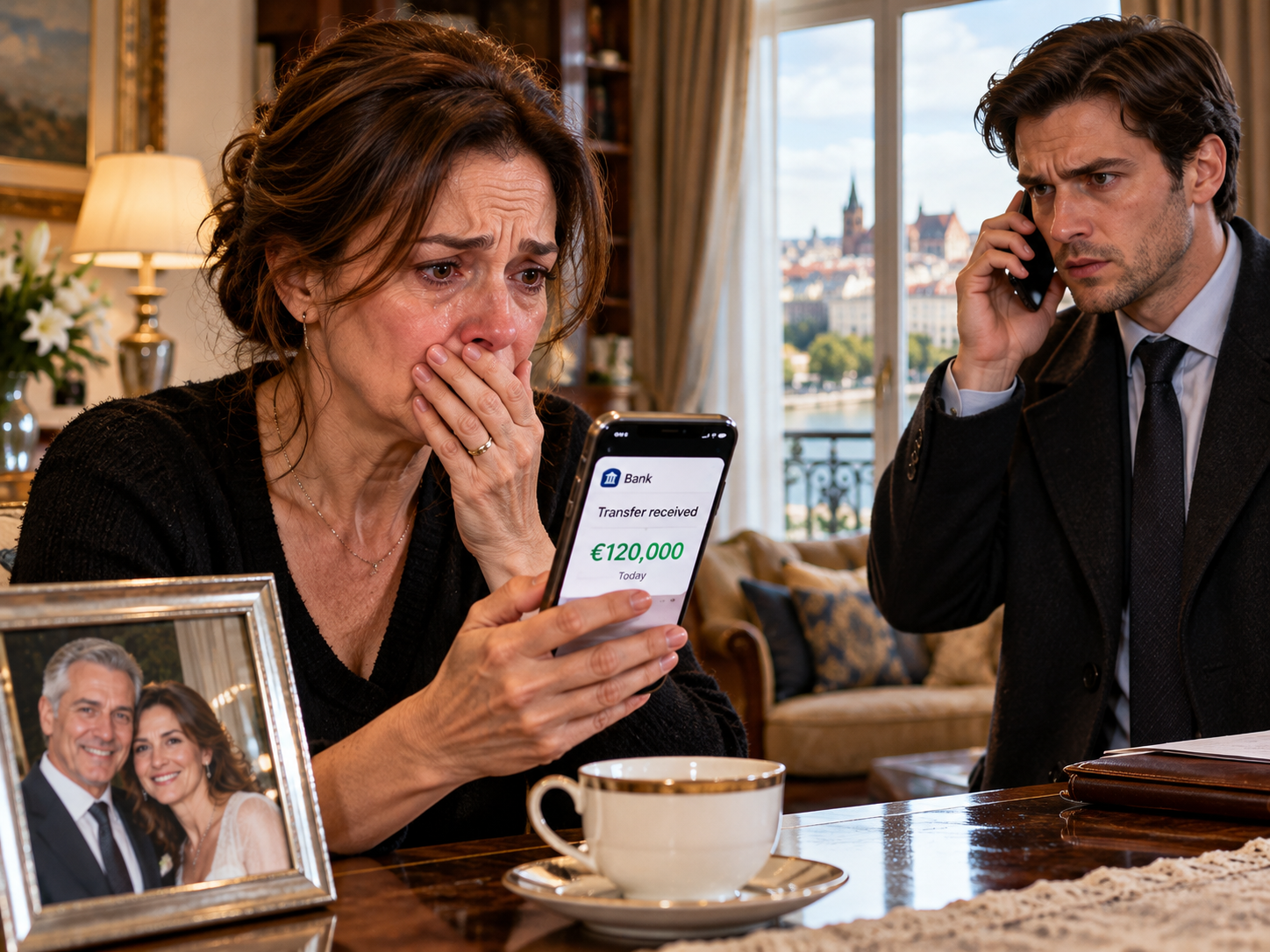
Mathieu's request arrived in the form of a formal letter from his attorney. It asked whether I would consider providing a statement confirming that I had not personally suffered a financial loss from the disputed acknowledgment and that I did not intend to pursue a separate civil claim against him. The letter did not demand that I withdraw the documents already submitted for review, but it suggested that a clear statement from me might help resolve the remaining questions more quickly.
I read it at the dining table, with Claire's earlier advice still fresh in my mind. The request was carefully worded, and I understood why Mathieu wanted it. The continuing review had created uncertainty around his professional future, and he feared that the unresolved document would damage his reputation. But the statement he wanted from me went beyond what I could honestly confirm. I could say that I had not knowingly accepted the obligation described in the disputed acknowledgment. I could not say that the matter had caused no harm, because it had cost time, legal fees, and months of uncertainty. Nor could I promise never to pursue a lawful claim if new evidence established a basis for one.
Claire agreed when I called her. She explained that I could respond with a factual statement limited to what I knew, but I should not sign a broad declaration simply to ease the pressure on Mathieu. The review had not established that he created the disputed signature, yet it had also not established that every step he took was proper. A statement from me could not replace the missing records or settle questions that belonged to the professionals examining the matter.
I asked Claire to draft a response that acknowledged the distinction. It would state that I had not knowingly signed or accepted the disputed undertaking, that the transfer had been authorized by Gérard, and that the bank had not established a basis for demanding repayment from me merely because the disputed acknowledgment existed. It would also make clear that I was not making an allegation about who created the signature and that any further conclusions should be based on the available evidence.
When Mathieu received the response, he called me himself. He sounded frustrated.
“Why can't you just say you don't blame me?” he asked.
“Because that isn't the same as saying the document is resolved.”
“I told you I didn't create the signature.”
“I heard what you told me. The review still has to establish what happened.”
He exhaled sharply. “You know what this is doing to my life?”
“Yes, Mathieu. I know it is difficult. It has also been difficult for me.”
“That money was supposed to protect you.”
“Then we should both want the records to show exactly what it was for.”
He did not answer. I could hear movement on his end, as though he were pacing in a room. When he spoke again, his voice had softened, but the frustration remained.
“My father wanted me to take over more of the company. Now every decision I made is being examined.”
“Your father's wishes do not remove the need for accurate records.”
He said I sounded like Claire. I told him that was not an insult. The conversation ended without agreement, but neither of us shouted. I was relieved that we had reached a point where disagreement did not automatically become a family emergency.
Over the next several weeks, the financial review continued. The professionals examined the emails Mathieu had supplied, compared the available copies of the acknowledgment, and requested clarification from the institution that had received the document. The evidence supported some parts of Mathieu's explanation, particularly his claim that he had been handling records he believed were already part of an arrangement. Other details remained uncertain. The review did not establish that he had forged my signature, and it did not establish that I had knowingly accepted the obligation. The distinction remained important.
At the same time, the company had to address questions about its internal procedures. Daniel, the company's finance director, explained that several approvals had been handled informally during Gérard's final months. Some transactions had supporting documentation, while others required additional records before their purpose could be confirmed. The company was not treating every incomplete file as evidence of misconduct. It was correcting the weaknesses in its systems so that no future employee would have to rely on a verbal assurance when a written record was required.
I was not involved in every operational decision, and I did not want to be. My inheritance included shares in the company, but the business still had its own governance arrangements. I asked for independent reporting and clear explanations of any issue that affected the value of my investment. I did not instruct the finance team to remove Mathieu from his position, nor did I demand that he be protected from every consequence. His role would be considered through the company's established procedures, with appropriate advice and evidence.
This was harder than I expected. Part of me wanted to use my new position to make sure no one could ever dismiss me again. I could imagine forcing Mathieu to resign, refusing to speak to Brigitte, or selling every property associated with Gérard simply to sever the last visible ties. Those choices might have given me a temporary sense of control, but they would not necessarily have been fair or wise. I had spent years suffering from decisions made according to emotion and family pressure. I would not replace them with decisions made out of resentment.
One afternoon, Brigitte called to tell me that Mathieu was struggling. She said he had lost sleep, become withdrawn, and stopped attending several family gatherings. She wanted me to withdraw my concerns so he could move on. I listened until she finished, then asked whether she understood that I had not accused him of forging the document.
“You keep saying that,” she replied. “But you refuse to clear his name.”
“I cannot clear him of something the review has not established.”
“You could tell them you trust him.”
“I can tell them what I know. I cannot tell them what I do not know.”
She accused me of being cold. I told her I was sorry Mathieu was struggling, but I would not sign a statement that went beyond the facts. Then I ended the call. My hands were trembling afterward, not because I regretted the decision, but because refusing Brigitte had once felt almost impossible. She had spent years making me believe that disagreeing with her meant rejecting the family. Now I could see that the family was not a single person whose approval I had to win. It was a group of adults, each responsible for their own choices.
Jamie contacted me a few days later. Her message was different from Brigitte's. She did not ask me to protect Mathieu or withdraw the review. She simply said she hoped the situation would eventually become clearer and that she was trying not to repeat the assumptions she had made during the Vail incident. I thanked her for the message. We exchanged a few ordinary updates about her work and the professional course she had completed. I was glad she had reached out without asking me to solve anything.
That weekend, I invited Jamie to lunch at a small restaurant near the river. She arrived on time and looked more confident than she had the previous year. She told me she had found a position that would allow her to gain practical experience while continuing to build her qualifications. The pay was modest, but she was proud of earning her own income and managing her expenses. I congratulated her and asked what she hoped to learn first. We spent most of the meal discussing her plans rather than the family dispute.
Eventually, she asked whether I believed Mathieu had done something wrong.
I took a moment before answering.
“I believe the document needs to be examined, and I believe he should answer questions about his role in submitting it. I do not know who created the signature or what he understood at the time. I will not pretend to know more than I do.”
Jamie nodded slowly. “That seems fair.”
I was relieved that she could hear the distinction. She had once accepted the family's assumptions about my money because they were easier than questioning the people she loved. Now she was learning that loyalty did not require her to make conclusions before the facts were available.
When I returned home, I found a message from Mathieu asking whether we could meet. He said he wanted to speak about our relationship rather than the legal review. I considered the request and agreed to a brief meeting in a public place. I told Claire about it beforehand and made clear that I would not discuss the estate's administration or sign any document during the conversation.
We met at a café where Gérard and I had sometimes stopped after appointments in the city. Mathieu looked uncomfortable as he took his seat. He ordered coffee but barely touched it. For several minutes, we spoke about ordinary things: the weather, the company, and the repairs being made at the villa. Then he set his cup down and looked at me.
“I know you think I have always taken you for granted,” he said.
I did not interrupt.
“When I was a child, I knew you were there whenever I needed something. I didn't understand what that meant. When I got older, I started thinking of your help as normal. I thought you were part of the family, so everything was shared. I didn't think about whether you had actually agreed.”
I felt a painful tenderness at the memory of the boy who had once left apple tart beside my plate. But I did not allow the memory to erase the years of dismissive behavior.
“You were a child when I began caring for you,” I said. “You were not responsible for the expectations adults placed on you then. But you became an adult, Mathieu. At some point, you had to learn that caring for someone does not give you the right to make decisions for them.”
He nodded, staring at the table.
“I know.”
“Do you?”
He looked up. “I'm trying to.”
It was not a perfect apology, but it was the first time he had spoken about our relationship without immediately defending himself. I told him I appreciated the honesty. I also told him that our relationship could not return to what it had been before the Vail trip and the financial review. I could be civil and even affectionate toward him, but I would not become responsible for his future or protect him from questions he needed to answer.
He asked whether I would ever trust him again.
“I don't know,” I replied. “Trust depends on what happens next, not on what either of us promises today.”
He accepted the answer without arguing.
We finished our coffee and parted outside the café. I watched him walk toward the station, his shoulders slightly hunched against the wind. I felt no victory. I felt sadness for the relationship we had lost and cautious hope that we might eventually build something more honest. I did not need to decide immediately what that relationship would become.
A week later, the review team issued an interim report. It confirmed that the disputed acknowledgment could not be relied upon as proof of my personal obligation in the absence of additional verification. The report also documented that Mathieu had submitted the copy, while noting that the available evidence did not establish who created the signature or whether he knew it was invalid. The team recommended that the relevant records be preserved and that any further investigation proceed through the appropriate channels.
Claire reviewed the report with me. She explained that it was not a finding of criminal guilt or innocence. It was a careful statement of what the evidence supported at that point. I understood the distinction, and I was relieved that the report did not attempt to force an answer where none was justified.
I sent a copy to the estate administrator and instructed my financial adviser to keep the disputed obligation separate from my personal financial planning. The €120,000 remained available as part of my security, and I continued to manage the estate according to the will. I did not use the money to finance a confrontation with Mathieu or to reward him for his apology. It was mine to manage responsibly, and I intended to do exactly that.
The experience taught me something about compassion that I had not understood during my marriage. Compassion was not the same as removing every consequence from another person's life. It could mean listening, recognizing uncertainty, and refusing to make an accusation without evidence. It could also mean saying no when someone asked me to provide certainty I did not possess. I could hope that Mathieu would learn from what had happened without agreeing to shield him from the review.
At home, I began organizing the apartment according to my own routines. I moved a table closer to the window, cleared the shelves of papers that no longer needed to remain in view, and invited a friend to stay for a weekend. We cooked together, walked along the river, and talked late into the evening. For once, I did not interrupt the conversation to answer a family call or check whether someone needed me to arrange something. The quiet felt less like an absence and more like space I had finally been allowed to occupy.
I still missed Gérard. Some evenings, I found myself wanting to tell him about the changes in the company or ask what he had meant by a note in one of his old notebooks. Then I remembered that I could no longer ask him. I would never know whether he regretted every silence or understood how much his decisions had affected me. I could only work with what he had left and choose how to live beyond it.
The review continued, but it no longer consumed every hour of my attention. The relevant records were preserved, the professionals were doing their work, and no unsupported claim had been treated as established fact. I had made my position clear. Mathieu would have to decide how to respond to the evidence, just as I had decided how to respond to the uncertainty.
When I turned off the lights that night, I felt something unfamiliar: I was concerned about Mathieu, but I was not responsible for rescuing him. I could wish him well without surrendering my judgment. I could remember the child I had cared for without pretending that the adult's choices no longer mattered. And I could leave the next step to him.
Click here to continue reading: PART 8: The Family Gathered to Discuss Gérard’s Legacy, but I Refused to Let Them Turn His Final Wishes Into Another Test of My Loyalty
My Husband Left Me €120,000, but His Son’s Call Made Me Fear What That Money Was Really Meant to Hide
Part 7 of 20

