
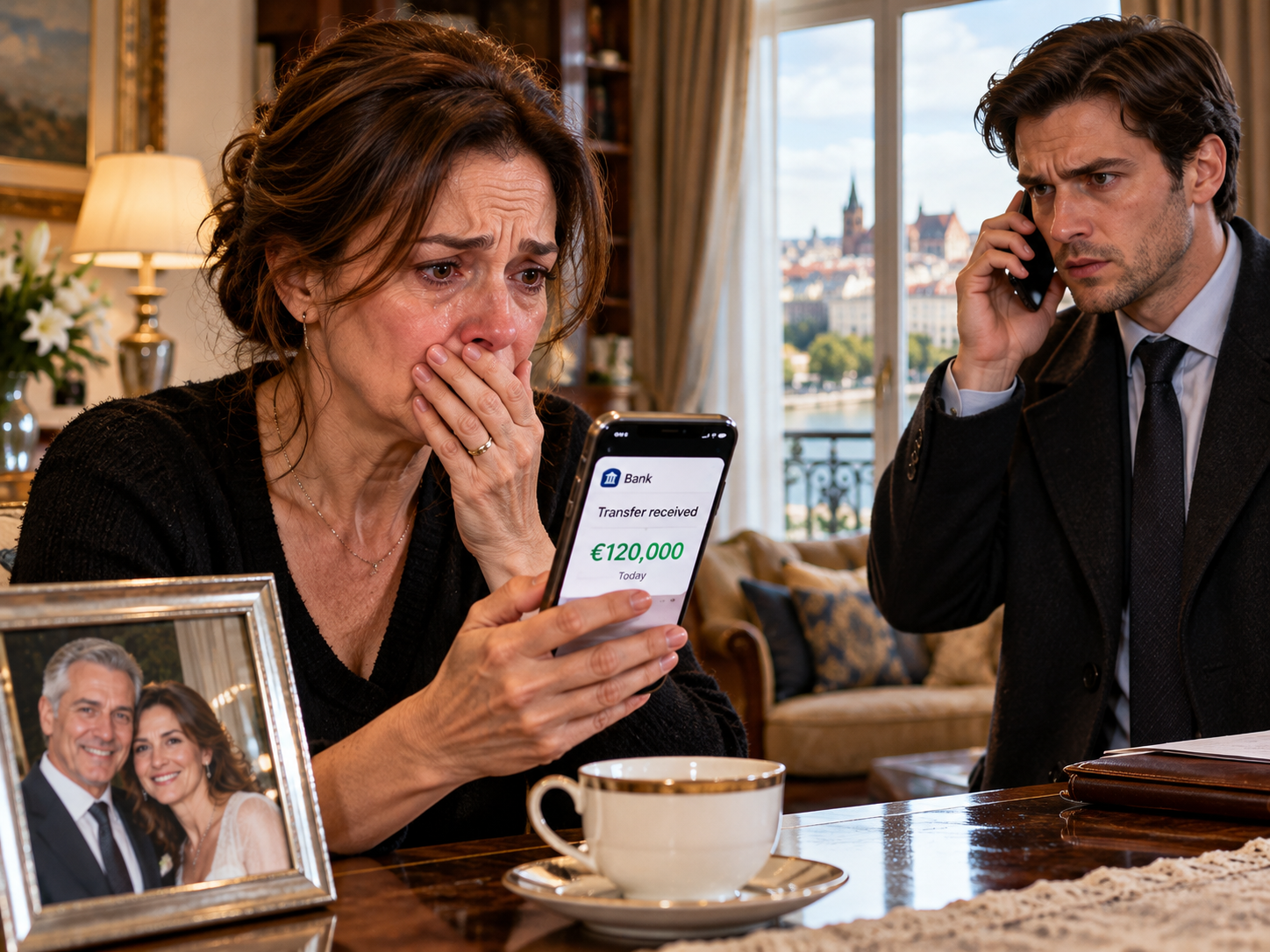
The notification arrived while I was staring at a cup of coffee I had forgotten to drink.
One short vibration against the wooden armrest, followed by a quiet chime. I glanced at my phone without much interest, expecting another message from the clinic or a relative offering condolences. Instead, a banking alert filled the screen.
Transfer received: €120,000.
I read it once, then again, moving my thumb across the glass as though the numbers might rearrange themselves into something I understood. They did not. The transfer was real. The amount was there, credited to my account that morning, with no explanation beyond a reference number I had never seen before.
Yesterday, Gérard Delmas had died in a hospital bed in Lyon. Twenty-five years of marriage had ended beneath the cold white lights of Saint-Vincent Clinic, where I had held his hand while his breathing became shallow and irregular. Now, less than twenty-four hours later, someone had deposited enough money into my account to change the rest of my life.
I should have felt relieved. I had never been wealthy in my own right before meeting Gérard, and although I had spent decades helping him manage his household and supporting the family, my personal savings had always been modest. But the money made my stomach tighten. Gérard had rarely given me anything without attaching an expectation to it, even when he called the gesture generous.
My phone began ringing before I could open the transaction details.
The name on the screen was Mathieu Delmas.
I answered, but I did not greet him. For a moment, all I could hear was the faint noise of traffic and what sounded like a door closing on his end.
“You received the transfer, then?” he asked.
His voice was controlled, almost businesslike. There was no tremor, no hesitation, nothing in his tone to suggest that he had lost his father the day before.
“Yes. I can see it.”
“Good. My father arranged it before he died.”
I looked down at the notification again. “Did he tell you why?”
Mathieu exhaled through his nose, impatient already. “He thought €120,000 was a fair amount for the years you spent with him.”
The sentence settled between us.
A fair amount.
For a second, I genuinely could not speak. Twenty-five years of marriage reduced to a figure that could be typed into a bank transfer. Twenty-five years of birthdays remembered, meals prepared, appointments arranged, sleepless nights beside a sick man, and family arguments I had quietly smoothed over so that Gérard could preserve his dignity.
I had not expected Mathieu to comfort me. We had never been especially close, and he had made it clear long ago that he regarded me as an addition to his father's life rather than a member of the family. Still, I had not imagined that he would speak about my marriage as if it were a temporary job that had now been paid in full.
“What exactly do you mean by fair?” I asked.
He ignored the question.
“There is something else. Father left a will. Maître Perrin is reading it this afternoon, and everyone has been asked to attend. You should come.”
“Everyone?”
“My aunt Brigitte. Her husband. Me. You know who.”
I glanced toward the photograph above the fireplace. Gérard stood beside me in it, one hand resting lightly on my shoulder. We had taken the picture at a restaurant near the Saône, shortly after our twentieth wedding anniversary. He had insisted on choosing the frame himself.
“Why are you telling me this as though I were a stranger?” I asked.
Silence followed, brief but unmistakable.
Then Mathieu said, “Because this is no longer about your feelings. It's about Father's estate. Be there at three.”
The call ended before I could respond.
I remained seated, my phone still pressed to my ear, listening to the empty line. Outside, a delivery truck rumbled past the building. Somewhere upstairs, a child was running along a corridor, his footsteps quick and carefree. Ordinary life continued as though nothing had happened.
I put the phone down.
Gérard had been fifty-eight when I first met him. I was twenty-three, living in a small village outside Limoges, working part-time at a local care home while helping my mother with household expenses. I had not planned to move to Lyon or marry a man nearly two decades older than me. My life had been modest, but I knew where I belonged.
Gérard arrived in the village because a business associate had recommended someone to help with his household. He was a widower with a young son, and his work required him to spend long days away from home. He wanted someone reliable to prepare meals, keep the house in order, and look after the boy when necessary.
That boy was Mathieu.
He was five years old, with dark hair that fell into his eyes and a habit of biting the skin beside his thumbnail whenever he became nervous. During our first meeting, he stood behind his father's leg and studied me suspiciously.
“Do you know how to make apple tart?” he asked.
I smiled. “I can learn your favorite recipe.”
He considered that answer, then disappeared into another room.
Gérard laughed. “He doesn't trust people easily.”
Neither, I would later discover, did Gérard. He simply hid it better.
At first, our relationship was practical. I cooked, cleaned, organized appointments, and made sure Mathieu ate something other than bread when his father returned late. I learned which shirts Gérard preferred for business meetings, how he liked his coffee, and which subjects could turn an otherwise pleasant evening into a quarrel.
He was not always unkind. Sometimes he came home carrying flowers, or stopped at a bakery because he remembered that I liked the small almond pastries sold there. He could be attentive when he wanted to be. Those moments mattered to me, especially because I had begun to care for Mathieu.
The child had been left without a mother when he was very young. He rarely spoke about her, but I sometimes found him standing beside her photograph in the hallway, tracing the frame with one finger.
One evening, after a nightmare, he came into my room and asked whether I would sit with him until he fell asleep.
I did.
The next morning, he left half a slice of apple tart beside my plate.
I kept that small gesture in my heart for years.
Gérard noticed how quickly Mathieu became attached to me. One evening, while I was clearing the dinner table, he stood near the kitchen door and said, “He needs a mother, you know.”
I remember drying my hands on a towel and looking at him.
“His mother cannot be replaced.”
“I didn't ask you to replace her,” he replied. “I'm asking you to stay.”
Perhaps I should have asked more questions. Perhaps I should have understood that a man could need someone in his household without knowing how to love her as an equal. But I was young, and I believed that affection, patience, and loyalty could gradually create a family.
We married two years later.
My mother cried at the ceremony. Gérard held my hand in front of the small group of guests and promised that I would never have to face life alone. Mathieu stood beside us in a little navy suit, solemn and uncomfortable, until I bent down and whispered that he could still ask me for apple tart whenever he wanted.
He laughed.
For a while, I thought I had found the life I wanted.
Then the expectations began to grow.
I stopped visiting my village as often because Gérard disliked spending weekends away from Lyon. I learned to host dinners for his business associates, remember the birthdays of relatives who rarely remembered mine, and remain pleasant when Brigitte made comments about my background.
At family gatherings, she had a particular way of examining me, as though she were looking for evidence that I did not belong.
“You're fortunate Gérard found you,” she once said while we arranged plates in the dining room. “Not everyone gets such a comfortable life.”
I asked what she meant.
She smiled. “Nothing unkind, darling. You came from very little. You should appreciate what you have.”
I returned to the kitchen without answering.
Gérard heard about the exchange that evening. When I told him how Brigitte had spoken to me, he sighed and said she had always been blunt.
“You know how she is. Don't make a problem out of every remark.”
So I learned to swallow my responses.
As the years passed, my responsibilities multiplied. I managed household accounts, coordinated repairs, accompanied Gérard to medical appointments, and helped Mathieu through the difficult transition from childhood to adulthood. When he failed an examination, I encouraged him. When he argued with his father, I listened. When he began bringing friends home, I made sure there was enough food.
I loved him as though he were my own son.
Yet the older he grew, the more he seemed to regard my presence as something permanent and therefore unremarkable.
He rarely thanked me. When Gérard praised me, Mathieu would sometimes remark that managing a household was hardly difficult. If I disagreed with his decisions, he accused me of interfering in a relationship that belonged to father and son.
I kept trying.
By the time I reached my forties, I had almost forgotten the woman who had once imagined building a life of her own. My clothes were chosen according to Gérard's preferences. My weekends were arranged around his family. Even my friendships had gradually faded because there was always something at home that required attention.
Two years before his death, Gérard bought me a black dress from an expensive boutique. It was elegant, fitted at the waist, with long sleeves and a neckline that suited me better than I expected.
I thanked him and hung it in the wardrobe.
When I tried it on later, he looked at me and laughed.
“Black makes you look severe,” he said. “Almost as if you don't belong in this family.”
I changed clothes.
I never wore the dress again.
Now, standing in front of the wardrobe the morning after his death, I pushed aside the pale blouses and simple dresses I had worn for years. My fingers found the black fabric at the back.
I took it down.
For several seconds, I held it against my body, looking at the woman reflected in the mirror. My face was swollen from crying. My eyes were tired, and the silver strands at my temples seemed more noticeable than they had the week before.
I put the dress on anyway.
I did not do it to punish Gérard. He was dead, and there would be no satisfaction in imagining his reaction. I wore it because I no longer wanted his preferences to determine what I was allowed to look like.
I returned to the living room and opened the banking application.
The €120,000 transfer had arrived from an account associated with a financial institution I recognized, but the reference number was unfamiliar. The transaction details did not identify a personal message or explain the purpose of the payment. I took screenshots and saved them.
Then I remembered something Gérard had said about six months earlier.
We had been sitting in his study while rain tapped against the windows. He was sorting through a stack of papers when he asked whether I still had the bank account I had opened before our marriage.
“Of course,” I replied. “Why?”
“No reason. Keep it active.”
He returned to his papers, and I assumed he had forgotten the question by the next day.
Now the memory felt different.
I checked the time. I had less than two hours before the meeting with Maître Perrin.
I slipped my phone into my purse, took the house keys from the bowl beside the entrance, and stepped outside.
The sunlight over Lyon was almost painfully bright. People walked past cafés with shopping bags and takeaway coffees, talking about work and weekend plans. I watched them through the taxi window as we crossed the city, feeling as though I had been placed behind glass.
At the entrance to the modern tower in Part-Dieu, I paused to look up. Maître Perrin's office occupied the upper floors, and the building's reflective windows caught the afternoon light.
Inside, the receptionist confirmed my appointment and led me toward a conference room.
Voices came through the closed door.
“Do you honestly think he'll leave her anything beyond the transfer?” Brigitte asked.
Her husband answered with a quiet laugh. “One hundred and twenty thousand is a comfortable settlement for someone in her position.”
“Keep your voice down,” Brigitte murmured. “She's here.”
I opened the door.
The conversation stopped.
Mathieu sat at the far end of the table, his phone lying beside his hand. Brigitte wore a dark blue jacket and a necklace I remembered Gérard giving her for her sixtieth birthday. Her husband sat beside her, studying me with the faint amusement of someone who believed he already knew how the story would end.
Brigitte's eyes moved over my dress.
“Well,” she said, leaning back in her chair. “You've made an effort.”
I ignored the comment and took the seat opposite Mathieu.
Maître Perrin entered a moment later carrying a thick folder. He was a careful, soft-spoken man who had handled Gérard's legal affairs for years. He greeted each of us, then closed the door.
“Thank you for coming. We will begin with the formal reading of Monsieur Delmas's final will and testament.”
Brigitte folded her hands on the table.
Mathieu finally looked up.
I placed my purse on the floor beside my chair and kept my hands in my lap.
Maître Perrin opened the folder.
“The document before me was executed several months ago and replaces the previous testament to the extent specified in its provisions.”
Brigitte's expression brightened at the word previous, as though she had just been reassured that everything would proceed as expected.
The lawyer began listing Gérard's property: the villa near Annecy, three apartments in Lyon, investments, company shares, and several financial accounts. With each item, Brigitte's husband leaned closer to her. Mathieu's eyes followed the lawyer's pages.
Then Maître Perrin reached the final section.
He stopped reading.
His thumb remained pressed against the edge of the paper.
I noticed the change immediately. His face had lost some of its color, and he looked toward me before returning his attention to the document.
Brigitte tapped one fingernail against the table.
“Is there a problem?”
Maître Perrin adjusted his glasses.
“No,” he said, although his voice had grown noticeably quieter. “There is simply a provision that requires particular care.”
He began to read.
“I, Gérard Delmas, leave the entirety of my assets…”
He paused again.
Then he raised his eyes and looked directly at me.
Mathieu stopped moving.
Brigitte's smile disappeared.
And for the first time since I had entered the room, I understood that the €120,000 might not have been the inheritance Gérard intended me to receive.
It might have been the reason he expected me not to ask questions.
Click here to continue reading: PART 2: The Will Gave Me Everything, but the Lawyer’s Fear Suggested My Husband Had Left Behind Something Much More Dangerous
My Husband Left Me €120,000, but His Son’s Call Made Me Fear What That Money Was Really Meant to Hide
Part 1 of 20

