
The invitation came from Brigitte's husband, who wrote that the family wanted to meet to discuss the future of Gérard's remaining affairs. The wording was polite, but the message made clear that they expected me to attend. They wanted to talk about the company, the properties, and the ongoing questions surrounding the disputed acknowledgment. They also wanted to discuss what Gérard had intended for Mathieu.
I read the invitation while sitting at my desk, then forwarded it to Claire. She advised me that I could attend if I wished, but there was no reason to discuss legal or financial matters without the appropriate advisers present. The estate was being administered according to the will, and the company had its own procedures. A family meeting could not replace either process. I decided to attend for the personal discussion, but I made it clear that I would not sign documents, agree to financial arrangements, or make decisions about the company during the gathering.
The meeting was arranged at Brigitte's house on a Saturday afternoon. I had not visited since Gérard's funeral, and I felt the old tension as I approached the front door. Brigitte opened it herself, dressed carefully and wearing the expression she used when she wanted to appear gracious while remaining in control. She greeted me with a brief kiss on each cheek and led me into the sitting room.
Mathieu was already there, seated beside his uncle. His posture was stiff, and he kept his hands clasped between his knees. Jamie sat near the window, looking uncomfortable but determined to remain. A folder lay on the coffee table, and I recognized the style of the papers as copies of documents related to the estate.
“Before we begin,” I said, “I want to be clear that I have brought no authority to make decisions about the estate or company today. If there are legal questions, they need to go through the lawyers.”
Brigitte's smile tightened.
“We are family, Rebecca. Surely we can talk without turning everything into a legal matter.”
“We can talk about our feelings and our relationships. We cannot settle financial questions by pretending the documents do not exist.”
Her husband gestured toward the sofa. “No one is asking you to sign anything. We simply want to understand what happens next.”
I sat down.
For the first few minutes, the conversation remained civil. Brigitte asked whether I intended to keep the villa near Annecy. I explained that I had not decided and was still reviewing the costs and responsibilities attached to the property. Her husband asked about the apartments in Lyon, and I said they were being assessed as part of my financial planning. I did not provide details about my accounts or investments. Those matters were private, and I had learned that sharing information did not guarantee understanding or goodwill.
Then Brigitte turned toward Mathieu.
“Your father always intended for you to be involved in the company,” she said. “That was never a secret.”
Mathieu nodded.
“He wanted me to take on more responsibility.”
“And now everything is complicated because of these documents,” she continued. “I think it would be reasonable for Rebecca to acknowledge that you were acting on your father's instructions.”
I looked at her carefully.
“What exactly are you asking me to acknowledge?”
“That you did not suffer a financial loss, that Mathieu was trying to help his father, and that the review should not prevent him from continuing his work.”
The request sounded similar to the statement his attorney had asked me to provide. I understood now why the family had arranged the meeting. They wanted me to offer reassurance that could be used to ease the pressure on Mathieu, even though the evidence remained incomplete.
“I can acknowledge that the review has not established that Mathieu created the disputed signature,” I said. “I can also acknowledge that he says he believed the document belonged to an existing arrangement. But I cannot certify that every action was proper or decide what role he should have in the company. Those questions require evidence and the company's own procedures.”
Brigitte shook her head.
“You always find a way to avoid helping him.”
I felt the old urge to explain every year I had spent caring for Mathieu, every meal I had prepared, every time I had defended him when Gérard was angry. I wanted to remind Brigitte that I had been there long before she began calling me selfish. But I recognized the trap. If I tried to prove my worth by listing my sacrifices, the conversation would become another trial in which I had to demonstrate that I deserved to be heard.
“I have helped Mathieu for much of his life,” I said. “I am not refusing to help him now. I am refusing to make a statement that goes beyond what I know.”
Her husband leaned forward.
“Surely there is a middle ground. You could say that you believe he acted in good faith.”
“I can say that he has told me he believed the document was part of an existing arrangement. Whether that belief was reasonable is something the evidence must help establish.”
The room fell silent.
Jamie looked down at her hands. Mathieu stared at the folder on the table. Brigitte appeared ready to argue again, but her husband touched her arm and asked whether they could discuss the company separately from the inheritance.
I agreed, provided the discussion remained general.
He explained that Mathieu had been struggling to understand his future at the company. Gérard had promised him greater responsibility, and the uncertainty surrounding the review had left him worried that his career would be permanently damaged. I listened and acknowledged that the situation was difficult. I also explained that the company needed to protect its records and reputation, regardless of who was involved. If Mathieu had acted properly, the documentation should help establish that. If procedures had been ignored, the company would need to address the weaknesses. Neither outcome required me to make a private promise.
Brigitte sighed.
“Your husband would never have wanted his son to suffer like this.”
The sentence hurt because it used Gérard's memory as a weapon. I could almost hear his voice telling me not to make a problem out of every remark. For years, I had responded by swallowing my objections and trying to keep the family calm. I could not continue doing that merely because Gérard was no longer alive to defend himself.
“I believe Gérard wanted Mathieu to succeed,” I said. “I also believe he wanted the financial records to be accurate. Those wishes are not in conflict. If we care about his legacy, we should want the facts established rather than ask someone to overlook questions because the family finds them uncomfortable.”
Brigitte looked away.
For a while, no one spoke. Then Jamie asked whether anyone wanted tea. The ordinary question broke the tension enough for the conversation to move toward less contentious subjects. We talked about her work, the repairs at the villa, and a relative's upcoming wedding. I stayed for another hour, but I did not agree to any financial arrangement or promise to withdraw concerns about the disputed document.
When I left, Mathieu walked me to the gate.
“I didn't ask them to put you under pressure,” he said.
“I know you may not have. But you need to understand that they cannot ask me to resolve a matter that belongs to the review.”
He nodded.
“I don't know how to make this right.”
“You can cooperate with the process. You can provide the records you have. And you can stop asking me to say more than I know.”
He looked at me for a long moment.
“I'll try.”
I told him that was all he could promise. Then I drove home.
The meeting left me tired, but it also clarified something important. The family had spent years treating loyalty as an obligation to protect its own members from discomfort. Gérard had done it by keeping financial concerns private. I had done it by smoothing over arguments and accepting responsibilities that were not mine. Mathieu had expected the family to interpret his actions generously because he was Gérard's son. Brigitte still believed that the right response to a difficult situation was to ask the person with the most resources to absorb the cost.
I could no longer participate in that pattern.
The following week, Claire received a request from the company for an independent review of its approval procedures. The request was not limited to the disputed acknowledgment. It covered the way financial documents had been authorized, stored, and submitted during Gérard's final year. The company wanted to identify whether its internal controls had been sufficient and what changes were necessary. Claire advised me that the review was appropriate and separate from the question of Mathieu's personal responsibility.
I supported the decision.
The review identified several areas where documentation requirements had not been consistently followed. Some transactions were supported by complete records, while others required additional explanations or could not be fully reconciled from the information initially available. The report recommended clearer authorization limits, consistent retention of original documents, and a requirement that any personal financial undertaking be signed and verified directly by the person accepting it. The recommendations were practical rather than punitive. They addressed weaknesses in the system without assuming that every gap represented deliberate misconduct.
The company adopted the recommendations. Daniel supervised the implementation, and the board received regular updates. Mathieu's responsibilities were reviewed according to the company's governance procedures, with his response and the available records considered. No one asked me to decide his future personally, and I did not attempt to do so. I wanted the company to remain stable and transparent, not to become an instrument of family punishment.
The review also clarified that my name had been included in financial correspondence without evidence that I had knowingly accepted the disputed obligation. That finding was important, but it did not establish who had prepared the signature or why the document had been submitted in the form it was. The remaining questions were documented, and any further action would depend on additional evidence. I accepted that limit. I had learned that a careful answer was more useful than a dramatic one that could not be supported.
Brigitte's attitude changed only slightly. She stopped asking me to withdraw the review, but she continued to suggest that the family would have been better off if I had handled everything privately. I told her that privacy was not a substitute for accuracy when financial records were involved. She did not agree, and I no longer tried to persuade her. Our conversations became shorter and more polite, which was an improvement over the accusations that had once filled them.
Jamie, meanwhile, continued building her own life. She accepted a position that offered practical experience and began saving toward a longer-term professional goal. She sometimes asked me for advice, and I answered when I could. I did not offer to pay her expenses or promise that the inheritance would provide a safety net for every family member. She did not ask. Our relationship became easier because neither of us treated affection as a hidden financial agreement.
Mathieu sent me an email after the company completed the first stage of its procedural review. He acknowledged that the financial records had not been handled as carefully as they should have been and said he understood why I had insisted on independent verification. He did not admit to creating the disputed signature, and I did not ask him to make an admission unsupported by the evidence. He said he intended to cooperate with any further questions and hoped that the family might eventually move beyond the conflict.
I replied that I appreciated his willingness to cooperate. I also said that moving forward would require honesty about what was known, what remained uncertain, and what each person was responsible for. I did not promise reconciliation. I did not threaten him. I simply left the next step open to his actions.
A few days later, I visited the cemetery where Gérard had been buried. I brought no flowers at first, only a small bundle of white roses from a shop near the entrance. I stood beside the grave and remembered the man I had married, not the man I wished he had been or the man Brigitte insisted he had always been. I remembered his generosity, his stubbornness, his moments of tenderness, and the ways he had allowed fear to become silence. I told him quietly that I had followed the documents as he had asked, even when the process hurt. Then I placed the roses beside the stone and walked away.
I did not expect an answer.
On the drive home, I realized that I had stopped waiting for Gérard's death to provide a final explanation for our marriage. His will had given me the estate. His letters and records had revealed some of the concerns he had kept hidden. The review had protected me from an unsupported financial obligation and improved the company's procedures. But none of those things could change the fact that I had spent years believing my needs mattered less than keeping the family comfortable.
That belief had ended.
I could honor Gérard's memory without defending every decision he made. I could hope Mathieu found a responsible way forward without taking responsibility for his career. I could speak to Brigitte politely without accepting her definition of loyalty. And I could continue building my own life without waiting for the family to agree that I deserved it.
The family meeting had not produced the reassurance Brigitte wanted. It had done something more useful. It had shown that I could remain in the room, hear the accusations, and answer without surrendering my judgment. I had not needed to raise my voice or threaten anyone. I had simply refused to say what I did not know.
That evening, I returned to the apartment and opened the windows. The air was cool, and the city lights had begun to appear across the river. I prepared dinner, set the table for one, and ate without checking my phone. No one needed an answer from me that night. No family decision waited on my willingness to absorb another person's uncertainty.
For the first time, I understood that Gérard's legacy was not something the family could define by demanding loyalty from me. It would be shaped by how the assets were managed, how the records were treated, and whether the people involved were willing to accept the limits of what they knew. I could contribute to that legacy through careful decisions, not through silence.
I finished dinner and washed my plate. Then I turned off the kitchen light and walked into the living room, where the photograph of Gérard still hung above the fireplace. I did not take it down. I did not need to. The photograph could remain as a record of the life we had shared, without becoming a command to repeat it.
The family could continue to disagree about what Gérard had intended. The financial review could continue where the evidence required it. Mathieu could decide what kind of man he wanted to become after the mistakes and uncertainties of the past year. Those choices belonged to them.
My choice was simpler.
I would not let love become a reason to abandon the truth again.
Click here to continue reading: PART 9: The Company’s Review Uncovered Another Unanswered Question, and I Had to Decide Whether Gérard’s Final Instructions Were Enough to Protect His Legacy
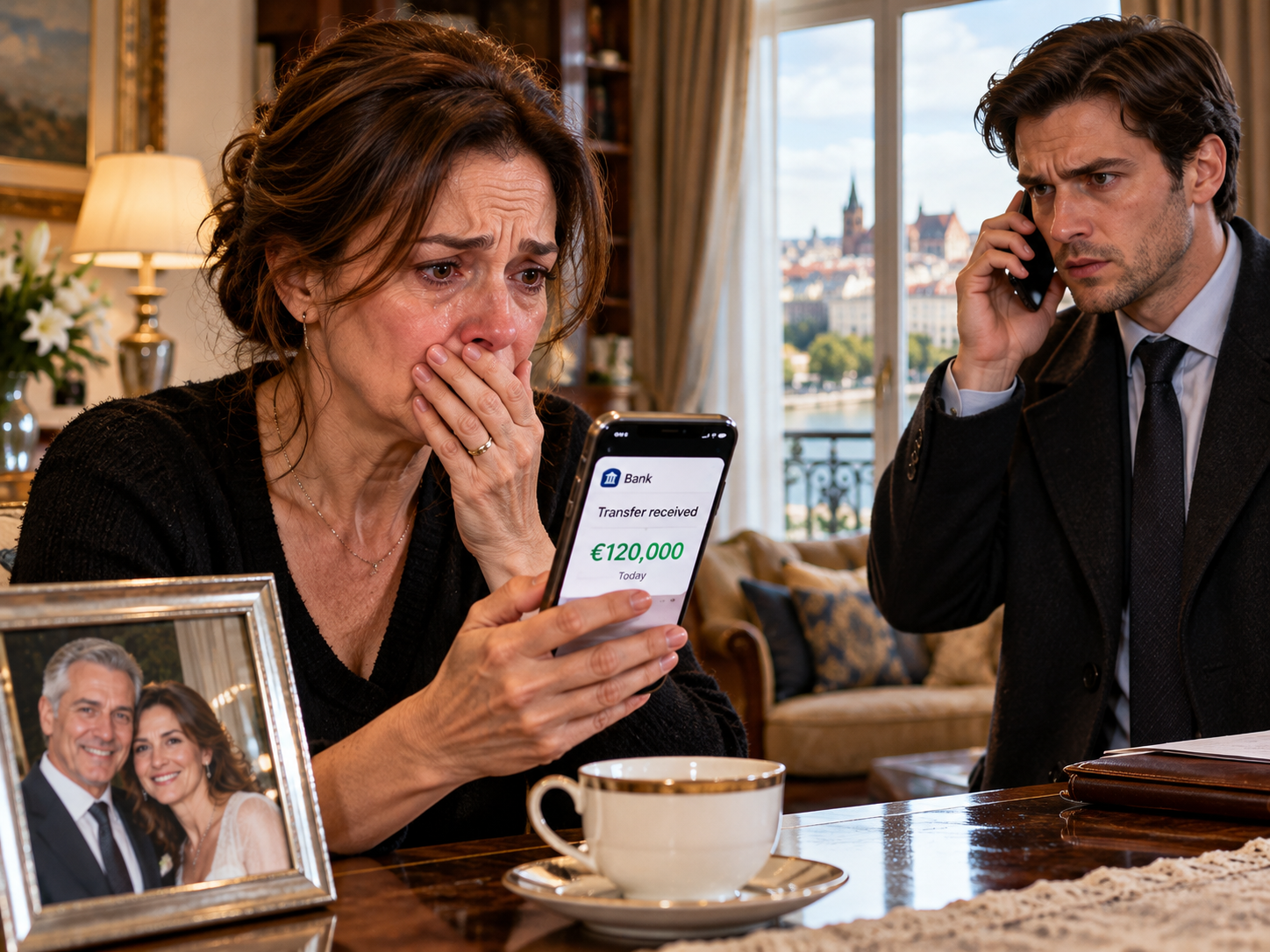
My Husband Left Me €120,000, but His Son’s Call Made Me Fear What That Money Was Really Meant to Hide
Part 8 of 20

