
The first sign that the financial review was entering a new phase came in an email from Daniel Price, the company's finance director. He asked whether I could attend a meeting with the independent reviewers the following week. Their preliminary report had identified several transactions that required further documentation, and they wanted to explain which matters had been resolved and which remained open. Daniel's message was measured, but I could tell he was concerned. The company had already tightened its approval procedures, preserved the relevant records, and cooperated with requests for information. He wanted to make sure that the next decisions were based on the evidence rather than on assumptions about Gérard or Mathieu.
I agreed to attend, provided Claire could join me. My inheritance included shares in the family company, which gave me a legitimate interest in its financial position, but I was not going to treat that interest as permission to interfere with every operational decision. I wanted an accurate account of what had happened, a clear explanation of the remaining uncertainties, and practical recommendations for protecting the business. I also wanted to ensure that nobody used my position as Gérard's widow to turn the review into a personal dispute. The company needed answers, not another family argument.
The meeting took place in a conference room at the company's Lyon office. Daniel was seated beside the independent review team's lead accountant, a woman named Madame Laurent. She had prepared a report with separate sections for confirmed findings, incomplete records, and recommendations. I appreciated the organization. For months, I had watched people blur those categories whenever the truth made them uncomfortable. Madame Laurent did the opposite. She explained what could be established, what required more information, and what the team was not prepared to conclude.
Several transactions had initially appeared unusual because the supporting invoices or approval records were incomplete. Some were later reconciled with supplier statements, delivery records, or correspondence that had not been included in the original files. Others remained insufficiently documented. Madame Laurent emphasized that a missing document did not automatically establish that a payment was improper, just as a confident explanation did not replace the need for evidence. The review team had recommended additional checks for the unresolved entries and stronger requirements for retaining original records. No conclusion had been reached that Mathieu had personally misappropriated company funds.
I listened carefully, asking questions about the dates, the approval process, and the limits of the team's conclusions. Daniel explained that the company had already introduced clearer authorization limits and required supporting documentation to be stored with each payment record. A second person would now review certain transactions before they were approved, and unusual entries would be flagged for examination rather than left for an annual review. The changes were sensible. They did not assume that everyone involved had acted dishonestly; they reduced the opportunity for confusion and made future decisions easier to verify.
At the end of the meeting, Madame Laurent turned to a transaction that had been recorded during Gérard's final year. The amount was not enormous compared with the company's overall finances, but the supporting paperwork had been incomplete. A note referred to an external financial arrangement, while another record indicated that the matter had been discussed with Gérard. The reviewers had not found sufficient documentation to establish the full purpose of the transaction. They wanted additional records from the relevant institution before deciding whether it could be reconciled.
I asked whether it was connected to the disputed acknowledgment bearing my name. Madame Laurent said there was a possible connection through the dates and reference numbers, but the evidence did not yet establish that the transaction and the acknowledgment represented the same arrangement. The team had requested the original records and would compare them when they arrived. Until then, it would be misleading to describe the transaction as either innocent or improper. I thanked her for being precise.
After the meeting, Daniel walked with me toward the elevators. He said he understood how difficult the review had become, especially because it involved Gérard's decisions and Mathieu's role in the company. He wanted me to know that the team would continue following the same procedures regardless of the family relationships involved. I told him that was exactly what I expected. I had no interest in seeing the company damaged by unsupported accusations, but I would not ask the reviewers to overlook incomplete records simply because the questions were uncomfortable.
That evening, Claire and I reviewed the meeting notes. She advised me not to draw conclusions from the new transaction until the underlying documents had been received. We also discussed the distinction between my role as a beneficiary of Gérard's estate and my interest as a shareholder. Those roles gave me rights and responsibilities, but they did not make me the investigator, accountant, or judge of every unresolved issue. I could request accurate information and insist on sound procedures. The professionals had to do the technical work.
I found the distinction reassuring. During my marriage, Gérard had managed most financial matters himself, and I had often been told that I did not need to understand the details. After his death, I had swung toward the opposite extreme, feeling that I had to examine everything personally in case another hidden problem appeared. The review was teaching me that responsibility did not require omniscience. It required asking the right questions, keeping the appropriate people accountable, and allowing qualified professionals to do their work.
A few days later, Mathieu sent me an email saying he had learned that another transaction was under review. He asked whether I had encouraged the reviewers to look more closely at his work. I replied that the review team had been appointed to examine the records and that I had not directed it to reach any particular conclusion. I reminded him that the company needed accurate documentation and that the same process applied to everyone. He did not answer, but I was relieved that I had kept the communication factual.
Brigitte was less restrained. She called that evening and said the review was damaging the family's reputation. She argued that Gérard had built the company through years of work and that the family should not allow a few incomplete files to overshadow his achievements. I agreed that his work deserved to be recognized, but I told her that preserving the company's reputation required correcting weaknesses rather than pretending they did not exist. A business could have a proud history and still need better controls. The two facts were not mutually exclusive.
She accused me of caring more about procedures than family loyalty. I told her that loyalty could not mean ignoring the evidence. Then I ended the call. My hands were shaking, but I did not regret what I had said. The old version of me would have spent the evening replaying the conversation and wondering how to repair Brigitte's opinion of me. Instead, I made dinner, read for an hour, and went to bed without sending another message.
The following week, Madame Laurent contacted Daniel to confirm that the additional documents had arrived. The review team needed time to compare them with the existing records, so no immediate conclusion was available. Daniel informed the board that the review remained active and that the company's new controls would stay in place. He did not speculate about the outcome or suggest that the arrival of new records proved wrongdoing. I appreciated his restraint. It was the kind of professional discipline I wanted associated with the company.
Meanwhile, I continued making decisions about the properties in the estate. The independent adviser had completed the assessments, and I decided to retain the Lyon apartment as my home while postponing a decision about the villa near Annecy. The remaining apartments would be managed according to their financial performance and maintenance needs. I did not need to keep every property because it had belonged to Gérard, nor did I need to sell everything to distance myself from the marriage. I could make practical choices based on my own circumstances.
One Saturday, I returned to the villa to review the maintenance plan. The caretaker showed me estimates for roof repairs, garden work, and a heating system that would need attention before winter. I asked for a second estimate before authorizing the larger expenses. Gérard would have called that excessive caution, but I knew the value of comparing options. I was no longer willing to make decisions simply because someone confident told me they were necessary. I wanted to understand what I was paying for and why.
In the study, I paused beside the empty drawer where the documents had been found. The room no longer felt like a place where secrets were waiting for me. The records had been inventoried, copied, and stored. If further evidence emerged, it would be handled through the established process. I could leave the room without searching every corner for another hidden envelope. That was a small freedom, but it mattered.
When I returned to Lyon, Jamie called to tell me she had completed her first month at work. She sounded proud and a little tired. She had been learning to manage deadlines, communicate with colleagues, and make decisions without asking her family to intervene. I congratulated her and asked what had surprised her most. She said that earning her own money had changed the way she thought about expenses. She was beginning to understand how much planning went into maintaining financial stability.
I told her that learning those things early would help her throughout her life. I did not lecture her about the Vail trip or remind her of the messages she had sent me. She already understood that her earlier expectations had been unreasonable. Our conversations had become more natural because I was no longer trying to force her to acknowledge every past mistake before allowing us to enjoy the present.
That evening, I received a message from Maître Perrin. He confirmed that the estate's administration was proceeding according to the will and that the new company records would be kept separate from the completed inheritance calculations unless they established a legitimate connection. He also reminded me that any additional legal action would depend on the evidence. I thanked him for the update and filed the message with the estate correspondence.
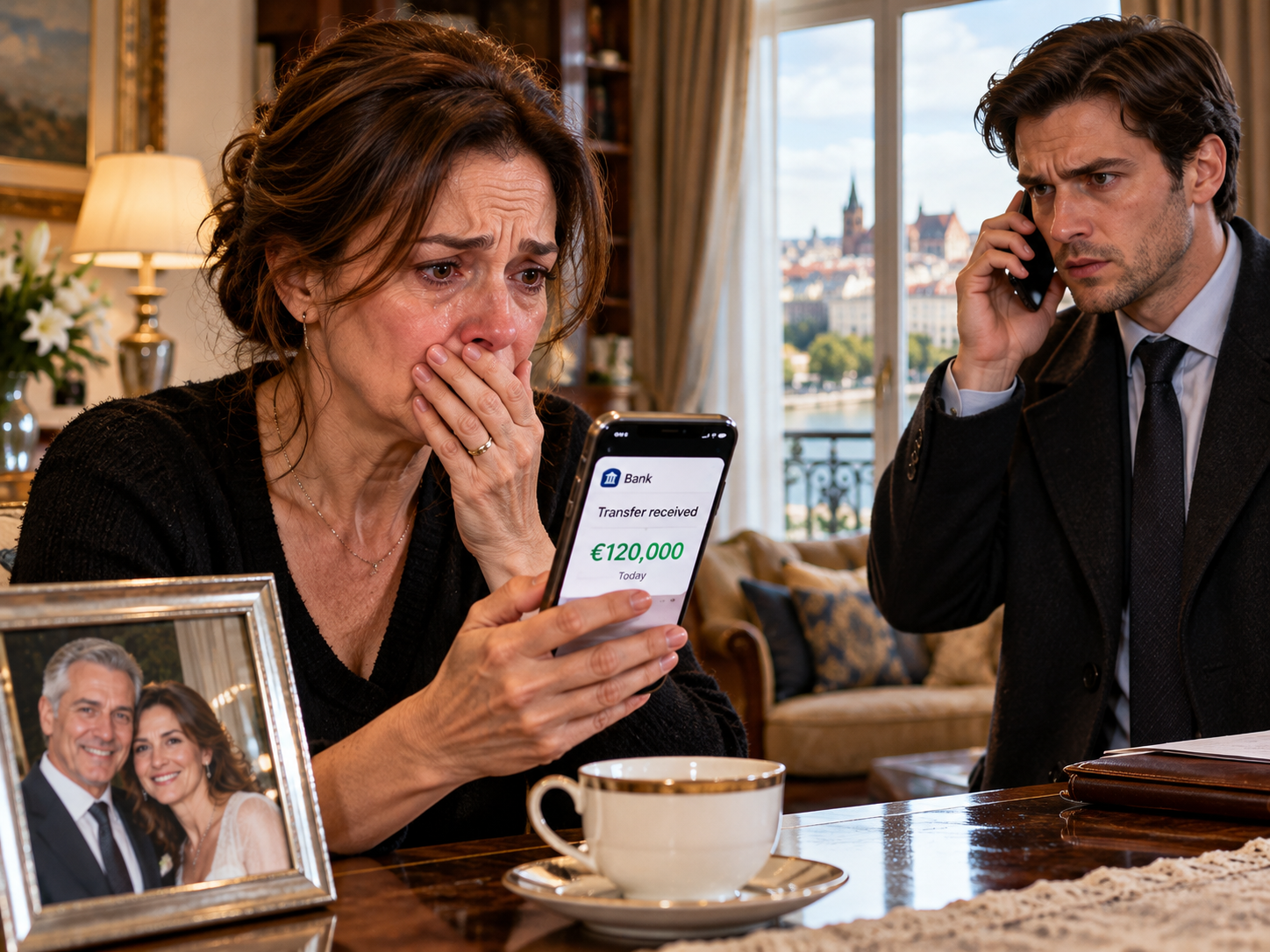
I sat by the window afterward, watching the lights appear across the street. I thought about the woman who had first seen the €120,000 notification and believed she was being dismissed with a final payment. The money had become a doorway into questions about the will, the company, the disputed acknowledgment, and the things Gérard had concealed during his last year. I had wanted a single explanation that would make every piece fit. Instead, I was learning to accept that the truth might emerge in stages, and that some uncertainties might remain.
The next morning, Daniel sent me a brief note confirming that the company's updated procedures were functioning as intended. Staff were attaching supporting documents consistently, and the approval process was producing a clearer record of who had authorized each transaction. The unresolved historical questions remained under review, but new business was continuing normally. I read the message, closed my laptop, and began planning my day.
The company did not need me to spend every hour worrying about its past. It needed me to make sensible decisions about its future. Gérard's legacy would not be protected by pretending his records were flawless. It would be protected by making sure the business could withstand scrutiny, correct its weaknesses, and continue serving its clients responsibly.
For the first time, I felt that I was managing the inheritance rather than being managed by it. The questions had not disappeared, but they no longer dictated every decision I made. I could let the review proceed while continuing to live, work, and build relationships beyond the family dispute. I could protect what mattered without turning my entire life into an investigation.
I turned off the light in the study and left the documents where they belonged.
Click here to continue reading: PART 10: The New Evidence Explained One Part of Gérard’s Plan, but It Also Revealed Why He Had Been Afraid to Leave Me Alone With the Truth
My Husband Left Me €120,000, but His Son’s Call Made Me Fear What That Money Was Really Meant to Hide
Part 9 of 20

