
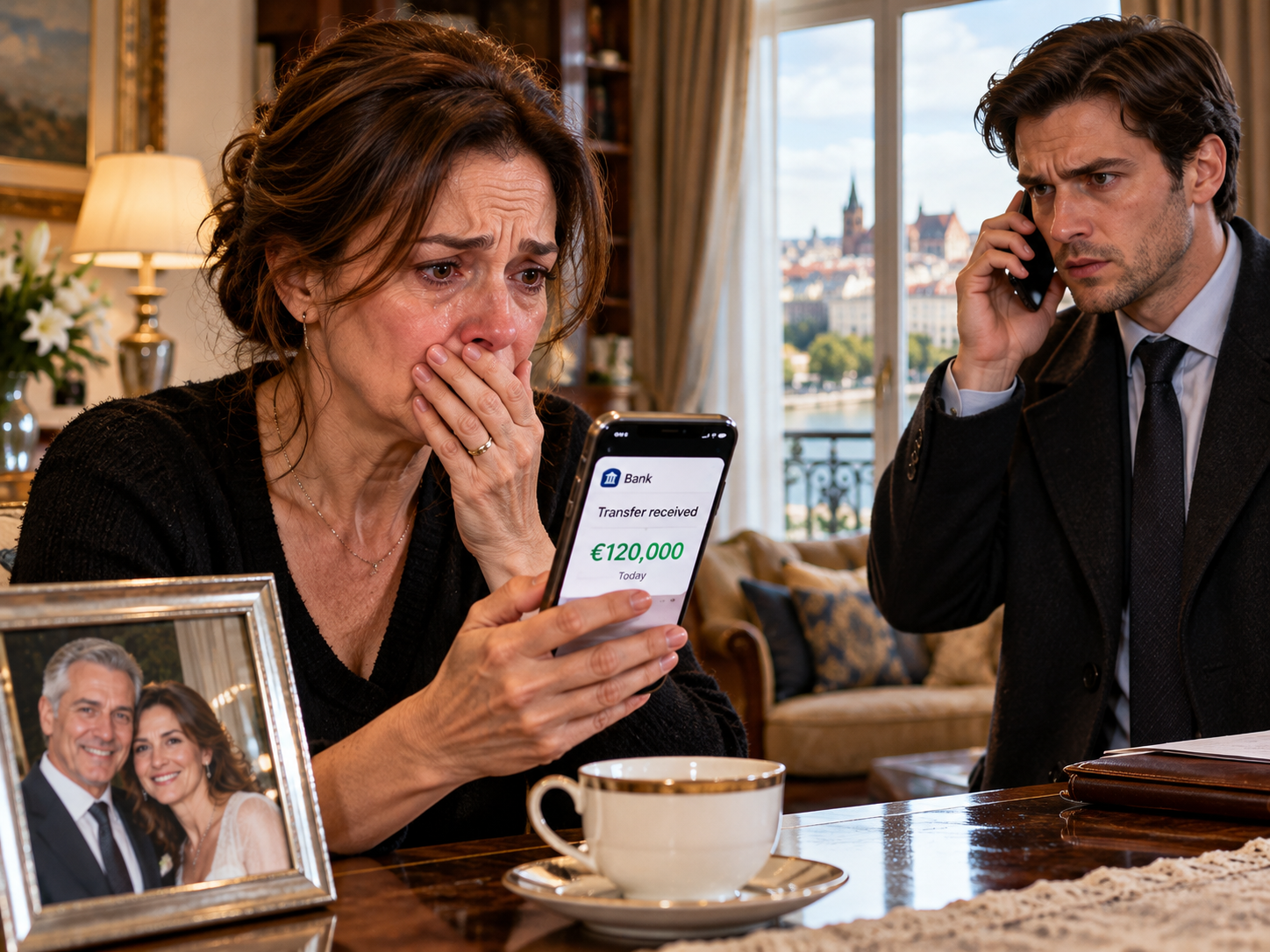
The first month after the estate was settled passed more quietly than I had expected. I woke each morning in the apartment Gérard and I had shared, made coffee for one, and began the practical work of arranging a life that no longer revolved around his appointments, preferences, or family obligations. The inheritance had given me financial security, but it had not given me a ready-made future. I had to decide what to do with the villa near Annecy, the three apartments in Lyon, and the investments that had once been managed almost entirely by Gérard. Every decision required attention, and for the first time in decades, I could make those decisions without asking whether someone else would approve.
I began by meeting an independent financial adviser recommended by Claire Moreau. I wanted someone who had no connection to Gérard's business associates and no personal loyalty to the Delmas family. We reviewed the estate's assets, expected expenses, taxes, and the ongoing responsibilities attached to each property. The adviser did not promise extraordinary returns or suggest that I should immediately sell everything. Instead, she explained the choices in plain language and gave me time to consider them. I kept the apartment in Lyon as my home, postponed any decision about the villa, and arranged for independent assessments of the other properties. It felt strange to be responsible for so much money, but it also felt right to understand what I owned rather than allowing another person to manage it for me.
Claire remained involved in the matters that required legal attention. The disputed financial acknowledgment had not been accepted as proof of a personal obligation, and the bank's review had not established that I knowingly agreed to guarantee the larger amount mentioned in the document. That conclusion protected me from an unsupported demand, but it did not answer every question about how the copy had been prepared or why Mathieu had submitted it. The relevant records had been preserved, and the appropriate professionals would handle any further examination. Claire reminded me that an unresolved question was not the same as a proven accusation. I agreed. I had no intention of turning uncertainty into a story that suited my anger.
Mathieu did not contact me for nearly three weeks. I heard through a relative that he had been spending long hours at the family company, trying to understand which responsibilities he could continue to hold after his father's death. His position had become more complicated because the company needed to review its financial procedures independently of the estate. I had no authority to decide his personal future simply because I was now the principal beneficiary of Gérard's estate. The company had its own governance arrangements, and any question about Mathieu's role had to be addressed according to those arrangements. I was careful not to confuse inheritance with ownership of every decision in the business.
Then, on a rainy Thursday afternoon, an envelope arrived at my apartment. The return address belonged to an office I recognized from Gérard's correspondence, but the handwriting on the front was not his. Inside was a short letter from a former administrative assistant who had worked with him during his final year. She explained that she had recently been asked to organize a collection of archived documents and had found a personal letter among papers that appeared to have been separated from the main estate file. She had not opened it. Because my name was written on the envelope, she had forwarded it through the office's usual procedure.
I called Claire before opening it. She asked me to photograph the envelope, preserve the postmark, and keep the original intact. Since the letter had come from an identifiable source and had been forwarded openly, there was no reason to assume it was improper, but we needed to document where it had come from. I followed her instructions, then sat at the dining table with the envelope in front of me. For several minutes, I could not bring myself to break the seal. I had already learned that Gérard's final arrangements contained more questions than answers. I did not want another hidden message to pull me back into the months when every memory seemed to conceal something.
When I finally opened it, I found two pages of handwritten notes and a folded copy of an appointment confirmation. The notes were dated about five months before Gérard's death. They were not a letter addressed to me in the usual sense, but a personal record in which he had listed questions he wanted to raise with his advisers. The first page referred to the transfer and the need to keep my personal account separate from the investment arrangement. The second mentioned a conversation with Mathieu about the company's financial records. Beside that entry, Gérard had written that he needed to distinguish between his son's explanations and the documents themselves.
I read the pages slowly, careful not to treat every sentence as proof of something larger. Gérard had written that he wanted to avoid accusing Mathieu without evidence, but he also wanted to ensure that no financial responsibility was attributed to me without my knowledge. He had noted that the disputed acknowledgment needed to be compared with the original records and that the investment institution should provide a complete transaction history. There was no direct allegation that Mathieu had forged my signature, and nothing in the notes established who had prepared the document. What they did show was that Gérard had begun asking questions about the same inconsistencies that later complicated the estate.
The appointment confirmation was for a meeting with a financial adviser several months before Gérard died. I remembered the day vaguely. He had told me he was going into Lyon for a routine appointment and had returned home unusually tired. When I asked whether everything was all right, he said that he was sorting out paperwork and did not want to discuss it until he had a clearer picture. I had accepted the answer because his health was declining and I did not want to add to his worries. Now I wondered whether his silence had been an attempt to protect me or another way of keeping control over information that affected both of us.
Claire reviewed the material the next morning. She confirmed that the notes were relevant to the chronology, but they did not establish the authenticity of the disputed acknowledgment or prove who was responsible for any irregularity. She sent a formal copy to the professionals already reviewing the matter and advised me to keep the original secure. I asked whether this new evidence meant that the earlier review had been incomplete. She explained that the review had answered the questions it had been commissioned to answer based on the records available at the time. New documents could justify further inquiry, but they did not automatically invalidate the earlier findings.
I was relieved by her answer, though I found it difficult to accept that the matter might remain unresolved for so long. A part of me wanted one person to stand up and explain everything: why the acknowledgment existed, how my name had come to appear on it, and why Gérard had waited until his final months to begin documenting his concerns. But wanting an answer did not make the evidence stronger. I had spent too many years allowing other people's confidence to substitute for facts. I would not make that mistake again merely because uncertainty was painful.
That weekend, I drove to the villa near Annecy. The property had been valued as part of the estate, but I had not visited since the funeral arrangements. The journey took me through stretches of countryside where the rain had left the fields dark and glossy. When I arrived, the caretaker opened the gate and showed me the maintenance records. The villa was in good condition, although several repairs would be needed before winter. I walked through the rooms slowly, noticing the photographs Gérard had placed on shelves and the books he had left beside his favorite chair. I had spent holidays there with him and Mathieu, but I had also spent long afternoons alone while the two of them discussed business. The house held memories I did not want to discard, yet I no longer felt obliged to preserve every object exactly where Gérard had placed it.
In the study, I found a small drawer that had been left locked. The caretaker had not touched it because it appeared to contain personal papers. I did not try to force it open. Instead, I photographed the lock and informed Claire that another container of records had been discovered among the estate's property. She advised me to have it opened through the proper inventory process, with the contents documented. I agreed. It was a minor inconvenience, but the disputed acknowledgment had taught me the value of preserving a clear record rather than relying on memory about what had been found or when.
While I waited for the appointment to arrange the inventory, I spent the afternoon walking near the lake. The sky cleared, and the water reflected the pale mountains beyond the town. I remembered a holiday when Mathieu was about twelve and had insisted he could row a small boat without help. Gérard had laughed as the boy struggled to keep it straight, then eventually climbed in to steady it. I had watched from the shore, holding their coats and worrying that one of them would fall into the water. The memory made me smile despite myself. There had been affection in our family, even if affection had not prevented later hurt. I did not need to erase the good years to acknowledge the failures that followed.
When I returned to Lyon, a message from Mathieu was waiting. He had heard that additional notes had been found and wanted to know whether I planned to use them against him. I read the message twice, then called him rather than beginning another exchange by text. He answered with obvious reluctance. I told him the notes had been forwarded to the professionals reviewing the financial records and that I was not making accusations. He said his father had been worried about many things during his final months and that I should not interpret every sentence as evidence of wrongdoing.
“I am not interpreting it as proof,” I replied. “That is why the documents are being reviewed.”
He sighed. “You could have told me before involving everyone.”
“I did not know what the notes meant until they were read. And this is not something I can resolve by privately asking you to explain them.”
For a moment, neither of us spoke. Then Mathieu said that he was tired of being treated as though he had done something terrible simply because his father had left the estate to me. I told him I understood that the situation was difficult for him, but the inheritance and the financial review were separate matters. He could challenge the will through the proper process if he had legal grounds. He could respond to questions about the records through the professionals handling them. What I would not do was abandon the review to make the family feel more comfortable.
He ended the call without another argument. I felt sad afterward, not because I thought I had said anything wrong, but because I could see how deeply the situation had divided the family. I had once imagined that Mathieu and I would remain close even after Gérard was gone. I had believed that the care I had given him as a child would count for something in adulthood. The reality was more complicated. He might remember those years differently from me, and he might never accept my place in the estate without resentment. I could not force him to understand what I had given or what I had endured.
A few days later, Claire informed me that the newly discovered notes had been added to the review file. They supported the chronology of Gérard's concerns but did not settle the question of the disputed signature. The bank would preserve the information, and the appropriate authorities could consider it if further evidence justified additional action. No conclusion had been reached about Mathieu's responsibility. I accepted that. It was not the dramatic answer I might once have wanted, but it was the honest one.
I returned to the apartment and placed the new correspondence in a locked cabinet. The €120,000 remained untouched except for the interest it earned in the account, and I continued managing the estate through independent advisers. The letter had not changed the terms of the will or created a new obligation. It had changed something inside me, however. I could no longer pretend that Gérard had understood everything and simply failed to tell me. He had been struggling with uncertainty himself, and his attempts to protect the family had sometimes made the truth harder to discover.
That evening, I took the black dress from the wardrobe and hung it where I could see it. I had kept it hidden for years because Gérard had once made me feel that it did not suit the woman he wanted beside him. Now it reminded me of the day I had decided to attend the will reading without dressing according to his preferences. I did not wear it that night. I simply left it in the open, where I would no longer have to reach behind other clothes to find it.
I began to understand that the inheritance had not ended the story. It had given me the means to stand independently, but it had also exposed how much of my life had been shaped by information I was never permitted to question. I could not change the years I had spent believing that silence was kindness. I could decide that the rest of my life would not be governed by the same habit.
When I went to bed, I thought about Gérard's final note and the instructions he had left behind. He had wanted me to trust the documents rather than the explanations people might offer. I was doing that now, even when the documents led to more questions instead of immediate answers. I would not turn suspicion into certainty, but neither would I bury evidence because it threatened the family's image. Whatever the next record revealed, I would meet it with my own judgment intact.
Click here to continue reading: PART 6: The Locked Drawer at the Villa Contained No Fortune, Only a Record That Forced Me to Reconsider What My Husband Had Been Afraid to Tell Me
My Husband Left Me €120,000, but His Son’s Call Made Me Fear What That Money Was Really Meant to Hide
Part 5 of 20

