Years passed without another crisis.
That was perhaps the greatest gift of all.
Life became ordinary.
There were birthdays.
Anniversaries.
Work deadlines.
Family dinners.
Minor disagreements.
Long weekends.
Rainy mornings.
Christmas dinners.
Bills.
Appointments.
Laughter.
The kinds of things I once believed could disappear forever.
They didn't.
Life continued.
Sam and his wife eventually had a child.
The first time I held my grandchild, I cried.
David stood nearby.
He cried too.
Sam noticed.
“Dad.”
David wiped his eyes.
“I'm fine.”
“You're crying.”
“I know.”
I laughed.
He smiled.
“I'm allowed.”
“Yes.”
The baby slept peacefully.
Sam looked at us.
“Can you believe this?”
“No,” I said.
David shook his head.
“Not at all.”
We stood there together.
Three generations.
A family that had survived becoming something different.
Later, David and I talked outside.
“He's going to be a good father,” I said.
“Yes.”
“You'll be a good grandfather.”
He smiled.
“I hope so.”
“You will.”
He looked at me.
“You know, I used to think being a father meant providing everything.”
“And now?”
“Being present.”
I nodded.
“That matters.”
He looked toward the house.
“I missed too much.”
“You can't change that.”
“I know.”
“But you can be there now.”
“I am.”
He smiled.
“I intend to stay.”
That was all I wanted.
Not an apology.
Not repayment.
Presence.
Years earlier, David had believed responsibility was something that could be transferred.
He had wanted the assets.
He had rejected the child.
Now he understood that responsibility was not an object.
It was a choice repeated every day.
He made that choice.
So did I.
One afternoon, Sam asked me to tell his child a story.
“What kind?”
“Any story.”
I smiled.
I could have told the child about the divorce.
About the house.
About the courtroom.
Instead, I told a story about a young woman who learned to trust herself.
I left out the names.
I left out the legal documents.
I left out the debts.
I left out the anger.
The lesson was enough.
When the child fell asleep, Sam sat beside me.
“That was good.”
“Thank you.”
“You never tell the whole story.”
“There are some parts children don't need.”
He nodded.
“Maybe someday.”
“Maybe.”
He looked thoughtful.
“Do you think I'll tell my child about the divorce?”
“You will decide.”
“What would you say?”
“Tell the truth without giving the child your pain.”
He nodded.
“That makes sense.”
We sat quietly.
Then he smiled.
“I think you did that for me.”
“I tried.”
“You did.”
That night, I went home alone.
I opened the closet.
The settlement box was still there.
I took it down.
Inside were the old documents.
The decree.
The financial schedules.
The transfer papers.
The pages that had once represented my entire future.
I read the first page.
Then I closed the folder.
I did not feel anger.
I did not feel triumph.
I felt distance.
The kind that comes when something once enormous becomes simply part of your history.
I put the documents back.
Then I noticed the handwritten letter David had given me years earlier.
I read it again.
He had written that he finally understood.
I had believed him.
Not because words were enough.
Because his life had eventually matched them.
He had become a better father.
A more responsible man.
A quieter person.
He no longer needed to prove himself through possessions.
That did not erase what happened.
It made what happened complete.
I placed the letter beside the settlement.
Then I closed the box.
The next morning, David called.
“Do you remember the kitchen?”
“Yes.”
“I was thinking about it.”
“Why?”
“I don't know.”
He laughed.
“Maybe because I'm getting old.”
“You're not that old.”
“Thank you.”
There was a pause.
“I wanted to tell you something.”
“All right.”
“If I could speak to myself that night, I would tell him to sit down.”
I laughed.
“What?”
“I was standing like I was negotiating a business deal.”
“You were.”
“I would tell him to stop.”
“Would he listen?”
“No.”
We both laughed.
Then he said, “I would tell him the house wouldn't save him.”
I listened.
“The cars wouldn't.”
“The money wouldn't.”
“The image wouldn't.”
“And Sam?”
David's voice changed.
“Sam was never something to lose.”
I closed my eyes.
That sentence completed something inside me.
Not because I needed to hear it.
Because Sam deserved to hear it.
And David finally understood it.
We talked a little longer.
Then we said goodbye.
I went outside.
The morning was bright.
I made coffee.
I opened the windows.
A breeze moved through the room.
Nothing about the morning looked extraordinary.
That was what made it beautiful.
I had once thought victory would feel dramatic.
It didn't.
Victory was waking up without fear.
It was having enough money because I understood what I needed.
It was working because I wanted to.
It was watching Sam become independent.
It was seeing David become responsible.
It was being able to remember without reliving.
It was knowing that the worst decision someone had made about me had not become the final definition of my life.
The old house was gone.
The vehicles were gone.
The wine cellar was gone.
The accounts had been divided.
The legal papers had been signed.
The marriage had ended.
But my life had continued.
More importantly, it had become mine again.
I remembered Jessica's words from years earlier.
“Let's see exactly what he thinks he's taking.”
At the time, I thought the sentence was about financial strategy.
It wasn't.
Not entirely.
David thought he was taking everything.
He thought the visible things were the valuable things.
He never understood that I had already decided what mattered.
Sam.
My freedom.
My dignity.
My future.
My ability to choose.
Those were the things I protected.
Everything else was negotiable.
That was why the courtroom had not been the end.
The settlement had not been the end.
The house sale had not been the end.
The apologies had not been the end.
The wedding had not been the end.
Even becoming grandparents was not the end.
Life had simply kept moving.
And I had moved with it.
One evening, Sam visited with his family.
The house filled with noise.
A child laughed.
Someone dropped a spoon.
David argued jokingly about dessert.
Sam's wife told him to stop.
I stood in the kitchen watching all of them.
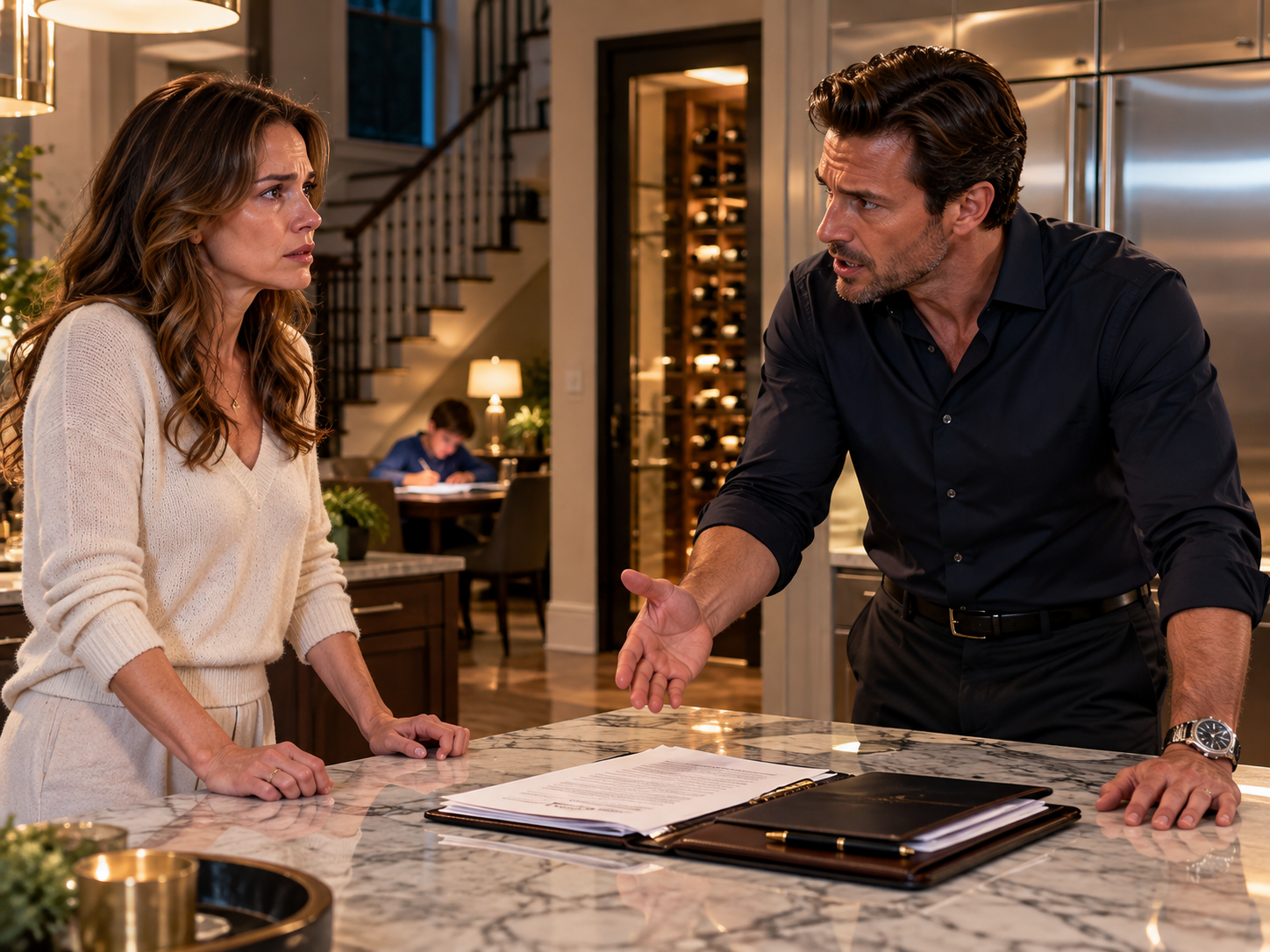
For a moment, I remembered the other kitchen.
The cold silence.
David's demand.
My fear.
The words that changed everything.
Then I looked at the people around me.
I realized the distance between those two kitchens was not measured in miles.
It was measured in choices.
I had chosen to leave.
David had chosen to learn.
Sam had chosen to love both of us.
And life had chosen to continue.
That night, after everyone left, I stood at the doorway.
The house was quiet.
I thought about the sentence that had once frightened me most.
“I want the house, the vehicles, everything… except the boy.”
He had thought he was asking for everything.
He had been wrong.
He had asked for things.
I had chosen a life.
And that was the difference.
I never needed the house.
I needed somewhere safe to stand.
I never needed the vehicles.
I needed the freedom to move forward.
I never needed the accounts.
I needed enough security to build again.
I never needed to defeat David.
I needed to stop being defeated by fear.
And I never needed to keep Sam from growing.
I needed to give him the freedom to become himself.
That was what remained.
Not the settlement.
Not the courtroom.
Not the property.
Not the marriage.
A life.
My life.
And when I finally understood that, there was nothing left to fight for.
Only something left to live for.
Click here to continue reading: PART 25: When my grandchild asked why Grandpa lived in a different house, I realized the story of our divorce would eventually belong to another generation
David Asked for the House, the Cars, and Every Dollar We Owned, But the One Thing He Refused to Take Was the Detail That Made His Demand Dangerous
Part 24 of 28