Years after the divorce, I found the original settlement in an old storage box.
I almost threw it away.
Then I opened it.
The pages were still in order.
The signatures were still clear.
David's name.
Mine.
The judge's approval.
The addendum.
I read it slowly.
Nothing had changed.
The same obligations.
The same assignments.
The same custody provisions.
The same signatures.
Yet the document felt completely different.
When I first signed it, it had represented uncertainty.
Now it represented history.
I placed it on the table.
Sam was home for a visit.
He had started working after college and was preparing to move into his own apartment.
He looked at the papers.
“What are those?”
“The divorce settlement.”
He smiled.
“You still have it?”
“Apparently.”
He picked up a page.
“Can I see?”
I handed it to him.
He read silently.
Then he looked at me.
“Dad really did get everything.”
“Almost.”
He smiled.
“The debt too.”
“Yes.”
He laughed.
“That's still funny.”
“It wasn't funny at the time.”
“I know.”
He put the paper down.
“Do you ever wish you'd fought for more?”
“No.”
He nodded.
“Good.”
Then he asked, “Would you do it again?”
I looked at him.
“If I knew everything I know now?”
“Yes.”
I smiled.
“Yes.”
He seemed relieved.
“Why?”
“Because the important decision wasn't about property.”
“What was it?”
“Whether I would let someone else's priorities determine mine.”
Sam sat down.
I continued.
“I had spent years thinking a successful marriage meant protecting the house, the accounts, the appearance of stability.”
“And then?”
“I realized stability isn't real if you have to sacrifice yourself to maintain it.”
He nodded.
“That makes sense.”
“I wanted you to have a stable childhood.”
“You did.”
“I wanted you to know that adults could make terrible choices without those choices becoming your identity.”
Sam smiled.
“They didn't.”
That answer meant more than any legal victory.
I closed the folder.
Outside, evening light moved across the yard.
Sam was leaving the next morning.
His apartment was small.
He was excited.
He had bought a used sofa.
He had found a secondhand table.
He was proud of it.
“Do you want help moving?”
“I'll ask Dad.”
“Good.”
He smiled.
“You two are very different now.”
“We are.”
“Was that hard?”
“Yes.”
“Was it worth it?”
“Yes.”
He nodded.
Then he hugged me.
I held him for a moment longer than usual.
After he left, the house became quiet.
I walked through the rooms.
The kitchen.
The living room.
The small hallway.
The spare bedroom.
Everything looked ordinary.
I liked ordinary.
There had been a time when I believed losing the big house meant losing the life I had built.
I understand now that I had built something more durable than walls.
I had built a relationship with my son.
I had rebuilt my career.
I had learned to trust my own judgment.
I had learned that leaving something valuable behind did not mean losing yourself.
That was the lesson David had accidentally given me.
He had shown me how quickly possessions could become burdens when they were treated as proof of worth.
He had shown me that confidence without attention could become arrogance.
He had shown me that a person could have everything they asked for and still discover it was not what they needed.
I did not hate him for that.
I was grateful that I learned before I spent another decade pretending.
The next morning, I received a message from David.
“Sam is moving tomorrow. Can we both help?”
I smiled.
“Of course.”
The next day, we carried boxes.
Books.
Kitchenware.
Clothes.
A desk.
A television.
Nothing glamorous.
Everything necessary.
David struggled with the desk.
Sam laughed.
“You're doing it wrong.”
“I am not.”
“You are.”
I watched them.
The scene was ordinary.
And somehow, that made it extraordinary.
No courtroom.
No attorneys.
No settlement.
No arguments about who owned what.
Just three people carrying boxes into a young man's first apartment.
When everything was inside, Sam ordered pizza.
We ate on the floor.
David looked around.
“Nice place.”
Sam smiled.
“Thanks.”
I looked at my son.
He had his own keys.
His own address.
His own future.
He no longer needed the old house.
Neither did I.
Before we left, Sam hugged us both.
“Thank you.”
David smiled.
“Call if you need anything.”
“I will.”
I looked at him.
He looked at me.
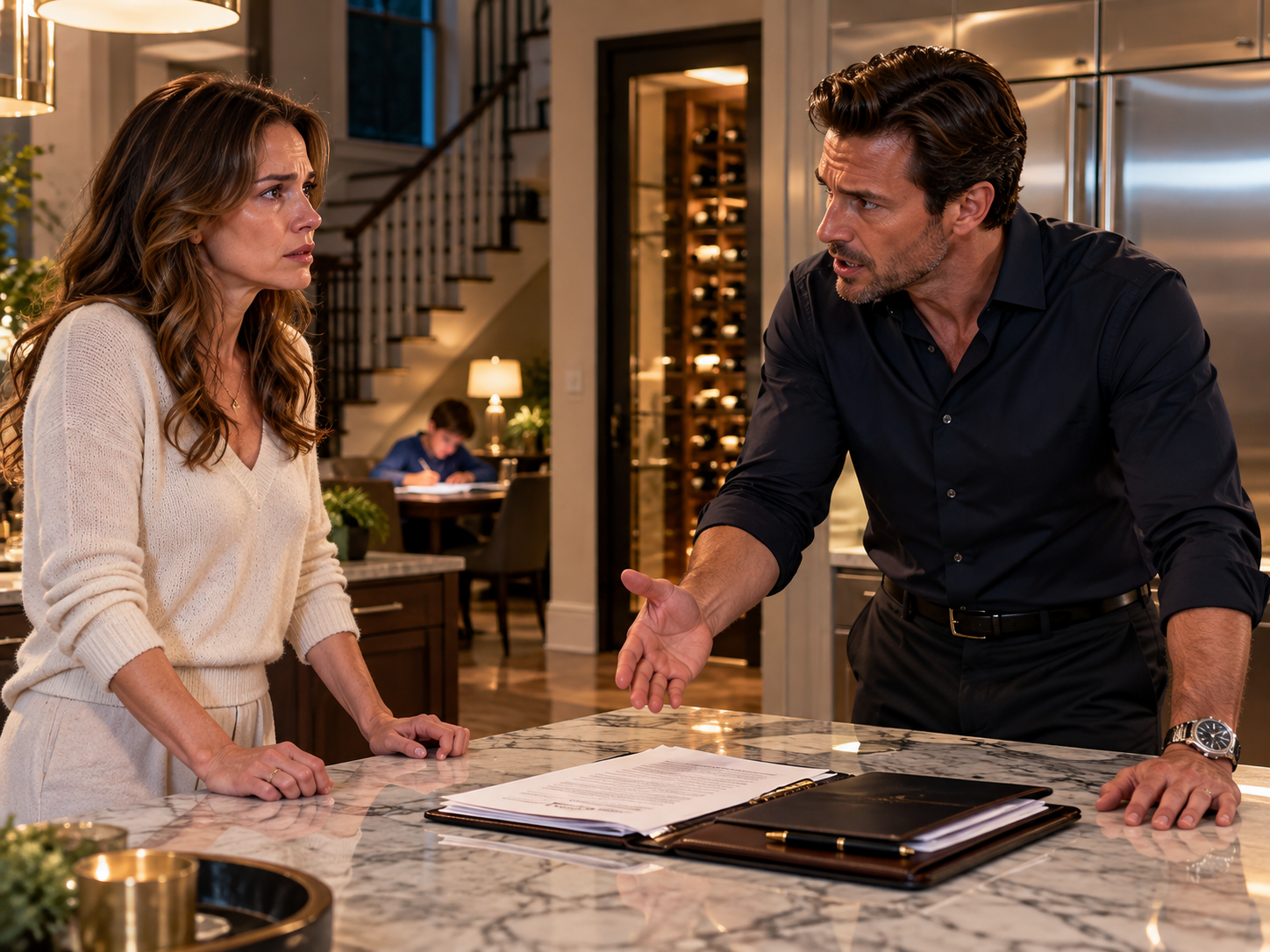
For a moment, I remembered the man sitting at the kitchen island years earlier.
He had believed the house would make him free.
Now he understood that freedom came from being able to live without proving anything.
We said goodbye.
I drove home alone.
At a red light, I thought about the title people would have given our story if they only saw the courtroom.
A woman gave her husband everything.
A man took the house, cars, and money.
A foolish wife walked away with almost nothing.
But none of those descriptions were true.
I had not given away my life.
I had given away property.
Those are not the same thing.
I had not lost my future.
I had protected it.
I had not been defeated.
I had refused to play the game David thought we were playing.
That was why his attorney's whisper had mattered.
Until that moment, David believed the divorce was a contest.
After that moment, he understood it was a contract.
The contract did exactly what it said.
He received the assets.
He received the obligations.
I received custody.
I received my freedom.
Sam received two parents who eventually learned how to stop making him carry their mistakes.
The final result was not perfect.
Nothing involving divorce ever is.
There were difficult years.
There were legal bills.
There were awkward conversations.
There were birthdays divided between two homes.
There were moments when Sam wished things had been different.
So did I.
But wishing for a different past did not require me to regret the present.
That was the part I understood most clearly now.
One evening, I opened the storage box again.
I looked at the settlement.
Then I placed it back inside.
I did not need to destroy it.
It was history.
History does not have to be erased.
It only has to stay where it belongs.
I closed the box.
Then I went outside.
The evening air was cool.
My phone rang.
It was Sam.
“Mom?”
“Yes?”
“I just wanted to say goodnight.”
I smiled.
“Goodnight.”
“Love you.”
“Love you too.”
The call ended.
I stood outside for another minute.
Years earlier, David had sat across from me and asked for everything.
The house.
The vehicles.
The savings.
Everything he could name.
Then he had casually said I could keep our son.
He had believed that was the lesser prize.
He was wrong.
I knew it immediately.
I just needed the courage to trust what I knew.
The house was gone.
The cars were gone.
The old accounts were closed.
The wine cellar belonged to someone else.
The marriage was over.
But my son was safe.
My future was mine.
My home was peaceful.
And I had learned that sometimes the strongest response to someone who insists on taking everything is not to fight for every possession.
Sometimes it is to step aside, let them take exactly what they demanded, and keep the one thing they were never wise enough to understand.
Your life.
Click here to continue reading: PART 13: Years after the courtroom, an unexpected message from David reopened an old question about the divorce and showed me how differently we now remembered that day
David Asked for the House, the Cars, and Every Dollar We Owned, But the One Thing He Refused to Take Was the Detail That Made His Demand Dangerous
Part 12 of 28