The final change came almost unnoticed.
Beatrice's house became known in the neighborhood as a place where caregivers could ask for help.
People came with questions.
How could they arrange temporary care?
What support existed for older relatives?
How could families divide responsibilities?
What happened when one person was doing everything?
Clara never expected to become part of those conversations.
Yet she found herself speaking more often.
Not as an expert.
As someone who had learned the hard way.
She always began with the same sentence.
“Care should never require you to disappear.”
The phrase became familiar.
Beatrice liked it.
“You're becoming famous.”
“Please don't say that.”
“Why?”
“I don't want strangers recognizing me.”
“You spent weeks pretending to be someone else.”
“Exactly.”
Beatrice laughed.
The care program grew slowly.
It remained personal.
People knew each other.
They shared meals.
They checked on one another.
And the house remained Beatrice's.
That mattered.
No one could claim it simply because they had a relationship with her.
One summer morning, Margaret visited.
She brought documents for the annual review.
Everything was in order.
Beatrice signed what was necessary.
Then she looked at Clara.
“Anything else?”
Margaret smiled.
“No.”
“Good.”
After Margaret left, Beatrice leaned back.
“I think we've finally run out of paperwork.”
Clara laughed.
“Impossible.”
“You're right.”
They spent the afternoon in the garden.
Arthur's tree had grown enormous.
Its branches shaded almost half the lawn.
Clara remembered the first time she had sat beneath it.
She had been terrified.
Now she felt peaceful.
Beatrice was quiet.
Then she said, “I think I'm ready.”
Clara looked at her.
“For what?”
“To give you the apron.”
Clara smiled.
“You mean the apron I already own?”
“I mean officially.”
Beatrice had kept the faded blue apron folded in the study.
She brought it outside.
She placed it on the table.
“I want you to take it.”
Clara touched the fabric.
“Why?”
“Because it belongs to the story.”
“I don't need it.”
“You don't need to wear it.”
Clara looked at her.
“Then what should I do with it?”
“Whatever you want.”
Clara thought for a long time.
Finally, she folded it carefully.
“I'll keep it.”
Beatrice nodded.
“But not hidden.”
“No.”
Clara carried it inside.
She placed it beside the coffee tin on the shelf.
Two objects.
Both visible.
Neither powerful.
They were reminders now, not prisons.
That evening, Clara opened the old wooden box one last time.
Arthur's letters were still there.
She read the one addressed to her.
Then she read the line about generosity.
She realized something.
Arthur had not saved her.
Beatrice had not saved her.
Margaret had not saved her.
She had participated in her own rescue.
People had helped.
Documents had mattered.
Truth had mattered.
But the decision to stop disappearing had ultimately been hers.
She closed the box.
The next morning, she took it to the care program archive.
Some letters would remain private.
Others would be preserved as part of the history of the house.
The one written to Clara stayed with her.
She did not need anyone else to read it.
It was enough to know Arthur had seen her.
Years later, Clara would still remember that.
Not because she needed his approval.
Because being seen at the right moment could remind a person to see herself.
One Monday morning, Clara arrived at the house carrying groceries.
Beatrice was in the kitchen.
“Put those there.”
“You're welcome.”
“I didn't thank you.”
“You're welcome anyway.”
Beatrice smiled.
They prepared breakfast together.
The routine was familiar.
But nothing about it felt compulsory.
Clara could leave whenever she wanted.
Beatrice could ask for help or refuse it.
They had boundaries.
They had choices.
They had trust.
After breakfast, Beatrice looked toward the window.
“Rain later.”
“You always know.”
“My knees know.”
Clara laughed.
The first drops began before noon.
They stood together watching the garden.
For a moment, Clara remembered that first Monday years earlier.
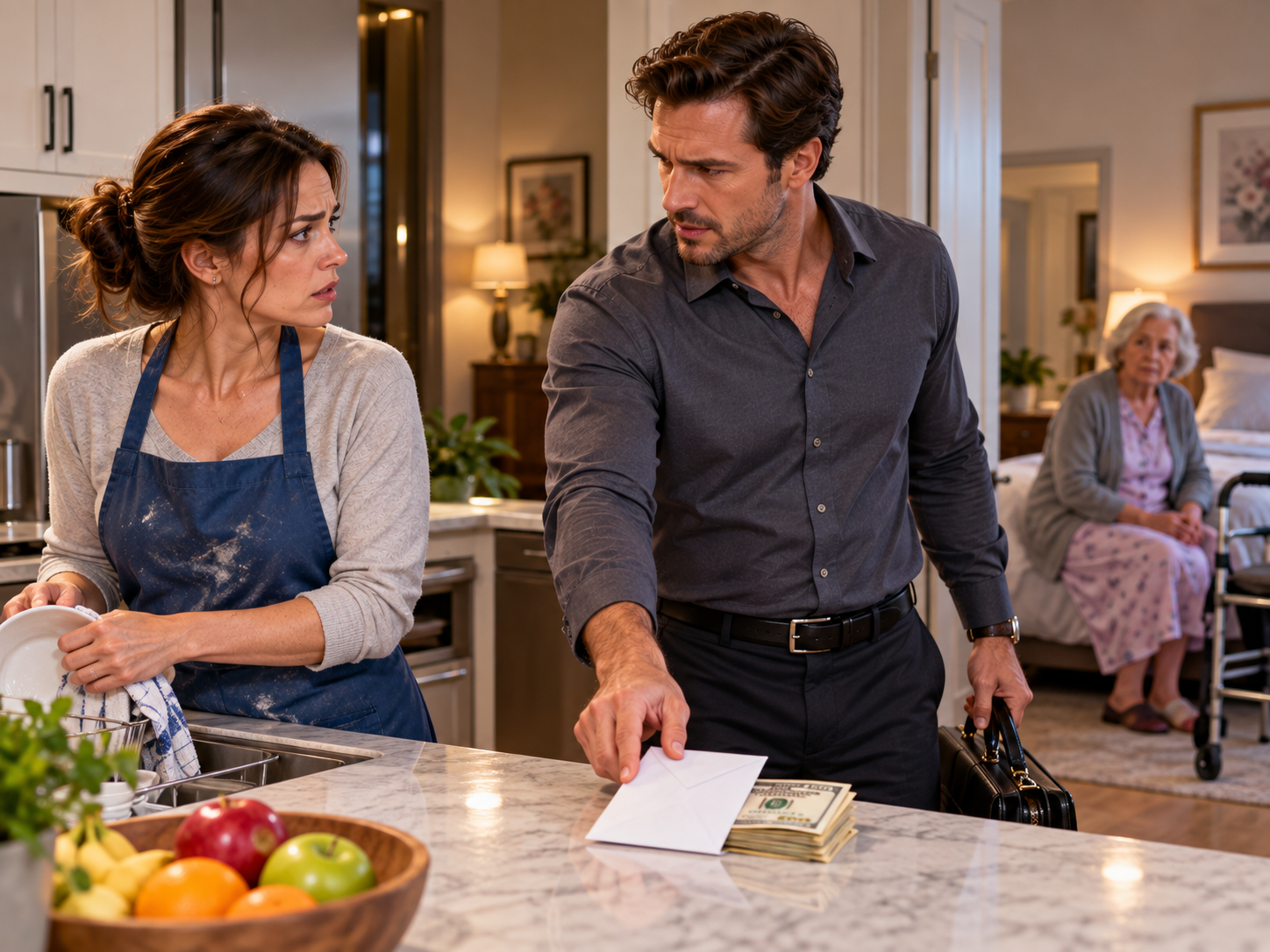
She remembered Julian placing cash on the counter.
She remembered wondering whether he had finally decided to help.
She remembered how quickly that hope had disappeared.
She remembered becoming Hazel.
She remembered the green folder.
The notary.
The coffee tin.
The confrontation.
The divorce.
The apartment.
The letters.
The care program.
Everything had begun with money.
Yet none of it had really been about money.
Beatrice interrupted her thoughts.
“What are you thinking?”
“That it feels like another life.”
“It was.”
“Sometimes I can't believe I was that woman.”
“You were always Clara.”
Clara smiled.
“Not always.”
“Yes.”
Beatrice pointed toward the shelf.
“You wore an apron. You changed your hair. You used another name.”
“And?”
“You were still you.”
Clara considered that.
Maybe she was right.
Hazel had not been a lie in every sense.
Hazel had been the part of Clara that finally acted when Clara was afraid.
She had not created courage.
She had uncovered it.
Clara looked at the blue apron.
“I think Hazel saved Clara.”
Beatrice smiled.
“Then Clara should thank her.”
Clara laughed.
“I will.”
That afternoon, Clara took the apron down.
She folded it.
Then she unfolded it.
She folded it again.
Finally, she placed it inside a simple wooden box.
Not hidden.
Not locked.
Just preserved.
The coffee tin remained beside it.
The two objects became part of the small private history Clara kept.
Not trophies.
Not evidence.
Reminders.
Years later, when someone asked Clara how she had managed to leave a marriage after spending so long caring for someone else, she never gave a dramatic answer.
She said she had started by telling the truth.
Then she had written things down.
Then she had asked for help.
Then she had learned that love without boundaries could become self-erasure.
And finally, she had chosen herself.
The person asking usually expected something more complicated.
Clara would smile.
“It wasn't easy.”
That was all.
Because it hadn't been.
But difficult did not mean impossible.
One evening, Beatrice sat beside Clara on the porch.
The sun was setting.
The garden was quiet.
“Do you ever think about what would have happened if you hadn't found the folder?”
Clara thought.
“Yes.”
“And?”
“I think someone would eventually have discovered the truth.”
“Maybe.”
“But I don't think I would have been the same.”
Beatrice nodded.
“Neither would I.”
They sat together.
The house stood behind them.
Its windows glowed warmly.
No one was waiting to inherit it.
No one was plotting a transfer.
No one was counting envelopes.
It had become what Arthur wanted.
A place where people could feel safe.
A place where care was visible.
A place where an older woman could remain the author of her own life.
And a place where Clara could walk through the kitchen without wondering whether she had permission to belong there.
Beatrice leaned her head back.
“Clara?”
“Yes?”
“Thank you.”
Clara smiled.
“For what?”
“For coming back.”
Clara looked at her.
“I never really left.”
Beatrice nodded.
“I know.”
The rain began softly.
Clara listened.
The sound no longer carried fear.
It was simply rain.
The kitchen was warm.
The tea was ready.
The house was quiet.
And Clara was exactly where she had chosen to be.
She thought about the first envelope.
The first disguise.
The first lie.
The first truth.
The first time she had spoken for herself.
Then she looked toward the shelf where the coffee tin and faded blue apron rested.
They were no longer symbols of what Julian had taken from her.
They were reminders of what she had discovered in herself.
Courage.
Boundaries.
Choice.
And the understanding that being loved should never require becoming invisible.
Beatrice called from the kitchen.
“Tea is getting cold.”
Clara laughed.
“I'm coming.”
She stood.
She walked inside.
And this time, there was nothing left to hide.
Click here to continue reading: PART 17: “The house had become a place of healing, yet Clara discovered that rebuilding a life also meant deciding what to do with the story she had survived”
My husband thought the cash on the kitchen counter was buying someone else’s labor, but I was already learning why he wanted his mother kept quiet
Part 16 of 20