
Years passed gently.
Not perfectly.
Gently.
Beatrice grew older.
Clara grew into a life she had once been too frightened to imagine.
The care program connected to the house eventually began serving people in the community.
It was never large.
That was intentional.
Beatrice wanted it personal.
She wanted people to be known by name.
She wanted caregivers to have reasonable hours.
She wanted families to understand that accepting help was not failure.
And she wanted older people to remain involved in decisions about their own lives for as long as possible.
Clara helped occasionally.
But she was not the person running it.
That mattered.
She had learned the difference between helping and carrying everything.
Julian became a distant name.
They never reconciled.
They never became enemies either.
There was simply distance.
Once, years later, Clara heard from Valerie.
Valerie had moved away.
She had apologized again.
Clara accepted the apology.
She did not rebuild the relationship.
Some doors could remain closed without hatred.
That was another lesson she had learned.
Beatrice occasionally mentioned Julian.
Not with anger.
Not with longing.
Just as part of the past.
“Have you heard from him?”
“No.”
“I hope he is well.”
“So do I.”
And that was enough.
There was no need for Clara to know more.
Her own life had become full.
She had friends.
Work.
Books.
Travel.
Quiet mornings.
People who knew her without requiring her to perform a role.
She still visited Beatrice every Monday.
The day had become symbolic without either of them intending it.
Monday had once meant an envelope.
Now it meant breakfast together.
Sometimes pancakes.
Sometimes soup.
Sometimes nothing more than tea and conversation.
One Monday morning, Clara arrived carrying fresh bread.
Beatrice was sitting by the window.
“You're late.”
Clara checked her watch.
“Three minutes.”
“Terrible.”
“You'll survive.”
“Perhaps.”
Clara set the bread on the counter.
Beatrice looked at it.
“Did you buy enough?”
“For six people.”
“There are two people.”
“I know.”
“You still haven't learned.”
“I learned that you complain regardless.”
Beatrice laughed.
They ate breakfast slowly.
Afterward, Clara washed the dishes.
Beatrice watched her.
“You know you don't have to do that.”
“I know.”
“Then why are you?”
“Because I want to.”
Beatrice smiled.
That was the difference.
Choice.
It changed everything.
After breakfast, Clara went into the kitchen.
She opened the cabinet beneath the sink.
The coffee tin was still there.
She took it out.
The metal was scratched now.
The lid had become slightly loose.
She turned it over in her hands.
Beatrice appeared behind her.
“You still have it.”
“Yes.”
“Why?”
Clara smiled.
“I think I'm ready to let it go.”
Beatrice raised an eyebrow.
“Are you sure?”
“Yes.”
Clara carried it outside.
They sat beneath the old tree.
The garden was quiet.
Clara placed the tin on the table.
For years, she had believed the tin represented everything she had been forced to endure.
Now she understood something else.
It represented the moment she stopped accepting someone else's version of reality.
The money inside it had never saved her.
The records had not saved her either.
What saved her was the decision to look directly at what was happening and refuse to pretend it was normal.
Beatrice touched the tin.
“Open it.”
Clara lifted the lid.
Empty.
They both laughed.
“Still empty,” Beatrice said.
“Completely.”
Clara looked inside one last time.
Then she closed it.
She did not throw it away.
Instead, she placed it on a shelf in Beatrice's study.
Not hidden.
Not beneath the sink.
Visible.
A reminder.
Later that afternoon, Clara found the old blue apron folded in a drawer.
She picked it up.
The fabric had faded even more.
There was a tiny stain near the pocket.
She smiled.
“Look what I found.”
Beatrice examined it.
“You really wore that?”
“I did.”
“You looked ridiculous.”
“You've mentioned that.”
“Because it remains true.”
Clara laughed.
She folded the apron.
“Should I keep it?”
Beatrice shrugged.
“Only if it reminds you of something useful.”
“It does.”
“What?”
“That I don't want to disappear again.”
Beatrice nodded.
“Then keep it.”
Clara placed the apron beside the coffee tin.
Two ordinary objects.
Two pieces of an extraordinary period.
Neither had power anymore.
That evening, Clara walked through the house.
She passed the bedroom where the green folder had once been hidden.
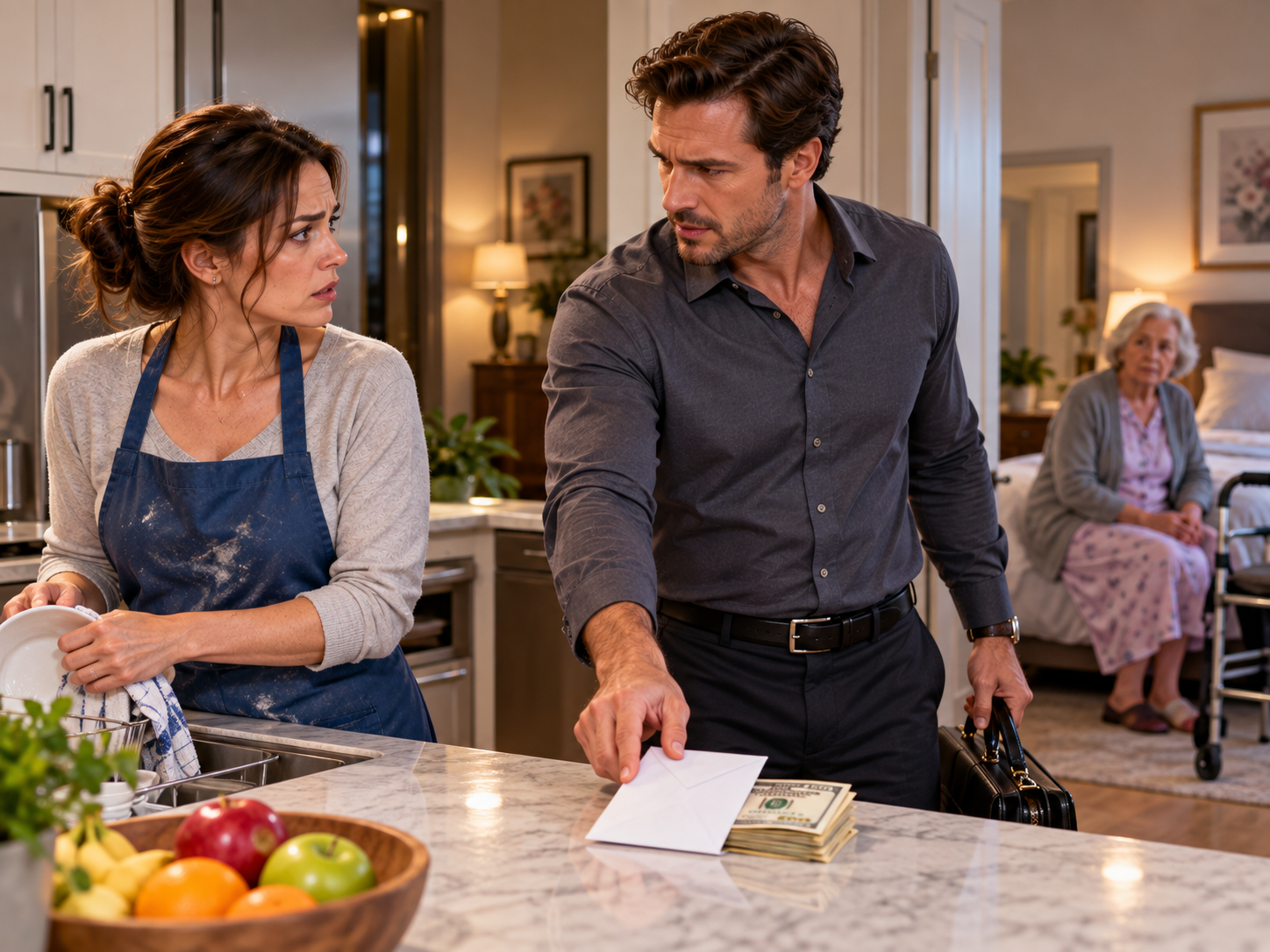
She passed the kitchen where the envelopes had appeared.
She passed the living room where Julian had once stood demanding explanations.
The memories remained.
But they no longer felt like wounds.
They felt like rooms she had already walked through.
She went outside.
Beatrice was sitting on the porch.
“Come here,” she said.
Clara sat beside her.
“Are you tired?”
“A little.”
“Then rest.”
Clara leaned back.
The sun was lowering.
The garden was quiet.
For a long time, neither spoke.
Then Beatrice said, “You know what I am most proud of?”
Clara turned.
“What?”
“That you stopped asking permission to be yourself.”
Clara smiled.
“I didn't know I was asking.”
“You were.”
“Maybe.”
Beatrice squeezed her hand.
“You aren't anymore.”
Clara looked at their joined hands.
She thought about the girl she had once been.
The woman who believed being a good wife meant saying yes.
The woman who believed caring meant carrying.
The woman who mistook silence for peace.
The woman who put cash into a coffee tin because she needed proof that what she was experiencing was real.
She felt compassion for that woman.
Not embarrassment.
Not anger.
Compassion.
She had done the best she could with what she understood then.
And when she finally understood more, she changed.
That was enough.
The final Monday of that chapter arrived without ceremony.
There was no confrontation.
No lawyer.
No envelope.
No hidden document.
No husband waiting in the doorway.
There was only rain against the windows.
Clara stood in the kitchen.
She looked at the counter.
Empty.
She looked beneath the sink.
Empty.
She looked toward the hallway.
Quiet.
Beatrice called from the living room.
“Clara?”
Clara smiled.
“I’m here.”
She walked toward her.
Beatrice looked up.
“Tea?”
“Yes.”
“Sit first.”
Clara sat.
They talked about ordinary things.
The weather.
The garden.
A book Beatrice had started.
The bread Clara had promised to bring next week.
Nothing important.
Everything important.
Because peace had become ordinary.
That was the ending Clara had never imagined.
Not revenge.
Not triumph.
Not a perfect life.
Peace.
The kind that did not need to announce itself.
The kind that arrived quietly and stayed.
Before leaving that evening, Clara went into the kitchen one last time.
She touched the coffee tin.
Then the faded blue apron.
She smiled.
She did not need to hide either one.
She did not need to destroy the past to move beyond it.
She only needed to stop living inside it.
She opened the front door.
Rain had softened to a mist.
Beatrice called after her.
“Clara?”
Clara turned.
“Yes?”
“Next Monday.”
Clara smiled.
“Next Monday.”
She stepped outside.
The door closed gently behind her.
And as she walked toward her car, Clara understood what she had not been able to understand on that first rainy Monday.
The money had never been the real betrayal.
The house had never been the real prize.
Even the marriage had not been the whole story.
The deepest wound had been being treated as though her love, her work, her loyalty, and her time were things another person could simply claim.
The deepest healing was realizing they belonged to her.
She could give them.
She could withhold them.
She could choose where they went.
And no one was entitled to them simply because they called her wife.
She drove away from the house.
Behind her, the windows glowed warmly against the evening rain.
Beatrice was safe.
The house was protected.
The truth had survived.
And Clara was free.
The next Monday would come.
There would be breakfast.
There would be tea.
There would be another ordinary conversation.
But there would be no alias.
No apron required.
No cash waiting on the counter.
No secret beneath a mattress.
Just Clara.
And everyone who mattered finally knew exactly who she was.
Click here to continue reading: PART 13: “The house had finally become peaceful, but when Beatrice asked Clara to return one last time, an old family question surfaced that neither woman had answered”
My husband thought the cash on the kitchen counter was buying someone else’s labor, but I was already learning why he wanted his mother kept quiet
Part 12 of 20