The following week, Clara returned to Beatrice's house with the photograph.
She had enlarged it.
Beatrice stared at the picture for a long time.
“Arthur hated photographs.”
“I know.”
“He always complained about his hair.”
“He had hair.”
Beatrice laughed.
“Exactly.”
Clara placed the photograph on the mantel.
For a moment, the room seemed to hold all three generations at once.
Arthur.
Beatrice.
The family they had built.
The family that had fractured.
And the people who had survived the fracture.
Beatrice sat beneath the photograph.
“I think he knew.”
“Knew what?”
“That Julian might eventually become obsessed with the house.”
Clara frowned.
“Why?”
“Because Arthur had seen what happened to his own brother.”
Beatrice paused.
“His brother fought with their parents over property.”
“I never knew that.”
“Neither did Julian.”
“What happened?”
“They stopped speaking for years.”
Clara looked at the photograph.
“Did they reconcile?”
“Eventually.”
“What changed?”
“The property was sold.”
Clara smiled sadly.
“Of course.”
Beatrice nodded.
“Once there was nothing left to fight over, they remembered they were brothers.”
“That sounds familiar.”
“It should.”
They both laughed.
Then Beatrice became serious.
“Arthur wanted to prevent that here.”
“And he did.”
“Not completely.”
“No.”
“Maybe nothing can completely protect a family from itself.”
Clara thought about that.
“Then why did he try?”
“Because trying is sometimes the only decent thing you can do.”
The sentence stayed with Clara.
That afternoon, Beatrice showed her an old financial ledger.
Arthur had maintained careful records.
Every property expense.
Every repair.
Every payment.
Every charitable donation.
Clara turned the pages.
“This is incredible.”
“He was obsessive.”
“I see that.”
Then she noticed something.
A recurring payment.
It had been made every month for several years.
“What was this?”
Beatrice looked.
“Oh.”
“What?”
“That was for a caregiver.”
Clara looked up.
“Before me?”
“Yes.”
“Why didn't I know?”
“Because it stopped before you married Julian.”
Beatrice explained that after Arthur became ill, the family had hired professional assistance for him.
The caregiver had helped Arthur bathe, eat, move, and rest.
Arthur had insisted on paying properly.
“He never wanted unpaid care,” Beatrice said.
Clara smiled.
“That sounds like him.”
“He said care was work even when it came from love.”
Clara's expression changed.
That was exactly what Julian had never understood.
Beatrice noticed.
“Your husband was raised by a man who believed that.”
“I know.”
“Then perhaps Arthur's lessons did not disappear.”
“No.”
“They just didn't reach everyone.”
Clara closed the ledger.
For the first time, she wondered whether Julian had ever understood how much his father had tried to teach him.
Maybe he had.
Maybe he had simply chosen differently.
Neither possibility changed what had happened.
But it made the story more complicated.
And Clara had stopped needing simple stories.
That evening, Beatrice asked Clara to walk with her through the garden.
They moved slowly.
The flowers were beginning to bloom.
At the far end stood an old bench.
Arthur had built it himself.
Beatrice sat.
Clara stood beside her.
“This is where he told me about the amendment.”
Clara looked at her.
“When?”
“Two years before he died.”
“What did he say?”
“He said he wanted the house protected.”
“From Julian?”
“Not specifically.”
Beatrice smiled sadly.
“He said, ‘Never protect something so fiercely that the people inside it become afraid of it.’”
Clara sat beside her.
“That sounds like the opposite of what happened.”
“Yes.”
“Why didn't you tell Julian about the amendment?”
“Because Arthur asked me not to.”
“Did he think Julian would try something?”
“He thought Julian might.”
Clara was quiet.
“Was he disappointed in him?”
Beatrice shook her head.
“Arthur was disappointed by choices. He never gave up on people.”
“That sounds difficult.”
“It was.”
Beatrice looked toward the house.
“He loved Julian.”
“I know.”
“He also loved you.”
Clara swallowed.
“I didn't know.”
“Arthur didn't say things easily.”
“That sounds familiar.”
Beatrice smiled.
“He believed love was something you showed through actions.”
Clara looked down.
“He did.”
They remained on the bench until the sunlight faded.
On the way home, Clara thought about the difference between the men she had known.
Arthur had believed care created responsibility.
Julian had believed care created entitlement.
Both had grown up in the same house.
The difference had not been the house.
It had been choice.
That realization freed Clara from another question she had carried.
She had often wondered whether Julian's behavior was somehow inevitable.
It wasn't.
He had choices.
He had made them.
And eventually, he had to live with them.
A few months later, Clara received an invitation to a small community event at Beatrice's house.
The care program was expanding.
Several families attended.
There were caregivers, older residents, volunteers, and local supporters.
Clara stood near the garden watching people talk.
A young caregiver approached her.
“Are you Clara?”
“Yes.”
“I've heard about you.”
Clara laughed.
“That sounds dangerous.”
The woman smiled.
“Beatrice says you helped make this place possible.”
Clara shook her head.
“She made the decisions.”
“You helped.”
“I did.”
The woman hesitated.
“Can I ask you something?”
“Sure.”
“How do you know when caring for someone becomes too much?”
Clara looked at her.
It was the kind of question she wished someone had asked her years earlier.
“You notice when you're disappearing.”
The woman frowned.
“What do you mean?”
“When your needs become embarrassing to you. When you stop asking for help because you think needing help makes you selfish. When everyone assumes you'll handle things because you've always handled them.”
The woman nodded slowly.
“And what do you do?”
“Tell someone.”
“What if they don't listen?”
“Tell someone else.”
The woman smiled.
“That's good advice.”
Clara looked toward Beatrice.
“She taught me.”
Beatrice was speaking with Rosa.
She glanced over.
Clara waved.
Beatrice waved back.
The event continued until evening.
When everyone left, the house became quiet again.
Beatrice sat in the kitchen.
“You were giving advice.”
“I was.”
“Did you charge?”
“No.”
“Then you're still learning.”
Clara laughed.
They cleaned up together.
Later, Beatrice asked Clara to bring the wooden box.
Clara placed it on the table.
“I've been thinking,” Beatrice said.
“About?”
“Arthur's letters.”
“What about them?”
“I want some of them preserved with the care program.”
Clara looked surprised.
“Why?”
“Because they explain why it exists.”
Clara nodded.
“That makes sense.”
“But yours should remain private.”
“Thank you.”
Beatrice closed the box.
“There are some things families need to remember.”
“And some things they need to let rest.”
“Exactly.”
They put the box away.
The following Monday, Clara brought flowers.
Beatrice arranged them herself.
The house smelled fresh.
Sunlight filled the kitchen.
Clara stood at the island.
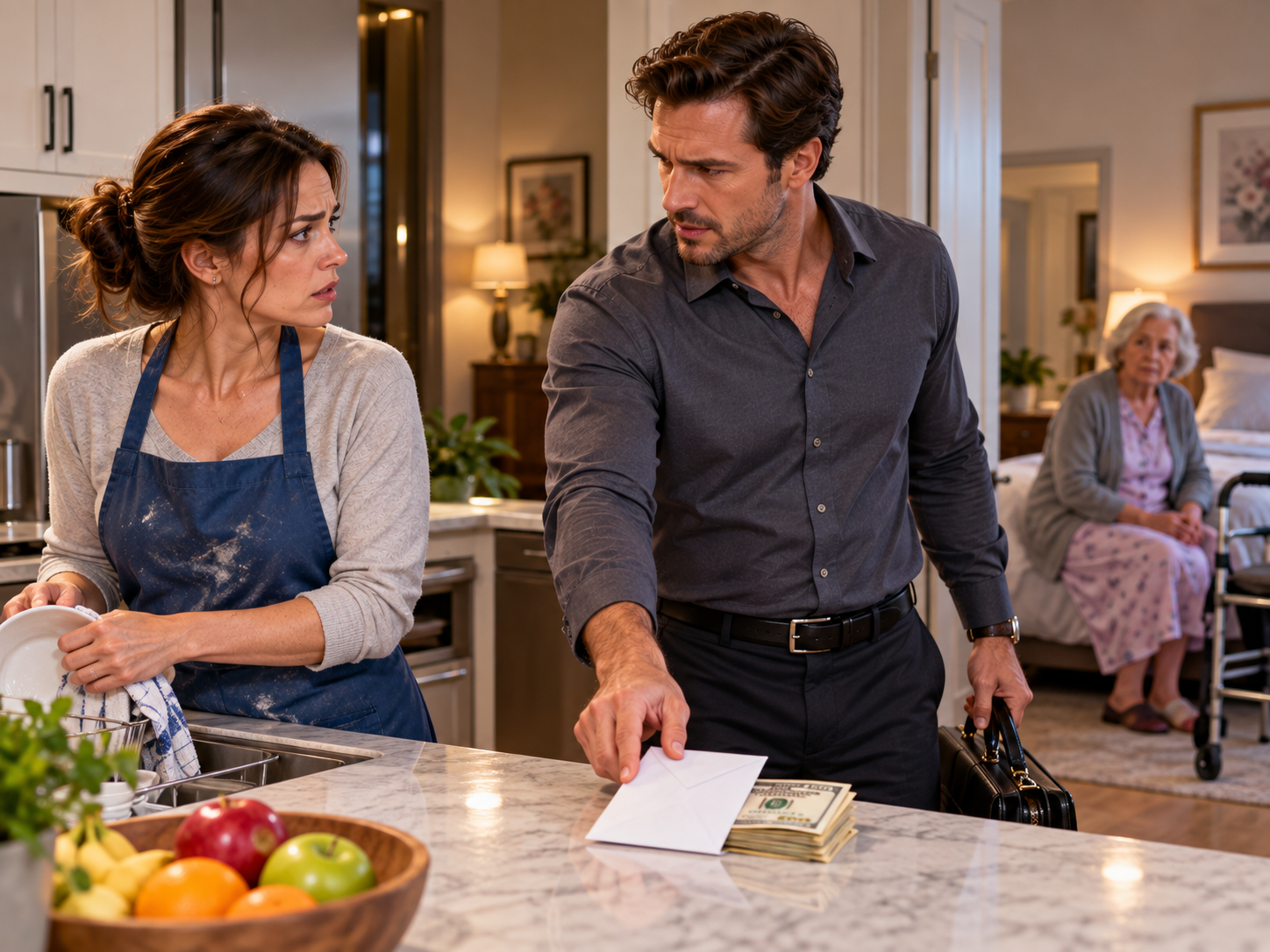
For one brief second, she remembered Julian's envelope.
Then the memory passed.
She no longer needed to fight it.
The past had become what it was supposed to be.
A place behind her.
Click here to continue reading: PART 15: “When Beatrice’s health suddenly faltered, Clara refused to become invisible again, and their hardest test became learning how to care without losing themselves”
My husband thought the cash on the kitchen counter was buying someone else’s labor, but I was already learning why he wanted his mother kept quiet
Part 14 of 20