
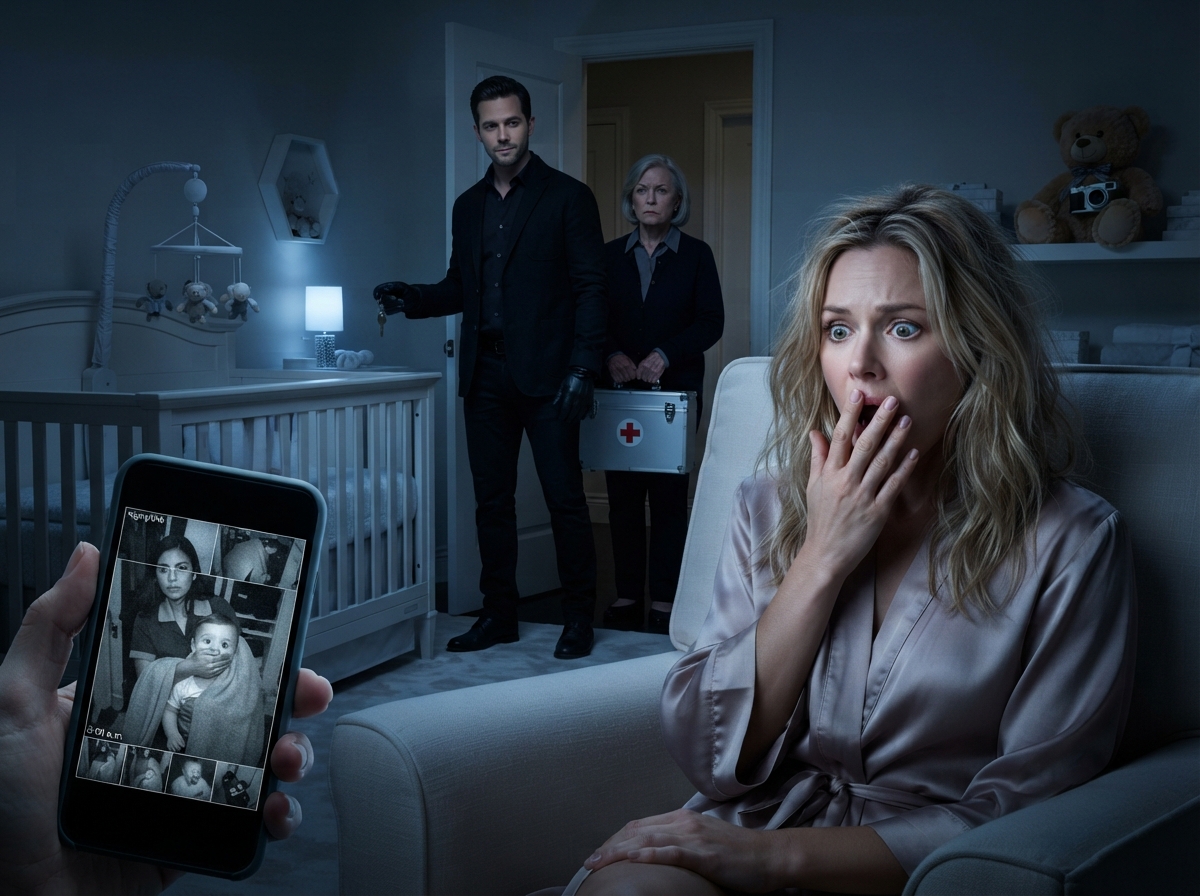
Noah's first week in the new house was quieter than I expected.
There were no nightmares every night.
No panic when someone entered a room.
No constant questions about whether he would be taken somewhere else.
But there were moments.
Small ones.
The first happened when a doctor came for a routine visit.
Noah saw the medical bag.
He froze.
His face went pale.
I immediately moved between him and the bag.
“It's okay.”
The doctor stopped.
“I’m not going to touch you without explaining first.”
Noah didn't answer.
I knelt beside him.
“You don't have to do anything you're uncomfortable with.”
He looked at me.
“Promise?”
“I promise.”
The doctor set the bag on the floor and opened it slowly.
He explained every item.
Noah listened.
After several minutes, he nodded.
“Can I look?”
“Yes.”
He examined the equipment.
Then he asked a question that made my heart hurt.
“Will you let them take me away?”
“No.”
“Even if they say I need to go?”
“No one makes that decision without you and me.”
He seemed to understand.
The appointment continued.
Afterward, he was tired.
He slept for three hours.
I sat beside him.
I watched his breathing.
I knew I couldn't erase what had happened.
I could only make sure his future contained experiences that contradicted it.
Doctors who explained.
Adults who asked permission.
Doors that stayed open.
Answers that were honest.
That became our routine.
Matthew, meanwhile, was fascinated by Noah.
He followed him everywhere.
If Noah sat down, Matthew crawled over.
If Noah picked up a toy, Matthew wanted it.
If Noah went upstairs, Matthew cried.
At first, Noah found it irritating.
“Mom, he keeps following me.”
“He likes you.”
“He's annoying.”
“He's six months old.”
“He still is.”
I laughed.
Noah tried not to.
Then Matthew grabbed his sock.
Noah sighed.
“Fine.”
He picked him up.
Matthew immediately smiled.
Noah looked at me.
“Why does he like me?”
“Because you're his brother.”
Noah looked at Matthew.
Then he smiled.
“Okay.”
The relationship between them grew quickly.
Noah became protective.
Matthew became attached.
Neither understood the history connecting them.
That was something they would learn gradually.
I did not want Noah to grow up believing he had been hidden because there was something wrong with him.
There wasn't.
The adults had failed him.
Not his body.
Not his worth.
Not his identity.
I repeated that whenever he asked.
One afternoon, he found the old photograph of me pregnant.
I had kept it in a box without looking at it for years.
He held it carefully.
“Is this me?”
I sat beside him.
“Yes.”
He stared at the photograph.
“I don't remember.”
“You were very small.”
“Was I sick?”
“Yes.”
“Did you know?”
“I knew you were sick.”
“Did you know I was alive?”
I swallowed.
“No.”
He looked at me.
“Why?”
“Because people told me you had died.”
He frowned.
“Who?”
I hesitated.
“People who were wrong.”
That answer satisfied him for the moment.
He returned the photograph.
Then he asked, “Were you sad?”
“Yes.”
“For five years?”
I looked at him.
“For a long time.”
He reached for my hand.
“I was here.”
“Yes.”
“I waited.”
The words nearly broke me.
I hugged him.
“I know.”
That night, after both boys were asleep, I sat in the kitchen with the photograph.
I turned it over.
On the back was a date.
The date of my first child's birth.
I realized I had spent years treating that photograph like evidence of death.
Now it was evidence of life.
I put it in a frame.
It belonged where I could see it.
The legal process moved forward.
Eleanor's attorneys argued that she had acted out of concern for Noah's health.
They claimed she had arranged private medical care because she believed I was incapable of making decisions after the birth.
But the records contradicted important parts of that explanation.
I had not been declared incompetent.
No court had removed my parental rights.
No legitimate process had authorized Eleanor to hide my child.
The medical records showed repeated attempts to keep Noah's existence from me.
There were also records showing that Matthew's blood had been collected without my informed consent.
The investigation separated what was medically justified from what had been unauthorized.
That distinction mattered.
I did not want exaggeration.
I wanted facts.
When the investigators interviewed me, I answered every question.
I told them about the hospital.
About being told Noah had died.
About Spencer.
About Eleanor.
About Rosa.
About the cameras.
About the basement.
I told them what I knew and what I didn't.
For once, I was not afraid of being called paranoid.
I had evidence.
But I also knew evidence was not the same as certainty about every detail.
The investigators would determine the rest.
One afternoon, Spencer came to the house with his attorney.
I met them outside.
He asked whether he could see the boys.
“Not alone.”
“I understand.”
“You can see them when the arrangements are approved.”
He nodded.
His attorney said, “Mr. Montgomery wants to cooperate fully.”
I looked at Spencer.
“Then cooperate.”
He did.
Over the following weeks, he provided access to financial records, medical correspondence, and communications between Eleanor and the private medical providers.
Some of those records were painful to read.
There were emails discussing Noah.
There were messages about keeping me uninformed.
There were notes about Matthew's compatibility.
One line made me stop.
“Valerie must not know until the treatment is complete.”
I read it twice.
Then I closed the file.
That sentence explained the entire house.
The locked basement.
The strange doctor.
The nighttime visits.
The cameras.
The psychiatric diagnosis they had prepared for me.
If I was declared unstable, they could make my objections easier to dismiss.
They had not simply hidden the truth.
They had been preparing to discredit me if I found it.
That realization made me colder than anger could.
I called my attorney.
“Did you see this?”
“Yes.”
“What happens now?”
“We continue documenting.”
I nodded.
“No shortcuts.”
“No.”
“Good.”
That evening, I found Noah sitting on the floor beside Matthew.
Matthew was asleep against his leg.
Noah was reading a picture book.
“What's the story?”
“It's about a family.”
I sat beside him.
“What happens?”
“The brother gets lost.”
My chest tightened.
“Does he come home?”
Noah smiled.
“Yes.”
“How?”
“The family looks for him.”
I looked at him.
“Good story.”
He nodded.
Then he leaned against me.
“Mom?”
“Yes?”
“I'm not lost anymore.”
I kissed his forehead.
“No.”
“You found me.”
I closed my eyes.
“Yes.”
Click here to continue reading: PART 7: The truth changed how I saw Spencer, Eleanor, and even Rosa, but my sons still needed a mother who could separate their safety from her anger
I thought the cameras would expose a careless nanny, but the first recording showed her protecting my baby from people I had trusted without question
Part 6 of 20

One Comment on “PART 6 – Noah had survived five hidden years, but the hardest part was teaching him that his mother had never abandoned him and that Matthew had never been his enemy”