
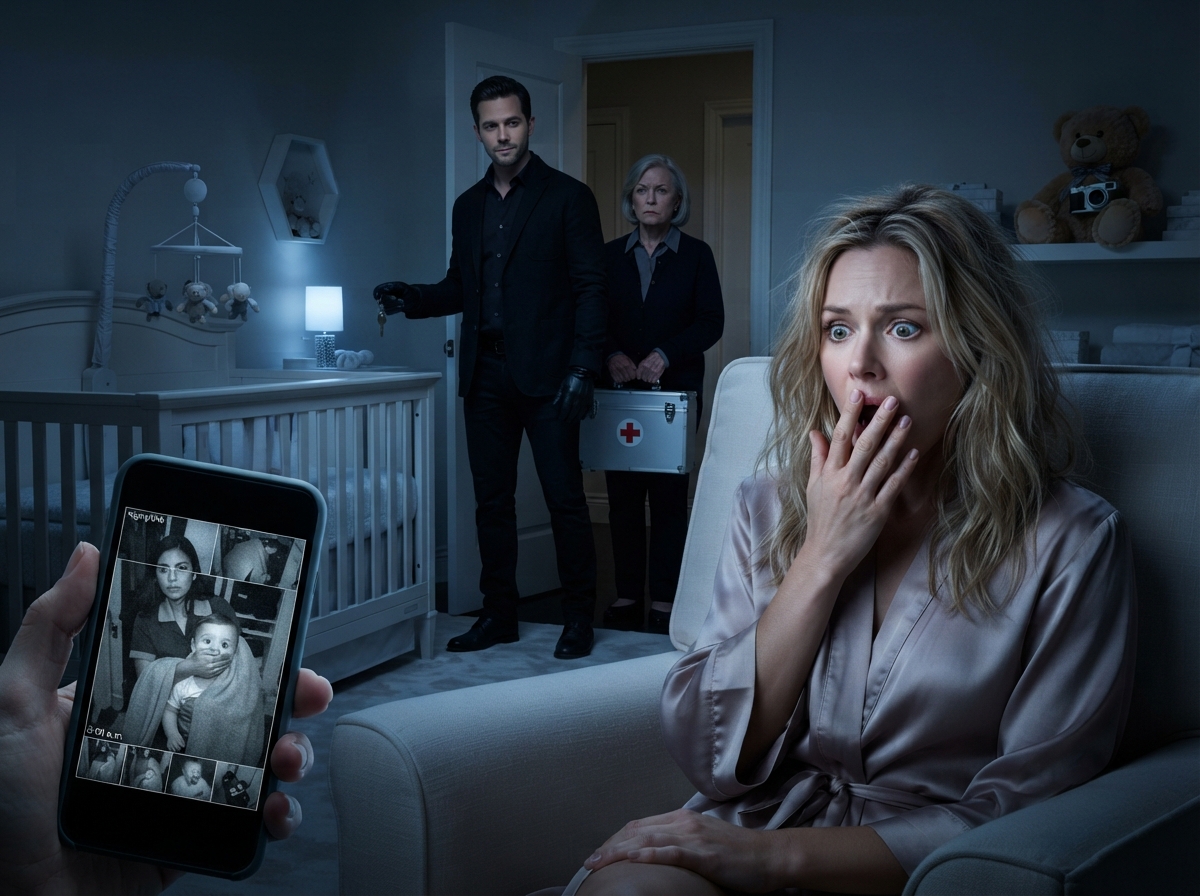
My granddaughter grew quickly.
One week she was a newborn sleeping against my chest.
Then she was crawling.
Then she was standing.
Then she was reaching for everything she wasn't supposed to touch.
Matthew complained.
Noah laughed.
Rosa brought toys.
I spoiled her.
That was my privilege.
One afternoon, Matthew caught me giving her another cookie.
“Mom.”
“What?”
“She already had one.”
“She wanted another.”
“She doesn't know what she wants.”
I looked at him.
“You used to say that about babies.”
He smiled.
“I know.”
I handed the cookie back to him.
“Fine.”
He laughed.
“You're impossible.”
“Probably.”
His daughter reached toward me.
I opened my arms.
He sighed.
“Okay.”
She came to me.
I kissed her forehead.
Sometimes the simplest moments felt almost sacred.
Not because they were dramatic.
Because they were ordinary.
That was what I had wanted all along.
A family life that did not require constant vigilance.
Years earlier, I had believed safety meant knowing everything.
Every movement.
Every room.
Every conversation.
Twenty-six cameras had given me information.
They had not given me peace.
Peace came later.
It came when I stopped believing control was the same thing as protection.
I still locked doors.
I still asked questions.
I still trusted my instincts.
But I no longer treated fear as proof.
That was important.
One evening, Noah and I sat on the porch.
He was holding his niece.
“She likes you.”
“She likes everyone.”
“No.”
He smiled.
“She really likes you.”
I looked at the baby.
“She has a good mother and father.”
He nodded.
“Matthew is doing well.”
“Yes.”
“You're proud.”
“Very.”
Noah looked toward the street.
“Sometimes I wonder what would have happened if you never found me.”
I took a breath.
“I don't know.”
“Would I still be alive?”
“I don't know.”
He looked at me.
“That's the part I hate.”
“Me too.”
“But it didn't happen that way.”
“No.”
“You found me.”
“I did.”
He smiled.
“Then that's what matters.”
I leaned back.
He was right.
There were questions I would never be able to answer.
What if Rosa had not recorded the evidence?
What if I had fired her?
What if the camera had not alerted me?
What if Matthew had been taken?
What if Noah had remained hidden?
There were hundreds of possible paths.
I refused to live inside them.
We lived in the path that actually happened.
The path where I opened the nursery door.
The path where the basement camera showed me my son.
The path where Rosa stepped out of the closet.
The path where the truth came into the light.
That was enough.
A few months later, I received a letter.
It was from Eleanor.
I recognized the handwriting immediately.
I almost threw it away.
Instead, I opened it.
The letter was short.
She wrote that she had spent years believing she had been protecting Noah.
She admitted that fear had become control.
She did not ask me to forgive her.
She did not ask for contact.
She simply wrote that she hoped the boys were happy.
I read it twice.
Then I folded it.
I did not respond.
Not because I wanted revenge.
Because silence was sometimes the clearest boundary.
I placed the letter in a drawer.
Then I went downstairs.
My granddaughter was sitting on the floor.
She was trying to put a block into a box.
She failed.
She tried again.
I watched.
She tried a third time.
This time, it worked.
She looked at me proudly.
I applauded.
She laughed.
I laughed too.
That was life.
Try.
Fail.
Try again.
Learn.
Move forward.
No hidden meaning required.
Later, Matthew asked whether I had heard from Eleanor.
“Yes.”
“What did she say?”
“That she hopes you're happy.”
He looked down.
“Are you going to answer?”
“No.”
He nodded.
“Okay.”
He didn't ask why.
He understood boundaries.
That made me proud.
One night, Noah came over after work.
He looked exhausted.
“Long day?”
“Yes.”
“Eat.”
He smiled.
“You sound like Grandma.”
I froze for half a second.
Then I laughed.
“Don't insult me.”
He laughed.
“I didn't mean it like that.”
“I know.”
He sat at the table.
“Do you ever wonder whether we became who we are because of what happened?”
I thought about it.
“Probably partly.”
“Do you wish it hadn't shaped us?”
“Yes.”
“Even if it made us stronger?”
“Yes.”
He looked surprised.
“Why?”
“Because children shouldn't have to suffer to become strong.”
He nodded.
That was something I had learned over the years.
I did not need to romanticize what happened.
The basement was not a gift.
The lies were not a lesson I should be grateful for.
The fear was not necessary.
What mattered was what we did afterward.
That was where the strength came from.
Not the suffering itself.
The choices that followed.
Noah finished eating.
“Mom?”
“Yes?”
“You're a good mother.”
I smiled.
“I made mistakes.”
“So did everyone.”
“I didn't find you soon enough.”
“But you found me.”
He stood.
Then he hugged me.
I held him.
I didn't argue.
Some truths did not need correction.
The next morning, I woke before sunrise.
I walked into the kitchen.
The house was still.
For a moment, I remembered the old house.
The massive rooms.
The long hallways.
The nursery.
The cameras.
The black gloves.
The silver medical case.
The closet.
The basement.
Then I looked around my present home.
A child's toy sat on the floor.
A photograph of my sons stood on the shelf.
My granddaughter's blanket was folded over a chair.
The kettle began to whistle.
I turned it off.
There was no alarm.
No alert.
No movement detected.
Nothing demanding investigation.
Just morning.
I opened the back door.
Fresh air came in.
I stood there for a while.
The past had not disappeared.
It never would.
But it no longer stood between me and the future.
That was enough.
Click here to continue reading: PART 16: The night I finally understood what the cameras had been trying to teach me, I stopped measuring safety by what I could see and started measuring it by the life we had built
I thought the cameras would expose a careless nanny, but the first recording showed her protecting my baby from people I had trusted without question
Part 15 of 20

