Years later, I returned to the old neighborhood.
I had no reason to go there.
At least, no practical reason.
I was driving nearby when I realized how close I was.
I slowed down.
The old house was still standing.
For a moment, I considered turning around.
Instead, I kept driving.
The gates were different.
The landscaping had changed.
The house looked smaller than I remembered.
That surprised me.
When I had lived there, it had seemed enormous.
Almost endless.
Now it looked like a building.
Just a building.
I parked across the street.
I did not get out.
I simply looked.
I remembered arriving there as a young woman.
I remembered believing I had everything.
A beautiful house.
A husband.
A child.
Money.
Security.
And yet I had been lonely.
The house had been full of people and empty of trust.
I watched the front door.
I thought about the night Rosa had hidden inside the closet.
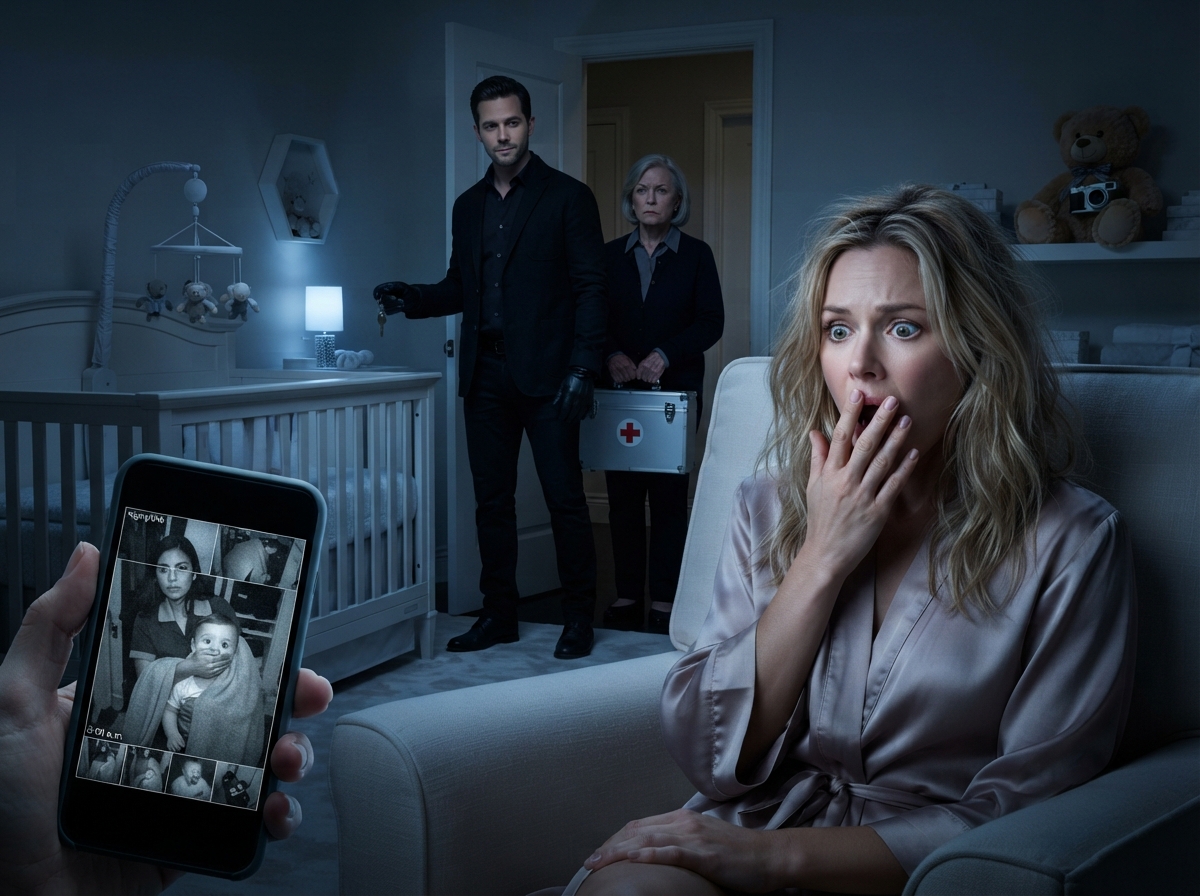
I remembered the camera feed.
The timestamp.
3:00 a.m.
The black gloves.
The silver medical case.
The boy in the basement.
My son.
I closed my eyes.
Then I opened them.
I was not shaking.
That surprised me.
The memory was still painful.
But it no longer controlled my body.
I drove away.
That afternoon, I called Noah.
“I went past the old house.”
He was quiet.
“How did you feel?”
“Okay.”
“Really?”
“Really.”
“That's good.”
“Yes.”
He laughed.
“You sound surprised.”
“I am.”
“You've come a long way.”
I smiled.
“So have you.”
He told me his daughter had started school.
I listened.
Then he asked about dinner.
We made plans.
The evening was ordinary.
Exactly what I wanted.
Matthew arrived late.
He apologized.
Traffic.
His daughter ran through the door.
“Grandma!”
I opened my arms.
She jumped into them.
“Did you miss me?”
“Yes.”
“How much?”
“This much.”
I squeezed her.
She laughed.
Noah came behind her.
“She's been asking about you all day.”
“Good.”
Matthew put food on the table.
Rosa arrived twenty minutes later.
She complained that everyone was making her late.
Nobody believed her.
We ate.
We talked.
We argued.
We laughed.
At one point, I looked around the table.
My sons were grown.
My granddaughter was telling a story nobody fully understood.
Rosa was correcting Matthew.
Noah was laughing.
Spencer called during dinner.
Matthew put him on speaker.
He wanted to say hello.
For a moment, everyone was connected.
Not as the family we had once imagined.
As the family we had actually become.
There were boundaries.
There were scars.
There were things that would never be forgotten.
But there was also love.
That mattered.
After dinner, the boys helped clean the kitchen.
My granddaughter fell asleep on the couch.
I covered her with a blanket.
Noah stood beside me.
“She looks peaceful.”
“She is.”
He smiled.
“That's what we wanted.”
I looked at him.
“Yes.”
He took the blanket's edge and adjusted it.
Then he said something that stayed with me.
“She'll never know the basement.”
I smiled.
“No.”
“She'll only know the family that came afterward.”
I nodded.
That was the gift.
Not erasing the past.
Building something stronger than it.
Later that night, everyone left.
I walked through the house.
I passed the living room.
The kitchen.
The hallway.
The spare bedroom.
Everything was quiet.
I went upstairs.
I looked into the empty room where my granddaughter had slept during a visit.
A small stuffed animal sat on the pillow.
I picked it up.
Then I smiled.
I remembered the teddy bear with the hidden camera.
I remembered how suspicious I had become.
How desperate I had been to know what was happening when I wasn't watching.
I had believed seeing everything would keep my family safe.
Now I understood.
There would always be things I could not see.
My sons would make decisions I didn't know about.
My granddaughter would grow up and have secrets of her own.
People I loved would make mistakes.
Life would happen outside my field of vision.
That was not failure.
That was life.
Trust did not mean believing everyone was incapable of hurting you.
It meant accepting that you could not control every possibility.
It meant teaching the people you loved how to recognize danger, speak up, ask for help, and make choices.
It meant being available.
Not omniscient.
I went downstairs.
The old teddy bear was in a box.
I opened it.
I held it for a moment.
Then I smiled.
It was just a teddy bear now.
Nothing more.
I put it back.
I closed the box.
And I decided that was the last time I needed to open it.
The next morning, Noah called.
“Mom.”
“Yes?”
“Are you busy?”
“No.”
“Can I bring everyone over?”
“Of course.”
“Why?”
“Because I want to see you.”
He laughed.
“You always say that.”
“Because it's always true.”
They arrived around noon.
My granddaughter ran through the door.
Matthew carried groceries.
Rosa brought flowers.
Noah brought coffee.
The house filled with noise.
For a moment, I stood in the kitchen and simply listened.
Children laughing.
Adults talking.
Cabinet doors opening.
Someone complaining about the temperature.
Someone else changing the music.
No alarms.
No cameras.
No fear.
Just people.
My people.
I looked at Noah.
He caught me watching him.
“What?”
“Nothing.”
“You're doing the mother thing.”
“What mother thing?”
“Looking at us like we're miracles.”
I smiled.
“You are.”
He shook his head.
“Come on.”
He hugged me.
Matthew joined us.
Then my granddaughter.
We stood there laughing.
I thought about the woman I had been years ago.
She had believed her family had been taken from her.
In some ways, it had.
But she had not known what could still be built.
She had not known Noah would grow up.
She had not known Matthew would become a father.
She had not known Rosa would remain family.
She had not known that Spencer could eventually learn to accept responsibility without demanding forgiveness.
She had not known that a house once filled with secrets could be replaced by a home filled with ordinary noise.
She had not known that healing would look so unremarkable.
That was perhaps the greatest surprise.
Healing was not one dramatic moment.
It was breakfast.
A phone call.
A birthday.
A school photograph.
A family dinner.
A child falling asleep on your shoulder.
A son asking for advice.
A granddaughter laughing.
It was waking up and realizing you had gone an entire day without thinking about the thing that once consumed you.
Then another day.
Then another.
Eventually, the memory remained, but it stopped asking to be remembered.
That was when I knew we were free.
That evening, after everyone left, I stood at the window.
The house was quiet.
I listened.
Nothing.
Then I smiled.
Years ago, I had installed twenty-six cameras because I thought I needed to see everything.
I thought if I could watch every hallway, every room, every movement, I could prevent disaster.
The cameras showed me the truth.
But they did not save my family.
People did.
Rosa did.
The evidence did.
The decision to open the door did.
The decision to believe what I saw did.
And after that night, choices did.
Every day.
Again and again.
I no longer needed to see everything.
I only needed to be present for what mattered.
When my sons called, I answered.
When my granddaughter cried, someone picked her up.
When someone was afraid, we listened.
When someone made a mistake, we talked.
When something felt wrong, we asked questions.
And when the truth hurt, we faced it.
That was enough.
I turned off the kitchen light.
I walked upstairs.
There were no cameras watching me.
No hidden screens.
No red recording lights.
Just darkness settling softly over the house.
I closed my bedroom door.
For the first time in my life, I did not need to know what happened after I stopped looking.
I trusted that morning would come.
And when it did, I would be there.
Click here to continue reading: PART 17: When my granddaughter started asking questions about the family photographs, I realized that every generation eventually discovers the stories adults once believed were too painful to tell
I thought the cameras would expose a careless nanny, but the first recording showed her protecting my baby from people I had trusted without question
Part 16 of 20