The final letter stayed on my desk for three days.
I couldn't bring myself to put it away.
Every morning, I read the last paragraph again.
Build a life in which you never again have to make yourself smaller to keep someone else comfortable.
It sounded simple.
Living it was harder.
Because even after everything, I still caught myself measuring my choices against other people's reactions.
If my mother sounded sad, I wondered whether I should visit.
If my father looked lonely, I wondered whether I should call.
If Leo apologized, I wondered whether I should immediately forgive him.
If Mariela sent a message, I wondered whether ignoring her made me cruel.
The old instincts didn't disappear just because I had named them.
They had to be replaced.
Slowly.
One choice at a time.
I began with the house.
I decided it would become a place where people could visit without pretending.
No secret conversations.
No private alliances designed to exclude someone.
No using kindness as leverage.
No keeping someone uninformed "for their own good."
The rules sounded almost embarrassingly basic.
That was the point.
My grandmother had spent years trying to create something simple in a family that kept making simple things complicated.
The first person I invited was my mother.
She arrived alone.
She stood at the front door holding a casserole.
"I didn't know what else to bring."
"You could have brought yourself."
She looked surprised.
Then she smiled.
"I'm trying."
"I know."
We ate at the kitchen table.
There was no performance.
No pretending.
She asked about Dallas.
I told her about work.
She asked about Elena.
I told her we were getting to know each other.
Then she asked the question I had been expecting.
"Do you think you'll ever come home?"
I looked at her.
"I am home."
Her eyes filled.
She nodded.
"I understand."
That answer mattered.
She wasn't asking me to return.
She was accepting the boundary.
After dinner, we walked through the garden.
She touched the rose bushes.
"Your grandmother planted these."
"I know."
"I helped her once."
I looked at her.
"Really?"
She smiled.
"I was twenty."
For the first time, I saw my mother not as the woman who had failed me, but as a young woman who had once been someone's daughter too.
That didn't erase what she had done.
But it complicated the picture.
Maybe that was healthier than having a villain.
People were rarely one thing.
My mother could love me and hurt me.
My father could regret his choices and still have made them.
Leo could care about me and still have laughed when he shouldn't have.
Mariela could have been frightened and still have manipulated people.
And I could love them without giving them unrestricted access to my life.
That was the hardest truth.
It was also the most freeing.
A few weeks later, Elena brought her children to the house.
They ran through the garden.
One of them found the old gardening gloves.
The other asked whether they could plant something.
I gave them each a small pot.
They got soil everywhere.
Elena apologized.
I laughed.
"Grandma would've loved this."
The children looked at me.
"Who's Grandma?"
I smiled.
"Someone who left us a lot of work."
They laughed.
That evening, we sat on the porch.
Elena looked toward the house.
"I think she knew we'd meet."
"I think so too."
"Do you ever wish you'd known sooner?"
I thought about it.
"Yes."
She nodded.
"Me too."
"But maybe we wouldn't have understood each other then."
She looked at me.
"That's probably true."
We sat quietly.
The sun disappeared behind the trees.
The garden became darker.
Then Elena said, "Dad told me something."
"What?"
"He said you were the first person who made him admit he was wrong."
I laughed.
"That's not exactly true."
"What is?"
"He knew."
"He just didn't say it."
I nodded.
"That's the difference."
The next morning, my father came by to repair the back fence.
I watched him work.
He measured twice before cutting the wood.
That was typical of him.
He had always liked certainty.
I walked over.
"You don't have to fix everything."
He looked at me.
"I know."
"Then why are you doing it?"
He thought.
"Because I can."
I smiled.
"That's better."
He smiled too.
There was no grand reconciliation.
Just a fence.
Sometimes that was enough.
Leo visited the following weekend.
He brought groceries.
He had changed in small ways.
He asked before moving things.
He didn't make jokes when someone was vulnerable.
He apologized without adding an explanation afterward.
I noticed.
I didn't praise him for it.
Change should not require applause.
But I appreciated it.
He stood in the kitchen.
"I found something."
He handed me a small photograph.
It showed my grandmother sitting at the dining table.
There were four children around her.
I recognized myself.
Leo was beside me.
Mariela was there.
And another child.
Elena.
I stared at the photograph.
"What?"
Leo smiled.
"Apparently Grandma brought all of us together once."
I turned it over.
A date.
Years before I remembered.
On the back, my grandmother had written:
"Someday they will understand that none of them needs to compete for love."
My eyes filled.
I showed Elena.
She laughed.
"Of course she did."
We placed the photograph in a frame.
It went on the hallway wall.
Not because it erased anything.
Because it told a fuller story.
There had been love.
There had also been fear.
There had been mistakes.
There had been silence.
There had been harm.
And there had been people who eventually chose to speak.
That was the story I wanted to remember.
Not a perfect family.
A family that finally stopped pretending it was perfect.
Mariela came once.
She stood outside for a long time before entering.
I invited her in.
She looked around.
"I like what you've done."
"Thank you."
She had brought a plant.
"For the garden."
I accepted it.
She didn't ask whether I forgave her.
I appreciated that.
We planted the small tree together.
Our hands got dirty.
At one point, she said, "I used to think I had to take your place."
I kept working the soil.
"You never had to."
"I know."
She looked at the tree.
"I don't want your place anymore."
I nodded.
"Good."
She smiled faintly.
"That's all?"
"That's enough."
She laughed.
We finished planting.
Before she left, she turned toward me.
"I think your grandmother would have liked me if I'd been honest with her."
"I think she would have told you when you were wrong."
Mariela smiled.
"Definitely."
Then she left.
I watched her walk down the path.
I didn't feel triumphant.
I didn't feel completely healed.
I simply felt finished with one chapter.
That night, I opened my grandmother's final letter one more time.
I had missed something.
At the bottom, beneath her signature, there was a postscript.
I read it slowly.
She wrote that people often believed forgiveness meant opening the door again.
She said it didn't.
Sometimes forgiveness meant putting the key down.
Sometimes it meant walking away without hatred.
Sometimes it meant leaving a door unlocked but refusing to stand beside it waiting.
Then came her final sentence.
She wrote that the most important thing I could inherit from her was not the house.
It was the courage to decide what kind of life came next.
I folded the letter.
Outside, the garden moved gently in the evening wind.
The little tree Mariela had brought stood near the herbs.
The rose bushes were beginning to bloom.
The house was quiet.
But it no longer felt empty.
Not because everyone had returned.
Because I had stopped measuring fullness by the number of people around me.
I had Elena.
I had Sophie.
I had a family that was learning, slowly, to respect boundaries.
I had memories of my grandmother.
I had work.
I had a garden.
I had a home.
Most importantly, I had myself.
The old version of me would have thought that sounded selfish.
The woman sitting at that kitchen table understood that it was survival.
I went outside.
The porch light cast a warm circle over the steps.
I watered the herbs.
Then the roses.
Then the small tree.
I stood there for a moment with the watering can in my hand.
The house behind me had once represented everything I had lost.
Now it represented something else.
A beginning.
Not a perfect one.
Not a painless one.
A real one.
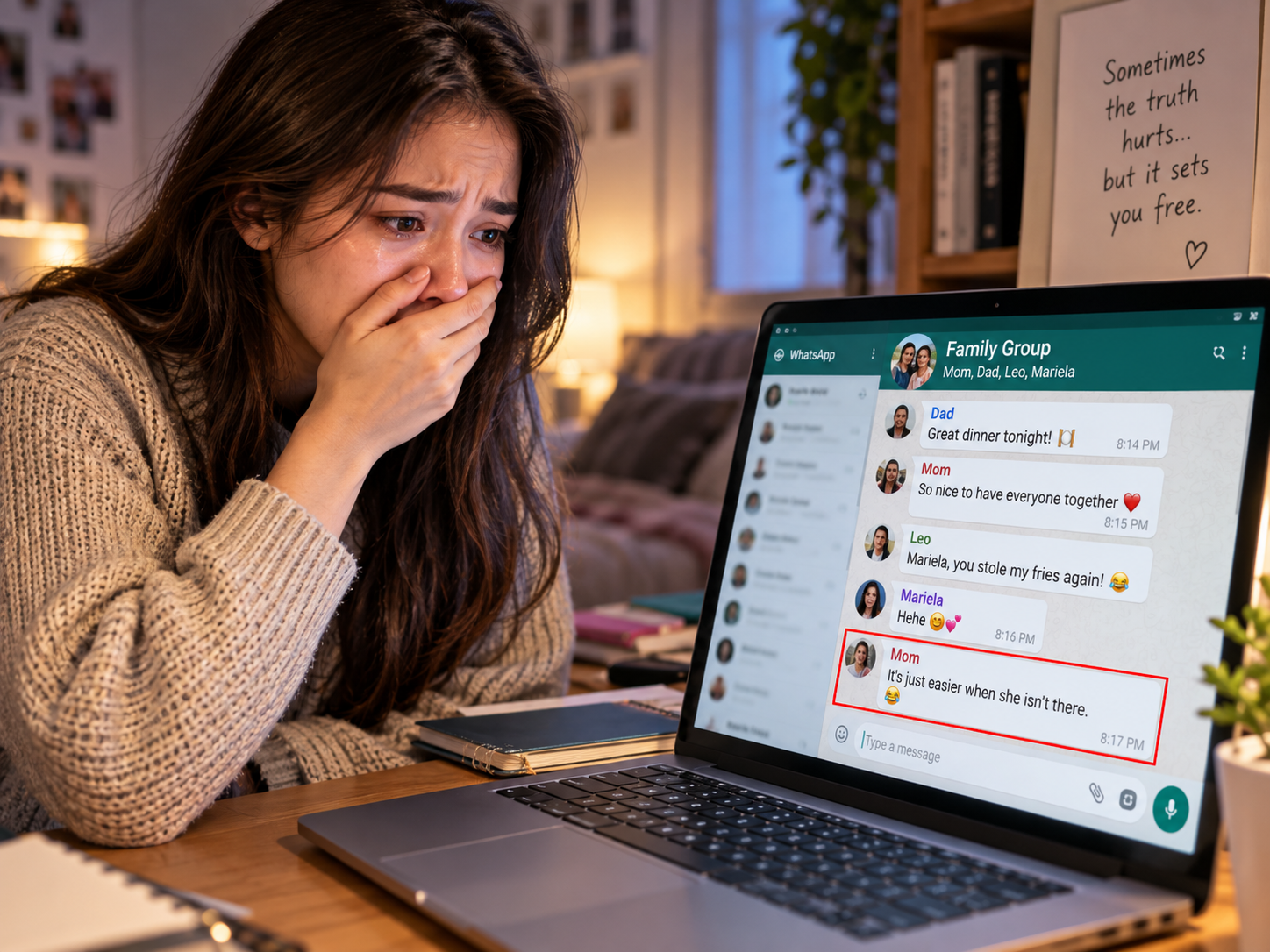
I thought about the first message I had seen on my laptop.
The sentence that had shattered the version of my family I had spent years defending.
At the time, I had believed that message was the end.
It wasn't.
It was the first piece of evidence that allowed me to stop doubting myself.
Everything after that had been a choice.
Leaving.
Working.
Returning.
Reading the letters.
Meeting Elena.
Setting boundaries.
Allowing some people back in carefully.
Keeping others at a distance.
None of those choices had been made for me.
That mattered.
I walked back into the house.
On the dining table sat the framed photograph of my grandmother with all of us.
I touched the glass.
For years, I had wanted a seat at the table.
Now I understood that the goal was never simply to be invited.
The goal was to sit there without fear.
To speak without rehearsing.
To leave without being punished.
To stay without disappearing.
That was what my grandmother had been trying to teach me.
And finally, I had learned.
I turned off the dining-room light.
The photograph remained visible in the dim hallway.
Tomorrow, the family might disagree again.
Someone might make a mistake.
Someone might disappoint me.
I might disappoint them.
That was ordinary life.
But nobody would get to convince me again that silence was the price of belonging.
I locked the front door.
Then I put the key in my pocket.
For the first time, it didn't feel like a symbol of something I had been denied.
It felt like mine.
And as I walked down the quiet hallway, I realized the family story had never really been about the secret dinners.
It had been about a girl who kept giving away pieces of herself because she thought that was what love required.
The woman she became finally knew better.
She could love people.
She could forgive.
She could remember.
She could even leave the door open.
But she would never again leave herself outside.
Click Here to continue read next: PART13: The family finally seemed peaceful, until one ordinary afternoon uncovered the last document my grandmother had deliberately kept hidden
The laptop was still open when one careless notification exposed the family secret I had spent years convincing myself was only in my head
Part 12 of 16