Elena and I didn't become sisters overnight.
There was no dramatic transformation.
No sudden flood of childhood memories we had somehow shared.
We were strangers with the same father.
That was the truth.
But it was also enough to begin.
We started with coffee.
Then lunch.
Then long phone calls.
She told me about her children.
I told her about Dallas.
She laughed when I described Sophie's rattling fan.
I showed her photographs of the garden.
She sent me pictures of her dog.
It was ordinary.
That was what made it meaningful.
Nothing was forced.
Nobody told us what we were supposed to feel.
My father stayed mostly out of the conversations.
I appreciated that.
He had already spent enough of his life arranging what other people knew.
This time, Elena and I could decide for ourselves.
One afternoon, she asked about Mariela.
I hesitated.
"Why?"
"Because Dad mentioned her."
I looked away.
"It's complicated."
"Everything seems complicated with our family."
I laughed.
"That's fair."
I told her the story.
Not every detail.
Just enough.
She listened carefully.
When I finished, she said, "She sounds scared."
"She was."
"That doesn't excuse it."
"I know."
Elena nodded.
"I've made mistakes because I was scared too."
That sentence stayed with me.
It was one thing to recognize that fear could explain behavior.
It was another to admit that explanation did not erase responsibility.
A week later, Elena came to the house.
She walked through the rooms slowly.
"This feels like Grandma."
"It does."
She stood in the garden.
"She used to talk about you."
I looked at her.
"What did she say?"
"That you noticed things."
I smiled.
"Apparently too much."
Elena laughed.
"She said you were the one most likely to ask why."
I thought about the family group.
The dinners.
The balcony.
Maybe that had always been my role.
Not troublemaker.
Question asker.
The person who couldn't accept an answer simply because everyone else had.
We sat beneath the old tree.
Elena looked at the house.
"Do you know why Dad stopped seeing me?"
I hesitated.
"I know what he told me."
"What did he say?"
"That the divorce became ugly and contact disappeared."
She nodded.
"That's part of it."
I looked at her.
"What was the rest?"
She was quiet.
Then she said, "Dad chose silence."
The words echoed what my grandmother had written.
"Your mother?"
"She was angry. But she didn't stop him forever."
Elena looked at the ground.
"He could have fought harder."
I didn't defend him.
"You're right."
She looked at me.
"I don't hate him."
"I don't either."
"Sometimes I wish I could."
I understood.
Hating someone could be easier than carrying disappointment.
We sat quietly.
Then she asked, "Did he do the same thing to you?"
I knew what she meant.
"Not exactly."
"But he let people make decisions for you."
"Yes."
She nodded.
"Then Grandma was right."
"About what?"
"He repeats silence."
That evening, my father came to the house.
Elena was there.
When he saw her, he stopped.
For a second, nobody moved.
Then Elena said, "Hi, Dad."
He looked like someone had taken the ground away.
"Hi."
They hugged.
I stepped outside.
I gave them privacy.
When my father eventually joined me in the garden, his eyes were red.
"Thank you."
"For what?"
"For giving her a chance."
"I didn't give her anything."
He smiled sadly.
"Maybe that's what I needed to hear."
We stood beside the garden.
He looked at the herbs.
"Your grandmother would love this."
"She would."
He reached into his pocket.
He pulled out a small key.
I recognized it.
"What is that?"
"There is another drawer."
I frowned.
"What?"
"In the old cabinet."
My heart sank.
"Another secret?"
He shook his head.
"Not a secret."
"Then what?"
"Something I should have given you years ago."
He handed me the key.
I stared at it.
"Where?"
"At the house."
We went inside.
He led me to a small built-in cabinet in the hallway.
I had never noticed it.
He opened the door.
Inside was a wooden box.
My grandmother's initials were carved into the lid.
I opened it.
There were letters.
Dozens.
Some addressed to me.
Some to Elena.
Some to my mother.
Some to my father.
My grandmother had written them over several years.
My father sat down.
"She told me to give these to you when you were ready."
I looked at him.
"Why now?"
"Because I finally understood that you were."
I opened the first letter.
It wasn't about the family conflict.
It was about me.
My grandmother wrote about the day I had asked her why adults sometimes tell children not to ask questions.
She wrote that I had been seven.
I didn't remember the conversation.
She did.
She wrote that I had been angry because my mother told me to stop asking why my father was upset.
My grandmother had answered me honestly.
She told me that adults sometimes hide difficult things because they don't know how to face them.
Then she wrote:
"Never confuse someone's fear of a question with proof that the question is wrong."
I stopped reading.
My father looked away.
I asked, "Did you know this was happening?"
"Some of it."
"Why didn't you stop it?"
He swallowed.
"Because I thought your mother and I could fix things ourselves."
"You couldn't."
"No."
I turned another page.
The next letter was written shortly before my grandmother died.
She wrote that she had become increasingly worried about my future.
She had seen how easily I apologized.
How quickly I accepted blame.
How often I gave up what I wanted to avoid conflict.
She feared I would grow into an adult who measured love by how much she could endure.
I stared at those words.
That was exactly what I had done.
My father said quietly, "She was trying to warn you."
"She was trying to prepare me."
He nodded.
I read another letter.
This one mentioned Elena.
My grandmother wrote that she hoped I would someday meet her.
She said Elena had inherited some of my father's stubbornness.
I laughed.
My father smiled.
Then my grandmother wrote something that made the room feel suddenly smaller.
She said that one day, my father might ask me to choose between forgiveness and distance.
She hoped I would understand that they were not opposites.
I folded the letter.
That sentence stayed with me.
For months, I had believed I needed to decide whether my family deserved forgiveness.
Now I understood the question was different.
I had to decide what relationship, if any, I wanted.
Forgiveness did not require access.
Love did not require surrender.
Family did not require pretending.
Those distinctions had taken years to learn.
My father stood.
"I won't ask you to come back."
I looked at him.
"Good."
He smiled faintly.
"I won't ask you to forget."
"Better."
He moved toward the door.
Then he stopped.
"Can I ask you something?"
"What?"
"Can I come to the garden sometimes?"
I considered it.
"With permission."
He laughed.
"Fair."
After he left, I returned to the box.
There was one final envelope.
My name was written on it.
The date was the week before my grandmother died.
I opened it.
The first line made me cry immediately.
She wrote that if I was reading the letter, she was probably gone.
She said she hoped I had learned that leaving was not the same as abandoning people.
Then she asked me to promise one thing.
Not to forgive everyone.
Not to return home.
Not to rebuild the family.
She asked me to build a life in which I never again had to make myself smaller to keep someone else comfortable.
I read the letter twice.
Then I placed it beside the others.
Outside, Elena was talking to my father.
Their voices were quiet.
Not perfect.
Not healed.
But present.
I looked through the window.
For years, I had thought the opposite of abandonment was staying.
Now I knew better.
Sometimes the opposite of abandonment was showing up honestly.
And perhaps that was what my family was finally learning to do.
Click Here to continue read next: PART12: The final letter explained why my grandmother had chosen me for the house, and its last instruction changed how I saw every person at that table
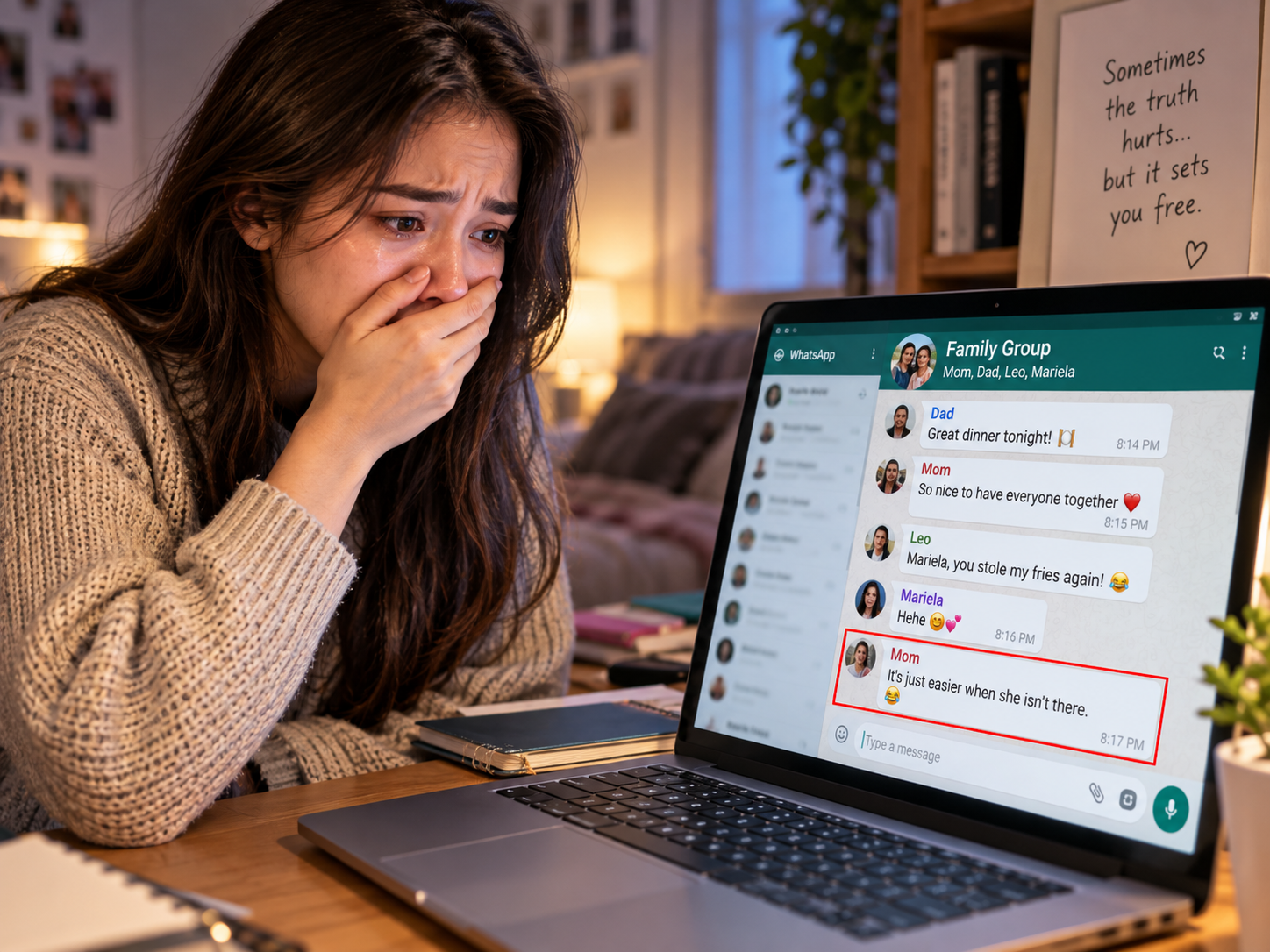
The laptop was still open when one careless notification exposed the family secret I had spent years convincing myself was only in my head
Part 11 of 16