Six months after I left, I returned to San Antonio.
I didn't return for my family.
That distinction mattered.
I needed my college transcripts and a few boxes I had left with my aunt.
The trip was short.
At least that was what I told myself.
My aunt opened the door before I knocked twice.
She pulled me into a hug.
Then she made coffee.
She didn't ask why I had left.
She didn't ask whether I was planning to reconcile.
She simply looked at me and said, "It took you a while, but you arrived right on time for yourself."
I carried those words with me all day.
My boxes were smaller than I remembered.
Some books.
A few photographs.
Old notebooks.
A jacket.
Things that had seemed important when I left.
I packed them into the car.
My phone buzzed.
Mom.
The message was brief.
"We can see each other if you've cooled down."
I read it once.
Then again.
I sat in the car with the engine off.
Six months earlier, that message would have pulled me back immediately.
I would have started explaining.
I would have apologized for leaving.
I would have tried to make the conversation easier for everyone.
This time, I simply stared at the screen.
Cooled down.
As though the problem had been my temperature.
As though the secret group hadn't existed.
As though my mother hadn't known about the dinners.
As though I hadn't slept on a balcony while Mariela used my room.
As though I had left because I was emotional rather than because I had finally believed what I was seeing.
I deleted the message.
I didn't block her.
I didn't answer.
That felt different.
Not forgiveness.
Not reconciliation.
A boundary.
Before leaving town, I drove past the old house.
I hadn't planned to.
The turn appeared, and I took it before I could change my mind.
The street looked smaller.
The houses seemed closer together.
The crooked gate was still there.
The paint was peeling.
The bougainvillea in front had grown over part of the wall.
For a moment, I expected to feel the old pull.
I didn't.
I parked across the street.
I stayed inside the car.
No one came outside.
I looked at the windows.
The kitchen light was on.
A shadow moved behind the curtain.
I wondered who was sitting at the table.
Maybe they were eating.
Maybe Mariela was there.
Maybe Leo was scrolling through his phone.
Maybe my mother was serving dinner.
Maybe my father was telling everyone about his day.
The thought didn't hurt the way it once had.
Then I looked toward the balcony.
I expected to see my old folding bed.
It wasn't there.
The space was empty.
No chair.
No boxes.
No laundry.
Nothing.
I stared at it for a long time.
It was strange.
That little balcony had once represented everything I couldn't say.
It had been the place where I slept while pretending I wasn't being pushed aside.
Now it was simply an empty patch of concrete.
I didn't know whether I felt angry or relieved.
Maybe both.
Maybe neither.
The house no longer belonged to the story I was living.
I started the car.
Before pulling away, I looked at the balcony one last time.
Then I drove.
Back in Dallas, life continued.
My apartment was still small.
The afternoon sun came through the window in a bright rectangle that moved slowly across the floor.
I worked.
I paid my bills.
I got tired.
Sometimes sadness appeared without warning.
Sometimes I dreamed about closed doors.
Sometimes I dreamed about tables where no chair had been placed for me.
But I woke up.
That mattered.
I had learned that healing wasn't a clean line.
Some mornings I felt free.
Other mornings, an ordinary smell or a certain song could bring the old house back in an instant.
I no longer treated those moments as proof that I had made the wrong decision.
They were simply memories.
I had them.
They didn't own me.
My family still existed.
I knew that.
Somewhere in San Antonio, they were living their lives.
Maybe they still blamed me.
Maybe they told the story differently.
Maybe I had become the difficult daughter who had abandoned everyone.
Maybe they believed they had done nothing wrong.
I couldn't control that anymore.
For years, I had spent enormous energy trying to make them understand my pain.
I had thought that if I explained it perfectly, they would finally see it.
But some people don't change their version of a story simply because you provide better evidence.
So I stopped arguing with an audience that had already chosen its side.
One afternoon, I went grocery shopping.
I walked past the produce section.
Apples were stacked beneath a bright sign.
I stopped.
There were dozens.
Red ones.
Green ones.
Large ones.
Small ones.
I picked four of the biggest red apples and placed them in my basket.
Four.
I didn't know why that number mattered.
Maybe because I was used to counting.
Maybe because I was used to wondering whether there would be enough.
Now there was.
When I got home, I put the apples into a bowl on my kitchen table.
The apartment was quiet.
Sunlight filled the room.
I washed one.
Then I stood by the open window and took a bite.
It was crisp.
Sweet.
Ordinary.
And I thought about the house.
Not with longing.
Not with hatred.
Just recognition.
I finally understood that I hadn't left because of one message.
I hadn't left because of one dinner.
I hadn't even left because they had moved me onto the balcony.
Those things had only made the truth visible.
I had left because I stopped asking them to give me permission to matter.
That was the real change.
For years, I had waited for my mother to choose me.
I had waited for my father to defend me.
I had waited for Leo to notice.
I had waited for Mariela to admit what she had taken.
I had waited for the family to become the family I needed.
And while I waited, I kept making myself smaller.
The secret group hadn't created the loneliness.
It had simply given the loneliness a name.
The dinners hadn't created the exclusion.
They had proven it.
The balcony hadn't created the displacement.
It had made it impossible to keep pretending.
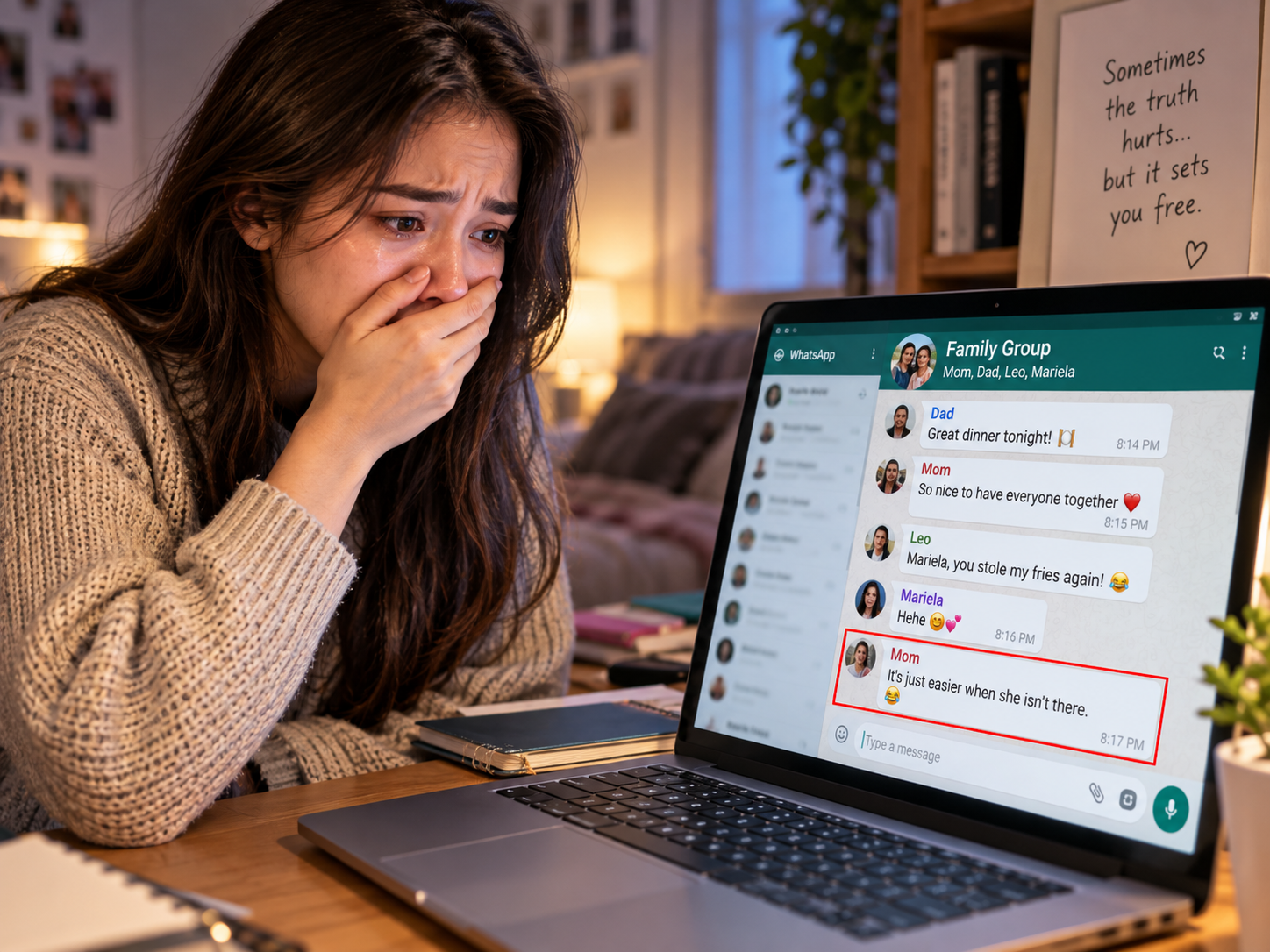
The message on that laptop had been a door.
I had finally opened it.
And once I saw what was on the other side, I couldn't unknow it.
I took another bite of the apple.
There was no one across the table.
No one telling me I was selfish.
No one asking whether I had saved enough for someone else.
No one reminding me that I should be grateful.
I was alone.
But alone was not the same thing as abandoned.
That distinction had taken me years to learn.
Sometimes I still thought about calling my mother.
Sometimes I imagined what it would feel like if she called and said the words I had waited for.
I'm sorry.
We were wrong.
You didn't imagine it.
You belonged here.
But I had stopped building my life around imaginary apologies.
Maybe someday she would understand.
Maybe she wouldn't.
Either way, I couldn't keep my life paused while waiting.
I opened the window wider.
Warm air moved through the room.
On the table, the bowl held three untouched apples.
The fourth was in my hand.
I looked at them and smiled.
There was something almost funny about how such a small fruit could carry so many memories.
But perhaps that was how ordinary things worked.
A room.
A chair.
A plate.
A balcony.
An apple.
They could become symbols of everything you had survived without realizing you were surviving.
I took another bite.
And this time, I didn't think about who had received the larger half.
I didn't think about who had been invited to dinner.
I didn't think about who was sitting at the family table.
I thought about the first night I had slept on Sophie's sofa.
The terrible coffee at the station.
The bus leaving San Antonio.
The dry Dallas heat.
The first paycheck.
The apartment.
The ridiculous rattling fan.
The apple Sophie had brought me.
All the small choices that had slowly returned my life to me.
I realized then that leaving hadn't made me a different person.
It had simply given me enough space to become the person I had been before I learned to disappear.
I finished the apple standing beside the open window.
Outside, traffic moved along the street.
Someone laughed in the apartment below.
A dog barked.
A truck passed.
Ordinary life continued.
I looked at the empty chair across my table.
For once, I didn't feel as though someone was missing.
I had spent years believing home was wherever my family gathered.
Now I understood something simpler.
Home was the place where I didn't have to earn the right to exist.
And I had finally built one.
I hadn't left that house when I saw the secret group.
I hadn't left when I discovered the dinners.
I hadn't left when they moved me to the balcony.
I left when I stopped asking them for permission to have a place at the table.
Click Here to continue read next: PART5: The life I had built in Dallas finally felt steady until an unexpected call from home reopened the question I thought I had already answered
The laptop was still open when one careless notification exposed the family secret I had spent years convincing myself was only in my head
Part 4 of 16