The house stood twenty minutes outside the city.
It was smaller than the home where I had grown up.
There was a narrow porch, two bedrooms, a faded blue door, and a garden that had been neglected for years.
I had passed it once as a child.
I remembered my grandmother pointing toward it from the car.
She had said it belonged to someone she knew.
Apparently, that had been another lie meant to protect something.
I unlocked the front door.
Dust floated through the sunlight.
The air smelled like old wood.
For a moment, I couldn't move.
My grandmother had been here.
That thought was stronger than everything else.
Her books were still on a shelf.
There was a chipped teacup in the kitchen.
A knitted blanket rested over the back of a chair.
Someone had preserved the house instead of emptying it.
I walked from room to room.
The second bedroom contained boxes.
I opened one.
Inside were photographs.
My grandmother with my mother as a young woman.
My father before his hair turned gray.
Leo as a baby.
Me.
Hundreds of photographs.
I sat on the floor.
There were pictures of me that I had never seen.
My grandmother holding me when I was small.
Me asleep against her shoulder.
Me standing beside her in the garden.
A birthday cake.
A school ceremony.
A Christmas morning.
I turned one photograph over.
On the back, she had written the date.
And beneath it:
"She always looks for everyone else before looking for herself."
I stared at the sentence.
Then I cried.
Not because it was sad.
Because someone had noticed.
I spent the afternoon cleaning.
Not because the house needed to be perfect.
Because doing something with my hands made the reality easier to understand.
By evening, I had opened every window.
The rooms filled with fresh air.
I swept the floors.
I wiped the kitchen counters.
I found an old radio and turned it on.
Music filled the room.
For the first time, the house felt alive again.
I stayed there overnight.
The bed in the main bedroom was old but comfortable.
I slept deeply.
In the morning, I woke before sunrise.
For a few seconds, I didn't know where I was.
Then I remembered.
The house was mine.
I walked into the kitchen.
There was a note taped inside one cabinet.
My grandmother's handwriting again.
It said that if I had reached this point, I probably knew more than she had ever wanted me to know.
I sat down.
The note continued.
She explained that my mother had struggled after my grandmother's husband died.
She had become dependent on the family for emotional support.
Mariela had entered the picture during a difficult period.
But the letter made something clear.
My grandmother did not blame Mariela for everything.
She blamed the family's habit of avoiding difficult truths.
That distinction mattered.
Mariela hadn't created every problem.
My parents had chosen how to respond.
Leo had chosen whether to participate.
I had chosen whether to remain.
That was uncomfortable because it meant there was no single villain who could explain everything.
There was only a family that had repeatedly chosen convenience over honesty.
I read the rest of the note.
My grandmother wrote that she had worried about my father controlling the property after her death.
She had therefore placed everything in legal documents that required my consent.
The house.
The account.
The remaining belongings.
Nothing could be transferred without me.
I understood why my father had been afraid.
Not of losing the house.
Of losing control.
That afternoon, I received a message from Leo.
He had somehow gotten my new number.
It said:
"Can we talk?"
I almost ignored it.
Instead, I replied.
"About what?"
He answered quickly.
"I didn't know about the house."
I believed him.
At least about that.
"What did you know?"
He took several minutes.
Then:
"The dinners."
I stared at the screen.
"Why?"
He wrote that he had believed our parents were trying to help Mariela.
He said he hadn't understood how deliberate the exclusion had become.
I replied:
"You joked about me."
There was a long pause.
"I know."
"Why?"
"I thought it was harmless."
I closed my eyes.
That answer was familiar.
Harmless.
That was the word everyone used for things that had hurt me.
A joke was harmless.
A dinner was harmless.
Moving my belongings was harmless.
Sleeping on the balcony was temporary.
A private group was harmless.
One decision after another.
Nothing was ever serious until someone finally left.
Leo sent another message.
"I was wrong."
I didn't know what to say.
He continued.
"Mom is different now."
I almost laughed.
"Different how?"
"She cries a lot."
I looked at the ceiling.
"That's not change."
He didn't answer.
Then he wrote:
"Mariela told her the truth."
My heart tightened.
"What truth?"
Leo said he didn't know everything.
But he had overheard an argument.
Mariela had admitted that she had encouraged my mother to believe I was selfish because she was afraid of losing her place in the family.
I read the sentence twice.
It explained something.
Not everything.
But something.
Mariela had been afraid.
That didn't excuse what she had done.
It did explain why she had clung to the role everyone had given her.
I asked Leo whether he believed her.
He replied:
"Yes."
I didn't know whether that made me angry or relieved.
Then he sent another message.
"There's something else."
I waited.
"She said Dad knew."
My stomach tightened.
"Knew what?"
"That she was manipulating Mom."
I put the phone down.
The house was silent.
I walked into the kitchen.
My grandmother's teacup was still on the shelf.
I touched it.
I thought about my father.
The man who had always insisted on rules.
Respect.
Family.
Responsibility.
He had known.
And still said nothing.
I called him.
He answered immediately.
"What do you want?"
"The truth."
He sighed.
"About what?"
"Mariela."
Silence.
Then he said, "She was scared."
"So were you."
"Of what?"
"Of losing control."
He didn't respond.
I continued.
"You knew she was lying."
"I knew she was afraid."
"That's not an answer."
He raised his voice.
"You don't understand what was happening in this family."
"I understand exactly what happened to me."
He became quiet.
I asked, "Did you know she was turning Mom against me?"
He finally said, "Yes."
The word landed heavily.
I closed my eyes.
"How long?"
"I don't know."
"You knew."
"Yes."
"And you did nothing."
"I thought it would settle down."
I laughed bitterly.
"That's what everyone thought."
He said nothing.
I asked the question I had avoided for months.
"Did you ever love me?"
The silence that followed was unbearable.
Then he said, "Of course."
"Then why did you let me disappear?"
His voice broke.
"I thought you were strong enough."
I sat down.
There it was.
The sentence that had followed me my entire life.
Strong enough.
Strong enough to give up the room.
Strong enough to sleep outside.
Strong enough to be excluded.
Strong enough to swallow every insult.
Strong enough to survive being loved last.
I whispered, "I shouldn't have had to be."
He began crying.
I had never heard my father cry.
It didn't erase anything.
But it changed something.
Not the past.
My understanding of it.
He wasn't a monster.
He was a man who had made cowardly choices because they were easier than confronting the family.
That was not an excuse.
It was simply the truth.
We stayed on the phone without speaking.
Finally, he said, "Your grandmother knew."
"I know."
"She warned me."
I looked at the old note.
"What did she say?"
"She told me that if I kept trying to keep everyone happy, eventually I'd lose the person who mattered most."
My throat tightened.
"Who did she mean?"
He whispered, "You."
The call ended a few minutes later.
I remained seated.
Outside, wind moved through the trees.
I looked around the house.
My grandmother had left me more than property.
She had left me evidence.
Evidence that I had not imagined everything.
Evidence that someone had seen the pattern before I was old enough to name it.
And perhaps most importantly, she had left me a choice.
I could turn this house into another battlefield.
Or I could turn it into the first place where nobody had to disappear.
I wasn't ready to decide.
But I knew I wouldn't sell it.
Not yet.
Click Here to continue read next: PART8: I invited everyone to the house for one final conversation, but the person who arrived first brought a truth none of us expected
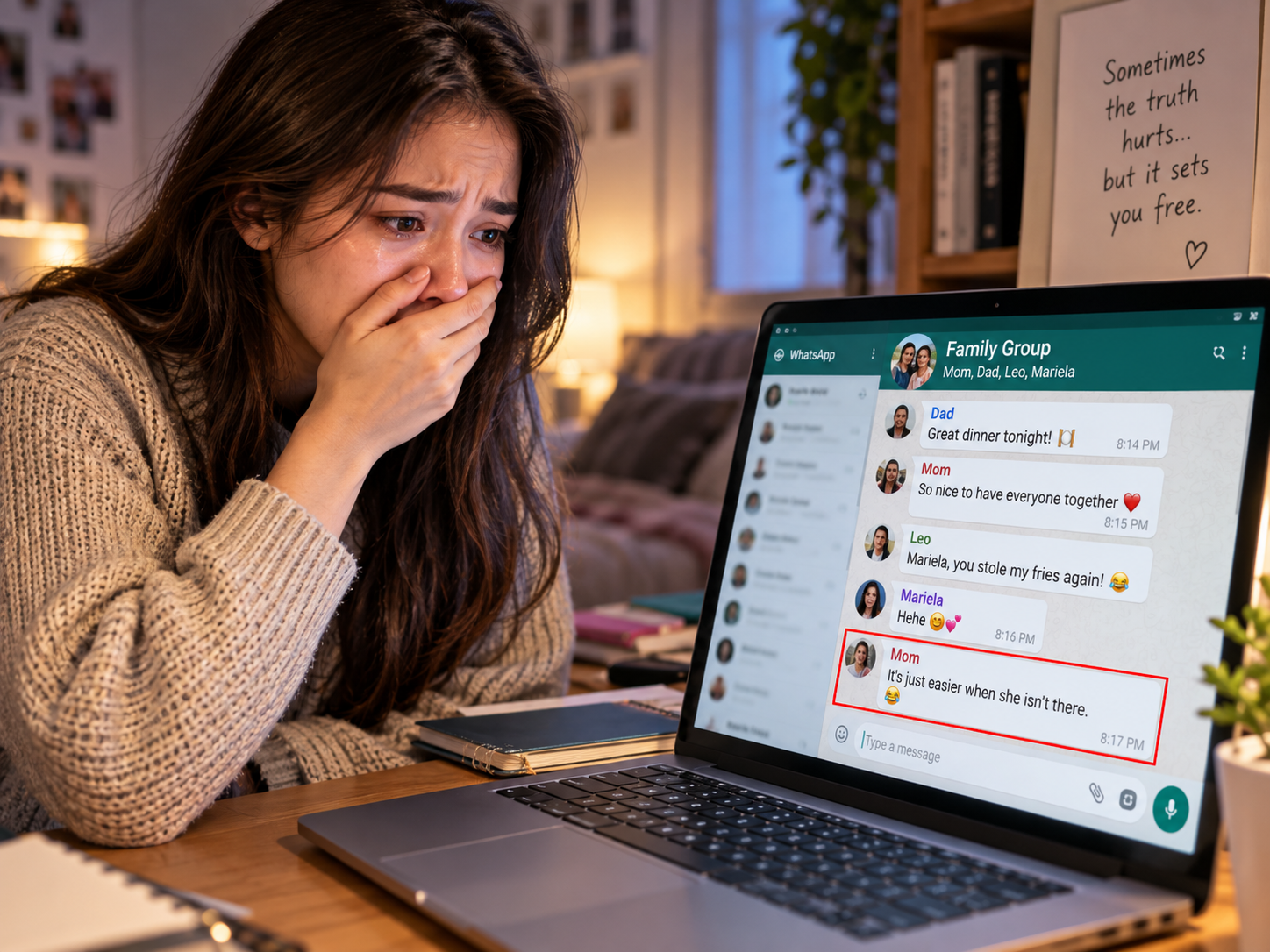
The laptop was still open when one careless notification exposed the family secret I had spent years convincing myself was only in my head
Part 7 of 16