
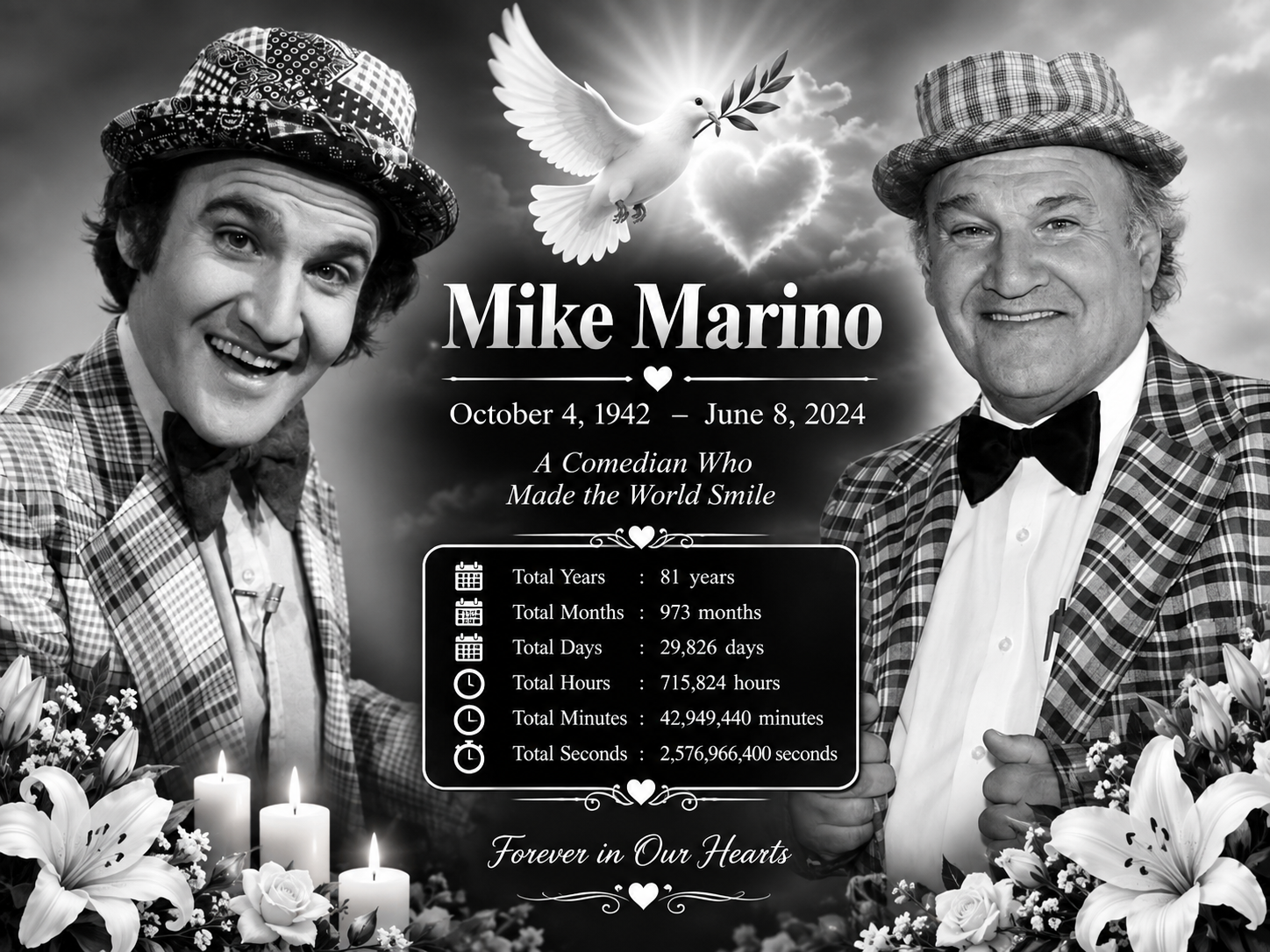
The deeper the record of Mike Marino’s career is examined, the harder it becomes to describe him through only one occupation. “Comedian” is accurate, but incomplete. “Actor” is also accurate, yet incomplete. He was a performer who moved between forms, carrying pieces of one discipline into another until they became part of a recognizable personal style.
That style had begun in New Jersey, where family, neighborhood life, school activities, and Italian-American traditions supplied the experiences that later became material. Marino did not have to invent an entirely separate identity for the stage. Instead, he repeatedly transformed familiar parts of his own background into entertainment.
The result was a career in which location mattered. New Jersey was not simply where Marino happened to be born and raised. It became one of the most recognizable elements of his professional identity. His nickname, “New Jersey’s Bad Boy of Comedy,” connected him directly to the place that had shaped much of his worldview.
But the nickname alone could never explain the longevity of the career. A regional identity can attract attention, but sustaining an entertainment career requires the ability to perform in different environments. Marino demonstrated that ability through acting, commercials, stand-up, television, character work, touring, and digital projects.
His early involvement in theater and music at Scotch Plains-Fanwood High School provided the first visible foundation. He participated in the Repertory Theatre, Drama Club, and Moonglowers and played drums in the marching band. His school history also records his early entry into professional acting through membership in the Screen Actors Guild at sixteen.
That early start gave his later career an important context. Marino was not someone who discovered entertainment after becoming an adult and then had to build a performance identity from nothing. The interest had already appeared during adolescence. The professional career simply grew larger around it.
Formal training followed at the Herbert Berghof Studio and the American Academy of Dramatic Arts. Acting therefore remained part of the foundation even when stand-up became the most visible portion of his career. The training helped prepare him for commercial work, television appearances, character performances, and the physical demands of comedy.
Commercials became one of the substantial early chapters. Marino was credited with more than 200 national television commercials and received a Best Actor Clio nomination. That record is easy to overlook because later audiences primarily associated him with stand-up, but it demonstrates how much camera experience he accumulated before and alongside his comedy career.
The commercial world also taught a valuable lesson about performance: a performer has to establish a personality quickly. There may be little time to communicate a character, a reaction, or a comic idea. Marino later carried that ability into television and stand-up, where the amount of time available could vary dramatically from a short appearance to an entire comedy set.
His television career expanded that range. Marino appeared in “As the World Turns,” “One Life to Live,” “Becker,” “Nikki,” “Frasier,” and “Party of Five,” among other programs. He also appeared on “The Tonight Show with Jay Leno.” These appearances placed him in different performance environments while keeping acting and comedy connected.
The stage remained the place where Marino could exercise the greatest control over his own material. There, his New Jersey experiences and Italian-American family background became central ingredients. Instead of abandoning his origins when he reached larger audiences, he made those origins part of the reason audiences recognized him.
That approach also gave him room to create characters. Cousin Mooney, Uncle Tommy, Cousin Michelle, and G.I. Giovanni became recurring figures associated with his work. They demonstrated that Marino’s comedy was not dependent on presenting only one version of himself.
Each character could emphasize a different personality or comic perspective. The characters also reflected the acting background that had been present since his youth. Stand-up gave Marino a direct relationship with the audience, while character comedy allowed him to step into another identity and then return to his own.
His touring career placed all of these skills under pressure. Comedy clubs, theaters, casinos, and event centers required repeated performances for different audiences. He also appeared at Just for Laughs in Montreal for seven consecutive years, according to reporting published after his death.
Touring meant that the New Jersey material had to work beyond New Jersey. A family story might begin in Scotch Plains, but the audience could be hundreds or thousands of miles away. The more universal elements of the story—family behavior, embarrassment, arguments, cultural habits, generational differences—allowed the material to travel.
That portability became one of the most important characteristics of Marino’s career. His comedy was geographically specific enough to have personality, but broad enough to be understood by people who did not share his exact hometown.
The same principle could be seen in his Italian-American material. Cultural identity was not presented as an abstract subject. It appeared through family relationships, food, neighborhood experiences, language, and recognizable personalities. That made the subject accessible even to people who came from different backgrounds.
“Make America Italian Again” later extended that part of his identity into a digital project. Legacy mentioned the project when remembering Marino, while his official website also presented it as part of his work. The project demonstrated how Marino continued adapting his established themes to different media.
“Live From My Mother’s Basement” offered an even more direct connection between his public work and his personal history. The podcast was recorded in the basement of the home where he had grown up. According to an April 2026 interview, Marino had purchased that house after the deaths of his parents and had been spending time walking around the neighborhood.
The physical setting mattered because it reflected a pattern that had appeared throughout his career. Marino repeatedly returned to the places that had shaped him. Rather than treating his childhood as something to leave behind permanently, he used it as a continuing source of material.
That pattern reached its clearest expression in “Mike Marino: Back 2 School.” The special was filmed at Scotch Plains-Fanwood High School with Daniel Catullo, turning the school environment into part of the performance. The school described the project as personal and as a full-circle moment for Marino.
The production recreated elements of the school period, including a 1981 classroom and an auditorium transformed into a comedy club. Marino could therefore stand in the same institution where he had once been a student while performing as the professional entertainer he had become.
The project also had a community purpose. The school’s account described the special as a way of giving back, with proceeds connected to music and theater programs. That made the return more than a personal exercise in memory. It connected his professional success to the educational environment that had helped him develop.
His 2024 induction into the Scotch Plains-Fanwood High School Hall of Fame added another marker to that relationship. The recognition came after decades of work and before his final illness, placing the achievement firmly within the career he had already built.
By then, Marino’s record also included the New Jersey Comedy Hall of Fame, where he had been inducted in 2008, and the USO Bob Hope Comedy Award, which he received in 2015. Those honors came from different parts of his professional life but together reflected the breadth of his work.
The USO chapter was particularly different from the others. Marino performed for service members in Bosnia and Afghanistan, bringing comedy into environments far removed from the New Jersey comedy clubs where his public identity had developed. His work with the USO became another example of his ability to carry the same profession into very different surroundings.
His connection with first responders and related charitable activities added still another layer. These efforts did not replace his entertainment career, but they became part of the public record of how he used his visibility outside ordinary performances.
By the time the final years arrived, therefore, Marino had already left a complicated professional map. There was no single place where the career could be contained and no single medium that could explain it.
The final health crisis did not simplify that history. It only placed a definitive endpoint on it.
And that endpoint made the earlier chapters easier to see as a whole.
Click Here to continue read next: PART14: Returning to the Places That Shaped Him Became One of Marino’s Most Visible Final Themes, Linking the Young Performer He Had Been With the Entertainer He Became
The Laughs Had Always Been Easy to Hear, but Behind the Jersey Jokes Was a Performer Quietly Building a Career From the Ground Up
Part 13 of 16


One Comment on “PART 13 – The Career Became Easier to Understand When Its Separate Chapters Were Placed Together, Revealing How Marino Turned a Jersey Childhood Into a Professional Language”