
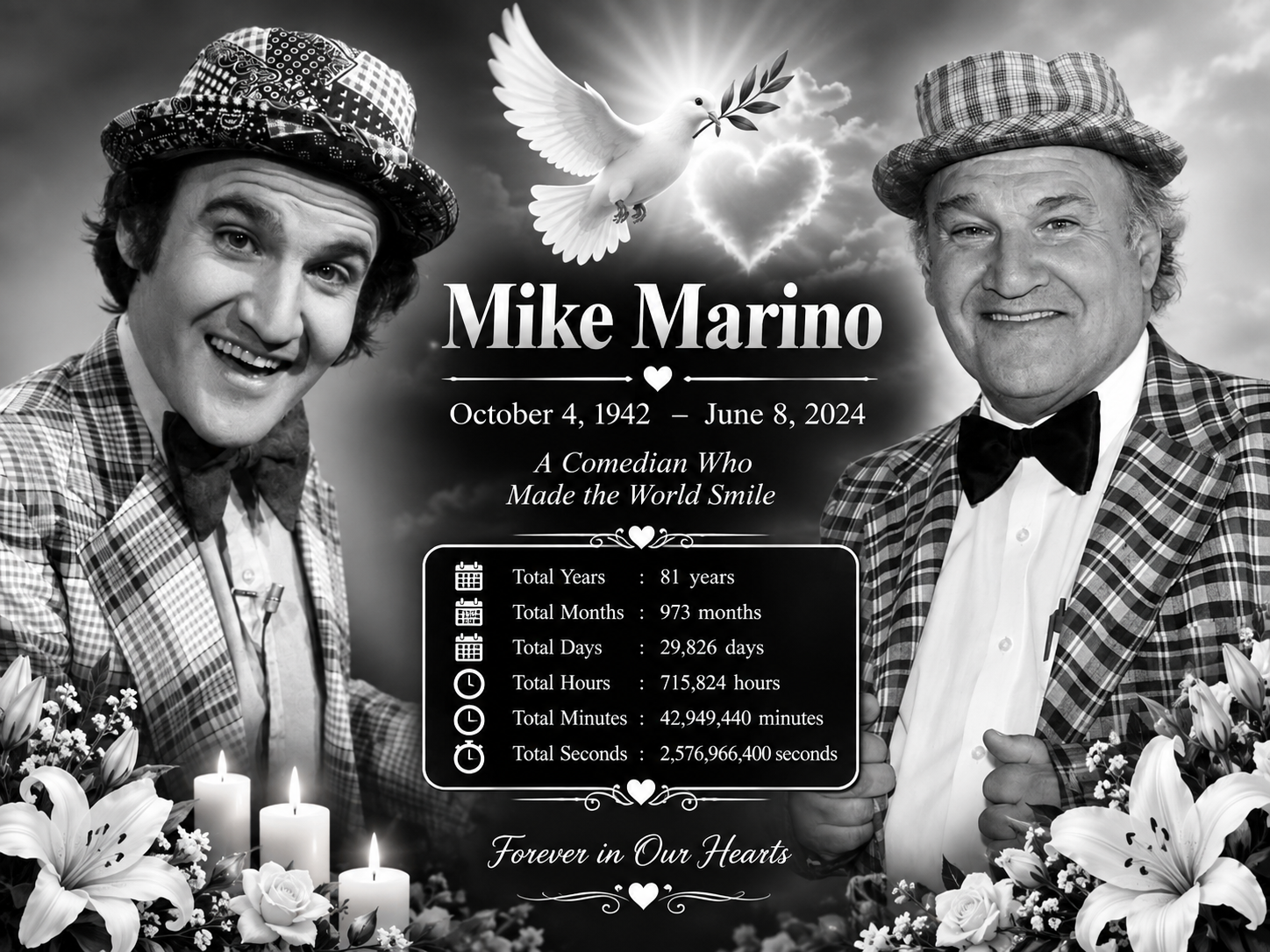
Mike Marino had spent decades making strangers laugh, but the most important question at the end of his life was not how many jokes he had told. It was how much of himself had gone into creating the man audiences called New Jersey's Bad Boy of Comedy.
His career did not begin with a microphone in his hand. Long before stand-up became his profession, Marino was a young performer in Scotch Plains, New Jersey, moving through school theater, music, and acting while trying to discover where his abilities could take him. Years later, those early experiences would become part of the story he repeatedly told onstage.
Marino was born in New Jersey and grew up in an Italian-American family in Scotch Plains. The details of that upbringing eventually became some of his richest comic material. Family habits, local characters, food, arguments, embarrassment, pride, and the particular rhythms of life in New Jersey could all become material once Marino learned how to look at them from the audience's side of the stage. ([Mike Marino][1])
At Scotch Plains-Fanwood High School, he was involved in several activities that already pointed toward entertainment. He participated in the Repertory Theatre and Drama Club, belonged to the Moonglowers, and played drums in the marching band. These were not separate pieces of an unrelated childhood. Together they gave him repeated opportunities to perform in front of other people. ([SPF K12][2])
The school auditorium would eventually become one of the most important locations in his professional story. At the time, however, it was simply part of his adolescence. He was learning timing through music, character through theater, and the strange discipline of standing in front of an audience and holding its attention.
There was also a practical side to his ambition. Marino did not simply decide that he wanted to be famous and wait for an opportunity. He pursued formal acting training after high school, attending the American Academy of Dramatic Arts in New York and studying at the Herbert Berghof Studio. Those institutions gave him a professional foundation before comedy became his best-known occupation. ([Mike Marino][1])
His early professional work was in acting and commercials. That period could easily disappear beneath the larger story of the comedian, but it mattered because television advertising gave Marino something every performer needs: repeated experience working under pressure, remembering material, understanding a camera, and communicating quickly.
By the early 1980s, he had already built enough of a reputation in commercials to receive recognition from the advertising industry. He was nominated for a Clio Award for his work in a commercial, an early sign that his ability as a performer was being noticed outside local theater. ([PVSC][3])
That recognition did not immediately make him a household name. Commercial work could put a performer in front of millions of viewers while leaving the performer personally anonymous. A face could be familiar without a name being attached to it.
Marino was determined to build something that belonged to him.
Stand-up comedy offered that possibility.
Instead of waiting for someone else to cast him, he could walk onto a stage with material he had developed himself. The audience's response was immediate. A joke either worked or it did not. A story either held attention or it lost the room. There was nowhere to hide behind another actor, another character, or a carefully edited commercial.
That directness suited Marino.
His comedy increasingly drew from the life he knew best: New Jersey, Italian-American family culture, everyday frustrations, relationships, food, local habits, and the exaggerated personalities found in ordinary family life.
The material was personal without requiring an audience to know him personally.
Someone from New Jersey could recognize the references.
Someone from an Italian-American household could recognize the family dynamics.
And someone who had never lived either experience could still recognize the basic human situations underneath the jokes.
That combination helped Marino develop a style that could travel.
He became a regular presence in comedy clubs and eventually performed at major venues across the United States and internationally. His official biography describes appearances at major clubs, theaters, casinos, and event centers, while other accounts note performances at venues including the Comedy Store and Laugh Factory. ([Mike Marino][1])
The more he performed, the more clearly his stage identity emerged.
Mike Marino was not trying to hide where he came from.
He leaned into it.
The Jersey identity became part of the act.
So did his Italian-American background.
Instead of treating those details as limitations, Marino made them the foundation of his comic world.
That approach became especially recognizable through recurring characters. His repertoire included Cousin Mooney, Uncle Tommy, Cousin Michelle, and G.I. Giovanni. These characters allowed him to stretch his storytelling beyond autobiographical observation and build a larger cast of personalities around his own performance. ([AOL.com][4])
The characters also gave audiences something to remember.
A comedian can tell hundreds of jokes, but recurring characters can become a kind of shorthand. Once an audience recognizes the voice, posture, or attitude of a character, the performer can return to that world without rebuilding it from the beginning.
Marino understood that.
His comedy was not only about individual punchlines. It was about creating recognizable people.
That skill came naturally from his acting background.
The actor and the comedian were not separate careers so much as two sides of the same performer. Acting taught him character. Stand-up taught him direct audience connection. Television taught him timing for cameras. Commercials taught him concise performance. His New Jersey upbringing supplied the subject matter.
The pieces were beginning to fit.
His television work expanded as well. He appeared in programs including As the World Turns, One Life to Live, Becker, Nikki, Frasier, and Party of Five. He also continued working in film and commercials. ([The Blue Magazine][5])
The television credits mattered because they showed that Marino's career could not accurately be described as stand-up alone.
He was an actor.
He was a comedian.
He was a commercial performer.
He became a storyteller.
Later, he would add podcasting and web production to that list.
But stand-up remained the center.
He became known nationally as “New Jersey's Bad Boy of Comedy,” a nickname that matched the personality he presented onstage. It was brash without requiring him to abandon the warmth of the family stories that formed much of his material.
The nickname also gave audiences an immediate idea of what they were going to receive.
They were not buying a lecture.
They were entering Marino's version of New Jersey.
And the longer he performed, the more that identity became inseparable from his professional name.
His career also began taking him beyond ordinary comedy-club appearances. Marino performed for corporate events, theaters, casinos, and special audiences. He appeared at the Just for Laughs Comedy Festival in Montreal for seven consecutive years, another indication that his act had traveled well beyond his home state. ([AOL.com][4])
The audience could change.
The room could change.
The country could change.
But the central material remained recognizable.
New Jersey.
Family.
Italian-American life.
Everyday absurdity.
The characters.
The performer himself.
That consistency became one of Marino's professional strengths.
But it also raised a question that would follow him for decades: how could a comedian remain connected to the place and family that created his material while continuing to grow beyond them?
The answer would come through something Marino understood unusually well.
He did not need to leave New Jersey behind to build a national career.
He could take New Jersey with him.
Click Here to continue read next: PART2: New Jersey Was Not Just the Setting for His Jokes; It Became the Language Marino Carried Onto Stages, Screens, Podcasts, and Audiences Far From Home
The Laughs Had Always Been Easy to Hear, but Behind the Jersey Jokes Was a Performer Quietly Building a Career From the Ground Up
Part 1 of 16

