
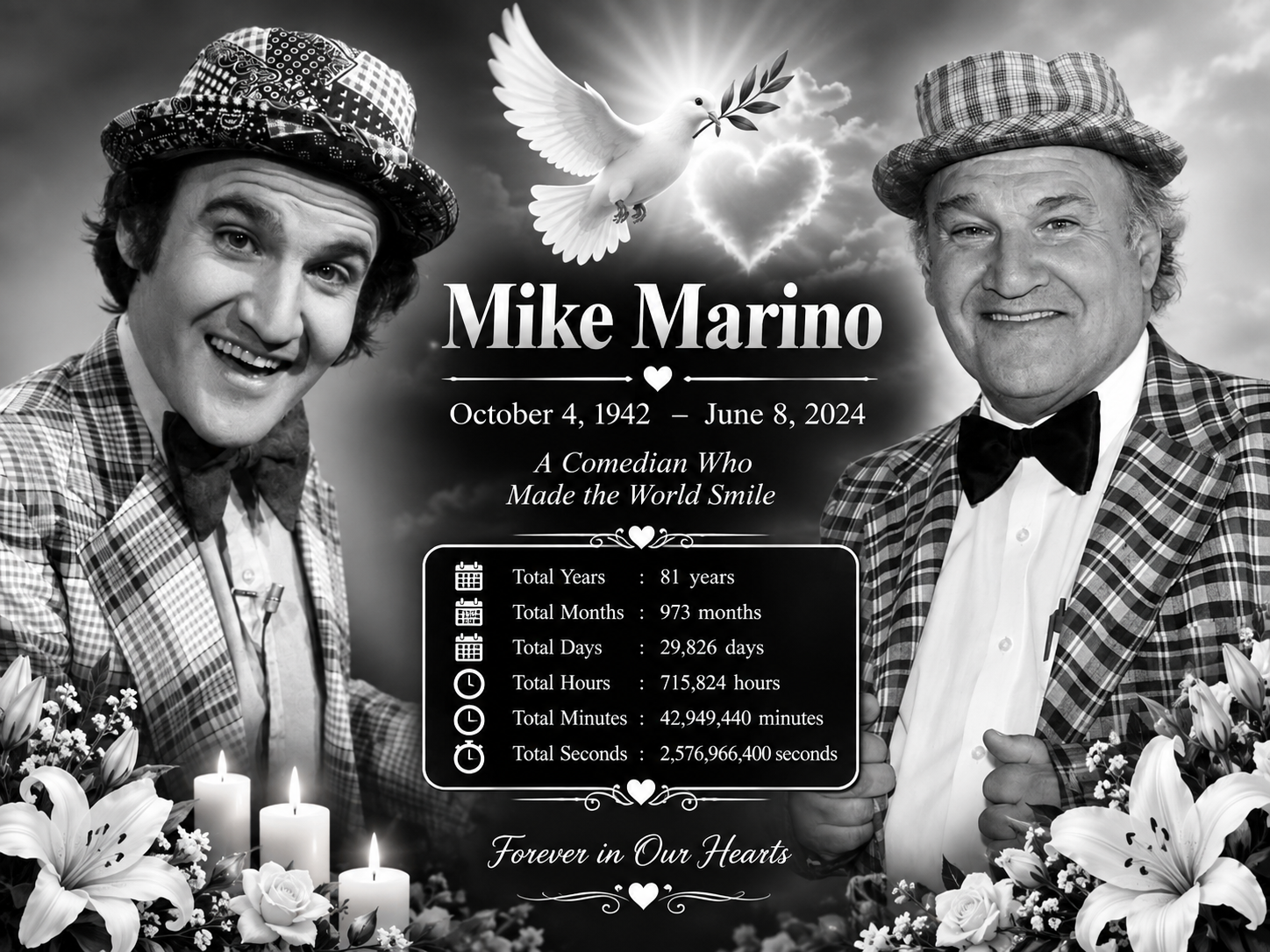
The final date had already been written into the record, but the story surrounding Mike Marino did not end when the performances stopped. September 15, 2026 marked the end of his life, yet it also began another phase in which audiences, fellow performers, hometown institutions, and people who had encountered his work began looking backward. The question was no longer what Marino would perform next. It became what would remain from everything he had already performed.
The answer was larger than one comedy special or one nickname. Marino left behind decades of stage appearances, television work, commercials, characters, interviews, podcasts, digital projects, and memories connected to New Jersey. His death therefore created an unusual contrast: the performer was no longer available to create another live moment, but thousands of moments from the past could still be revisited.
News of his death spread quickly through the comedy community. News 12 reported that condolences came from fellow comedians and venues where Marino had performed, while describing the Scotch Plains native as a comedian who had built his career around family, food, his Italian upbringing, and his New Jersey roots. ([News 12 – Default][1]) The subjects that had once supplied his jokes were now among the details used to describe the life behind those jokes.
That description mattered because it showed how closely Marino’s professional identity had remained connected to his origins. Some performers spend a career trying to separate themselves from the place where they began. Marino repeatedly did the opposite. New Jersey remained visible in his stage identity, his storytelling, his projects, and eventually in the place where one of his last major specials was filmed.
The nickname “New Jersey’s Bad Boy of Comedy” had become shorthand for that relationship with place. But after his death, the nickname could no longer be understood only as a marketing phrase. It had become part of the public record surrounding a performer whose material repeatedly returned to the same cultural landscape. His work made regional identity part of the performance rather than merely a backdrop.
Parade’s account of his death emphasized another part of that identity: Marino’s Italian-American heritage and New Jersey upbringing had been central to his comedy. The publication also noted his recurring characters, including Cousin Mooney, Uncle Tommy, Cousin Michelle, and G.I. Giovanni. ([Parade][2]) Those characters now function as pieces of a comic world that continues to exist through recordings and memories.
A character can outlive its creator in a way that an ordinary conversation cannot. Once a performance has been recorded, the voice, mannerisms, timing, and personality can return without the performer physically entering the room. Marino had spent years developing those characters, and their continued existence in recordings gives audiences another way to encounter the work after his death.
That is especially important with a comedian because live performance is normally temporary. A joke happens, the audience reacts, and the moment disappears. Marino’s career increasingly existed in formats that could preserve those moments: television appearances, filmed specials, online clips, podcasts, and other recordings.
His digital work made that preservation even more relevant. “Make America Italian Again” had already extended his comedy beyond the traditional club stage. The project became part of the public identity associated with Marino, and Legacy specifically referenced the slogan when remembering him after his death. ([Legacy.com][3]) The phrase therefore remained attached to the comedian even after the person behind it was gone.
The same was true of “Live From My Mother’s Basement.” The podcast had an unusual relationship with his biography because the location was connected to the home where he had grown up. Rather than building an entirely new fictional world around his public identity, Marino used a real place from his personal history as part of his later creative work.
That house carried another layer of meaning after the deaths of his parents. In an April 2026 interview, Marino discussed purchasing the home and walking around the neighborhood where he had grown up. The detail connected his later life with the geography that had supplied so much of his comedy.
The connection between home and career appeared again in “Back 2 School.” The special had been developed with Daniel Catullo and filmed at Scotch Plains-Fanwood High School, where Marino had been involved in theater and music as a student. The school’s own account described the project as a homecoming and quoted Marino calling it a full-circle moment because he wanted to give back to the place that had shaped him. ([SPF K12][4])
That statement became especially meaningful after his death, but it should still be understood in its original context. At the time the special was created, Marino was not making a memorial. He was making a comedy special. He was returning to a place that mattered to him and turning the experience into entertainment.
The school itself represented the beginning of the professional story. Marino had participated in the Repertory Theatre, Drama Club, and Moonglowers, and he had played drums in the marching band. His school history also records that he became a Screen Actors Guild member at sixteen. ([SPF K12][4])
Those early experiences help explain why the later career could move so naturally between acting and comedy. Marino had not discovered performance only after becoming a comedian. Performance had been part of his life from adolescence, and the skills developed through school theater, music, and formal acting training remained useful throughout his professional years.
The American Academy of Dramatic Arts and Herbert Berghof Studio were part of that formal training. From there came acting work, commercial appearances, television credits, and eventually a much larger comedy career. His résumé included more than 200 national television commercials and a Best Actor Clio Award nomination.
The commercial work is easy to overlook when remembering Marino primarily as a comedian, but it represents an important part of his professional development. Commercials demanded concise performances and strong camera presence. Marino learned to communicate character and personality quickly, skills that later became valuable in comedy and television.
His television credits provided another permanent record. He appeared in programs including “As the World Turns,” “One Life to Live,” “Becker,” “Nikki,” “Frasier,” and “Party of Five.” He also appeared on “The Tonight Show with Jay Leno.” Legacy specifically noted his stand-up appearances on stages around the country and his television work, placing the touring comedian and television performer within the same career record. ([Legacy.com][3])
His comedy career also included the Just for Laughs festival in Montreal, where Parade reported that he appeared seven consecutive years. ([Parade][2]) The festival appearances formed part of the broader touring history that carried his New Jersey-centered comedy into venues far beyond his home state.
Another major part of that history was the USO. Marino performed for service members, including in Bosnia and Afghanistan, and received the USO Bob Hope Comedy Award in 2015. Parade and other accounts have continued to include that honor among the major markers of his career. ([Parade][2])
The award connected him to a tradition of entertainment that was different from commercial television or comedy clubs. In those settings, performance could be part of a larger effort to bring familiar entertainment to people serving far from home. Marino’s work in that environment became another part of the story audiences could look back on.
His honors also included induction into the New Jersey Comedy Hall of Fame in 2008. Later, in 2024, he was inducted into the Scotch Plains-Fanwood High School Hall of Fame. The two recognitions came from different parts of his world: one from the comedy community and one from the hometown institution where his performance ambitions had first taken shape.
That progression created an unusual arc. The young performer entered entertainment. The adult comedian built a professional identity. The established entertainer received recognition from the comedy world. Then his hometown recognized him as one of its own successful alumni.
His death did not erase those milestones. Instead, they became reference points through which people could reconstruct the career. Each one represented a different chapter, and together they showed why a single description could never completely contain Marino’s work.
The final months added another dimension to the record. After surgery for a brain tumor earlier in 2026, Marino continued working toward recovery. News 12 later reported that he was battling Stage 4 brain cancer following the surgery and that he had spoken publicly about physical therapy and follow-up appointments. ([News 12 – Default][5])
After his death, those medical details became part of the chronology, but they did not replace the decades that came before them. The illness belonged to the final chapter. It was not the whole story.
And that distinction became increasingly important as tributes began appearing. People were remembering the comedian they had seen on stage, the actor they had seen on television, the hometown performer who returned to his school, and the characters whose voices remained recognizable.
The archive was becoming the new stage.
Click Here to continue read next: PART10: The Places Marino Returned To Became Part of His Lasting Record, From Scotch Plains and His Childhood Home to Comedy Clubs, Television Sets, and Stages Overseas
The Laughs Had Always Been Easy to Hear, but Behind the Jersey Jokes Was a Performer Quietly Building a Career From the Ground Up
Part 9 of 16

