
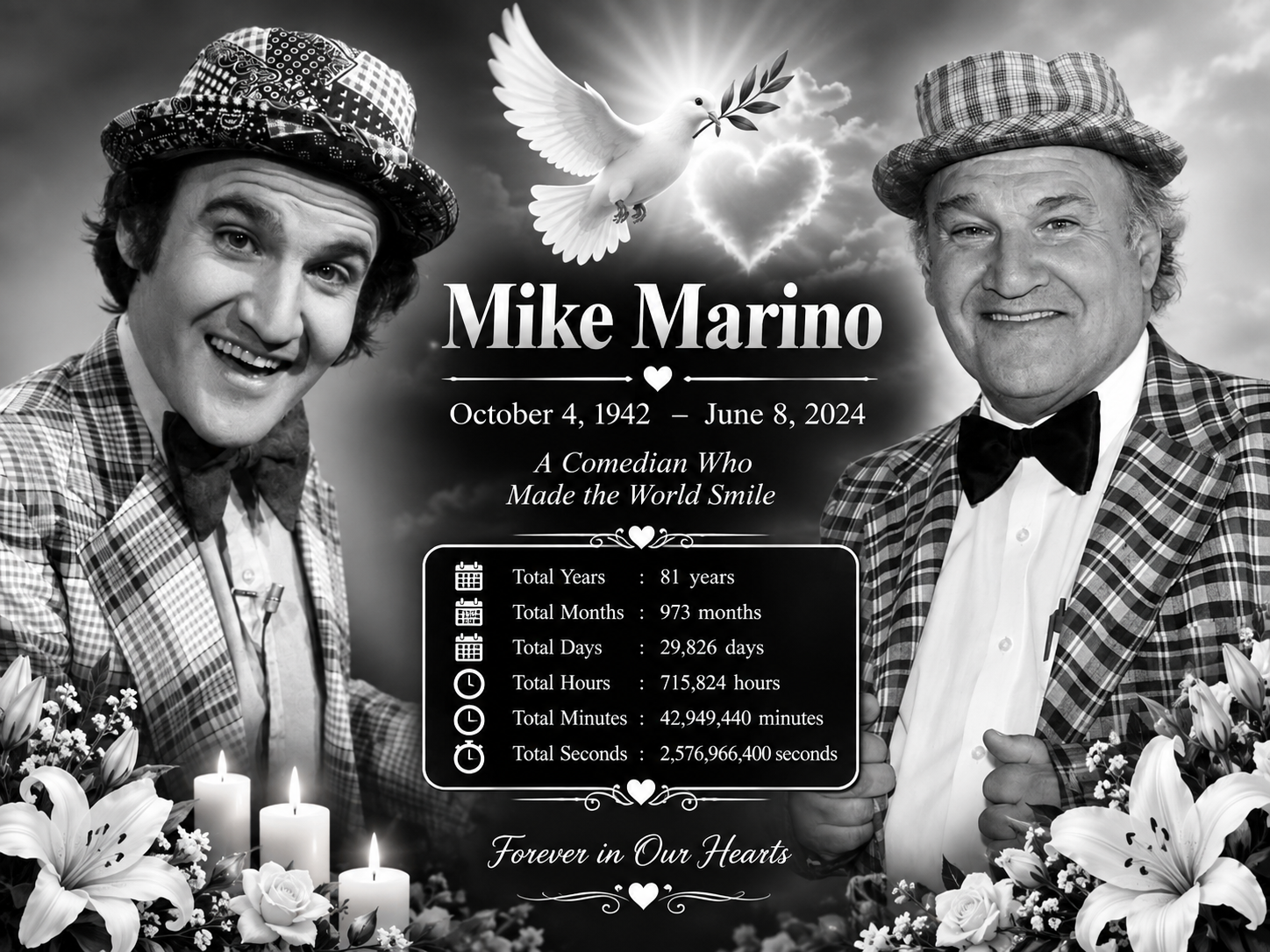
The story of Mike Marino can be followed backward as easily as it can be followed forward. Begin with the final date, September 15, 2026, and the trail moves through his last medical battle, his final projects, his years of television and comedy, his military performances, his hometown recognition, and eventually the young performer who first discovered the stage.
That backward movement changes the meaning of individual details. A school theater appearance is no longer merely a school activity. It becomes the beginning of a professional life. A commercial is no longer simply a short television spot. It becomes one piece of a career that eventually included more than 200 national commercials.
A comedy character is no longer only a source of laughter. It becomes part of a recognizable world created over years of performance.
A hometown return is no longer simply a special event. It becomes one of the final major examples of Marino bringing the story back to where it began.
The earliest chapters of his career were rooted in New Jersey. Marino attended Scotch Plains-Fanwood High School and became deeply involved in its performance programs. He participated in the Repertory Theatre, Drama Club, and Moonglowers, and he played drums in the marching band. ([SPF K12][4])
The school’s history also records that Marino became a member of the Screen Actors Guild at sixteen. That fact provides an unusually clear marker of how early professional entertainment had entered his life.
After high school, he studied at the American Academy of Dramatic Arts in New York City and had also trained at the Herbert Berghof Studio. Acting remained an important part of his professional identity even after comedy became his best-known field.
Commercials offered a major early avenue. Marino was credited with appearing in more than 200 national television commercials and receiving a Best Actor Clio Award nomination. The achievement connected him to the advertising industry while demonstrating the camera skills that would remain useful throughout his career.
Television followed and continued for years. His credits included daytime programs such as “As the World Turns” and “One Life to Live,” along with “Becker,” “Nikki,” “Frasier,” and “Party of Five.” His appearances on “The Tonight Show with Jay Leno” brought him into a national late-night setting.
The transition toward comedy did not erase the acting foundation. Instead, the two careers overlapped. Character work required acting ability, while stand-up gave him the freedom to build an identity around his own experiences.
That identity became closely associated with New Jersey.
The nickname “New Jersey’s Bad Boy of Comedy” eventually became one of the simplest ways to describe him, but the identity behind it was built from many specific elements: family stories, Italian-American experiences, regional observations, characters, physical comedy, and a willingness to turn familiar situations into material.
His recurring characters expanded that world. Cousin Mooney, Uncle Tommy, Cousin Michelle, and G.I. Giovanni became recognizable figures in his performances. Parade specifically identified those characters when describing the legacy of the comedian after his death. ([Parade][2])
The characters also reflected a broader truth about Marino’s work. He was interested in recognizable personalities. His comedy often began with things that audiences could identify from their own families, neighborhoods, and communities, then pushed those observations into performance.
That approach helped him travel. A comedian whose material is rooted entirely in one location can become difficult to understand outside it. Marino’s work instead used New Jersey as a doorway into broader experiences involving family, culture, food, relationships, and everyday behavior.
His touring career carried those stories across the country and beyond. He performed in comedy clubs, theaters, casinos, and event centers and appeared at Just for Laughs in Montreal for seven consecutive years. ([Parade][2])
The stages changed, but the basic identity remained recognizable.
Television expanded the audience again. Digital media later expanded it further.
“Make America Italian Again” provided a platform that connected his Italian-American identity with a modern media format. The slogan became closely associated with him and was specifically mentioned in Legacy’s remembrance. ([Legacy.com][3])
“Live From My Mother’s Basement” went in another direction, placing the performer inside a home connected to his childhood. The basement became a setting for conversation and entertainment, connecting Marino’s early life with his later career.
That home also became part of his life after his parents died. In the April 2026 interview, Marino discussed buying the house and walking around the neighborhood where he had grown up. His career had taken him around the world, yet part of his later creative life was rooted in the same community where the story had begun.
Then came the school special.
“Mike Marino Back 2 School” brought him back to Scotch Plains-Fanwood High School, where he and Daniel Catullo created a television comedy special using the auditorium and school environment as part of the production. The school described the project as a homecoming and noted that proceeds from the taping would benefit music and theater programs. ([SPF K12][4])
The project also showed how strongly Marino’s professional identity remained tied to the school. He had not simply returned as an alumnus attending an event. He returned as a working entertainer, using the building and its memories as material for a new production.
In 2024, he had been inducted into the Scotch Plains-Fanwood High School Hall of Fame. The honor came after the New Jersey Comedy Hall of Fame induction in 2008 and the USO Bob Hope Comedy Award in 2015.
Each recognition represented a different community.
The New Jersey Comedy Hall of Fame reflected his place in the state’s comedy history.
The USO award reflected his performances for military audiences.
The high school Hall of Fame reflected the community where his professional ambitions had begun.
Together, they formed a kind of three-point outline of the career.
The career also included charitable activities and support for first responders. Those efforts were part of the public record surrounding Marino, even though they did not always receive the same attention as his television and comedy work.
Then, in 2026, the chronology changed.
Marino became ill while performing on a cruise ship, and doctors discovered a brain tumor. Surgery followed in January, according to the later News 12 report, and Marino publicly discussed his efforts to recover through physical therapy and follow-up appointments. ([News 12 – Default][5])
The story could have stopped there if his recovery had continued normally. Instead, his health became more serious. By July, News 12 reported that Marino had spoken from a hospital bed about battling Stage 4 brain cancer following the surgery. ([News 12 – Default][5])
The medical details became part of his final public chapter, but they did not define the decades before it.
He remained the same performer whose career had included national commercials, television acting, stand-up, characters, touring, military performances, podcasts, and digital projects.
In the days before his death, Parade reported that Marino had been placed in hospice care. ([Parade][2]) The final stage of his life was therefore increasingly separated from the public rhythm of comedy touring.
On September 15, 2026, he died at 63.
The exact medical wording surrounding his death should remain precise. News 12 reported that he died following a battle with brain cancer, citing posts on his official social-media pages. Legacy reported his death at 63 but said that a cause of death had not been announced. ([News 12 – Default][5])
What is not uncertain is the length and breadth of the career that came before that date.
More than three decades of comedy were remembered by the family tribute reported by Parade. ([Parade][2]) The career reached comedy clubs and theaters, television programs and commercials, military stages and digital platforms.
The work also returned repeatedly to family.
It returned to New Jersey.
It returned to Italian-American identity.
It returned to characters.
And, eventually, it returned physically to the school where the performer had first begun learning how to stand before an audience.
That return gives the final chapters a natural continuity. Marino did not finish his career by abandoning the person he had once been. He brought that person forward. The teenage performer remained visible inside the adult comedian.
The New Jersey identity remained visible even after national television exposure.
The acting foundation remained visible inside the character work.
The family stories remained visible inside the stand-up.
The home remained visible inside the podcast.
The school remained visible inside the final special.
The military performances remained visible inside the record of his career.
Nothing about the final illness needed to erase those connections.
If anything, the chronology makes their preservation more important.
After September 15, there could be no new tour announcement, no new character appearance, no new television role, and no new performance created by Marino himself. But the work already completed did not disappear.
A recording can still begin.
A television appearance can still play.
A podcast episode can still be heard.
A character can still enter the room through a screen.
A story about New Jersey can still make someone recognize a piece of their own family.
That is the practical meaning of a performance archive. It does not make the performer present again. It preserves evidence of the moments in which the performer was present.
Marino’s archive is unusually varied because his career was unusually varied.
There is the young actor.
There is the commercial performer.
There is the television actor.
There is the stand-up comedian.
There is “New Jersey’s Bad Boy.”
There are Cousin Mooney, Uncle Tommy, Cousin Michelle, and G.I. Giovanni.
There is the performer who traveled with the USO.
There is the comedian who returned to his high school.
There is the podcaster recording from the basement of his childhood home.
There is the creator associated with “Make America Italian Again.”
And there is the man whose final months were marked publicly by a serious battle with brain cancer.
All of those descriptions belong to the same career.
None of them alone is enough.
The final record therefore does not need a manufactured final speech or an invented goodbye. The documented life already provides its own ending.
A teenager found performance.
An actor built a career.
A comedian found a voice.
A New Jersey performer carried that voice across the country and beyond.
A character creator built a world around family and culture.
A touring entertainer reached military audiences.
A hometown alumnus returned to the school where the journey began.
A performer facing serious illness continued to be connected with his work until the final months.
And on September 15, 2026, the live career ended.
The archive remained.
The stage remained in recordings.
The school remained.
The characters remained.
The stories remained.
And the voice that had spent decades turning ordinary experiences into comedy could still be heard whenever someone chose to press play.
Click Here to continue read next: PART13: The Career Became Easier to Understand When Its Separate Chapters Were Placed Together, Revealing How Marino Turned a Jersey Childhood Into a Professional Language
The Laughs Had Always Been Easy to Hear, but Behind the Jersey Jokes Was a Performer Quietly Building a Career From the Ground Up
Part 12 of 16

