
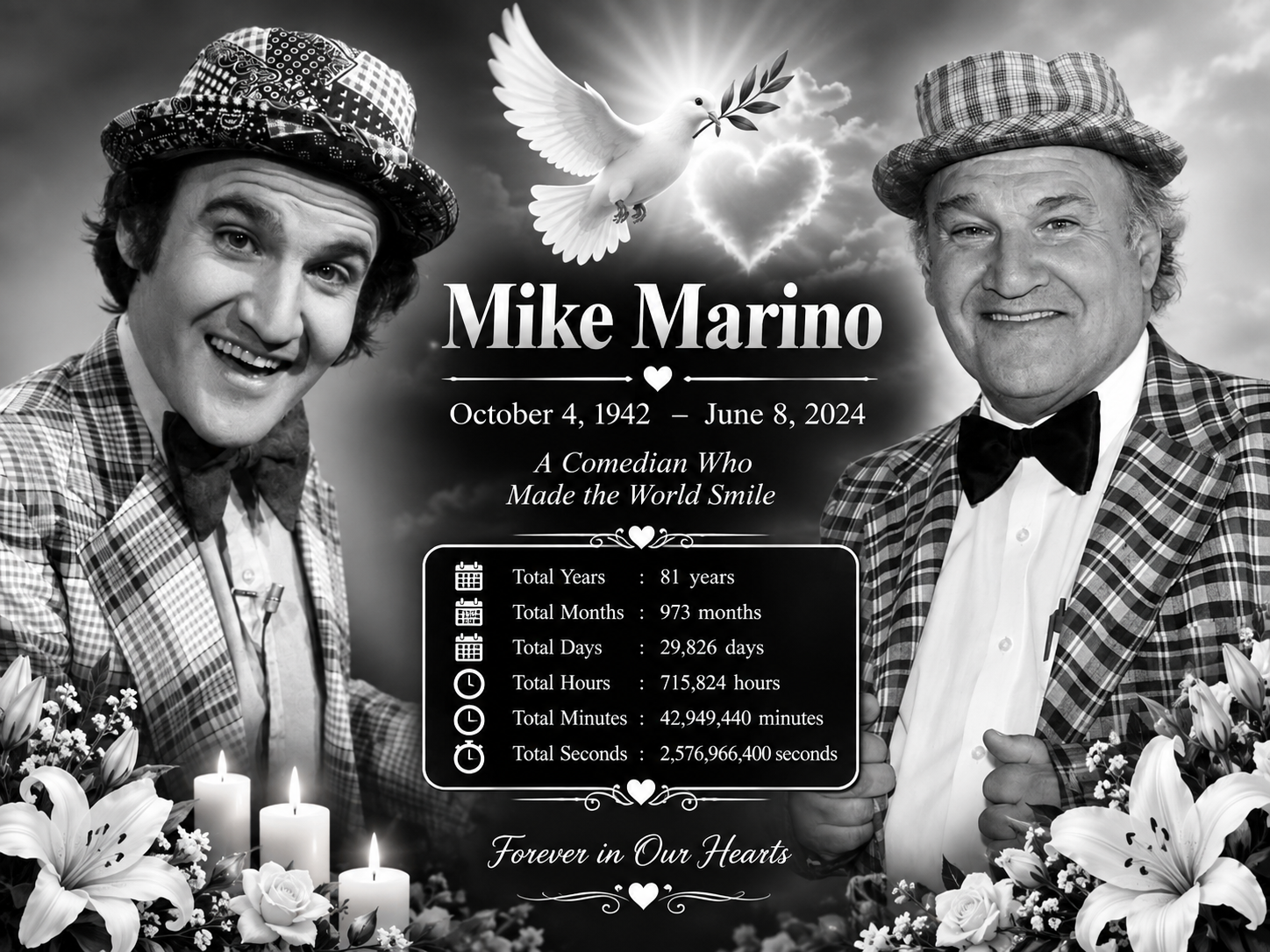
The transition from comedy clubs to military audiences did not require Mike Marino to become a different person.
He remained a comedian.
The difference was the audience.
For years, he had performed in clubs where the crowd came specifically to laugh. The setting was familiar: a stage, a microphone, tables, drinks, a spotlight, and people waiting for the next joke.
Performing for American service members carried a different responsibility.
Marino became part of USO entertainment efforts and performed for troops and veterans, including performances connected with locations such as Bosnia and Afghanistan, according to accounts of his career. His work for military audiences eventually earned him the USO Bob Hope Comedy Award in 2015. ([The Blue Magazine][5])
The award connected Marino to a long tradition of entertainers who had used comedy as a way to bring familiar entertainment to people serving far from home.
For Marino, the connection made sense.
His comedy was already built around familiarity.
He talked about family.
He talked about home.
He talked about the frustrations and absurdities of ordinary life.
Those subjects could matter even more to people who were physically separated from their families and communities.
A joke about home could become a small reminder of home.
A story about family could create recognition for someone living thousands of miles away.
The role of comedy in that setting was not to solve the difficulties faced by service members.
It was simpler.
For a short time, the audience could laugh.
Marino continued performing for those audiences and supporting military-related causes. His USO Bob Hope Comedy Award became one of the most significant honors of his career. ([Renna Media][8])
The award also fit a pattern in Marino's life.
He had built a career around entertainment, but he did not keep entertainment confined to commercial success.
He used his performance skills for charitable events and community causes.
His professional biography lists appearances connected with charities and organizations, while accounts of his work after September 11 describe his involvement with events supporting families of fallen first responders. ([The Blue Magazine][5])
Those efforts were part of the less visible side of his career.
The audience at a sold-out comedy club could see the performer.
The audience at a charity event might remember the cause.
The audience of service members might remember the evening.
Different rooms created different kinds of memories.
Marino's career was large enough to contain all of them.
He continued acting as well.
Television appearances in shows such as Frasier and Becker demonstrated that his performance ability was not limited to stand-up. His earlier work in commercials had already established him as a camera performer, and his theater training continued to influence how he handled characters. ([The Blue Magazine][5])
The actor inside the comedian remained visible.
He could create a character quickly.
He could change physical behavior.
He could exaggerate a voice.
He could move between himself and a fictional personality.
That versatility gave his comedy a theatrical quality.
It also made his recurring characters easier to remember.
Cousin Mooney.
Uncle Tommy.
Cousin Michelle.
G.I. Giovanni.
They were not simply names attached to jokes.
They became pieces of a larger comic world.
The world was heavily influenced by Marino's Italian-American upbringing.
Food and family appeared repeatedly.
So did the tension between generations.
The old expectations of parents collided with the habits of children.
New Jersey pride collided with the embarrassment of growing up there.
Family traditions became material.
Marino's method was to make those conflicts recognizable rather than preach about them.
The audience could laugh first and recognize the truth underneath afterward.
That was part of his strength as a storyteller.
He did not need every joke to depend on a complicated premise.
A small family incident could become enough.
A familiar phrase could become a character.
A memory from high school could become a routine.
A neighborhood habit could become a story.
The material remained close to ordinary life.
That quality also helped explain why his eventual return to Scotch Plains became so important.
By the time he was inducted into the Scotch Plains-Fanwood High School Hall of Fame in 2024, he had already spent decades performing professionally. He had received major recognition from the comedy community and the USO, appeared on television, acted in commercials, and performed around the world. ([Renna Media][8])
Yet the school remained part of his identity.
The Hall of Fame ceremony introduced him to Daniel Catullo, another alumnus who had built a career in entertainment. Catullo had become a director and producer with multiple Emmy Awards. Marino and Catullo began discussing the possibility of working together. ([SPF K12][2])
The result was “Mike Marino Back 2 School.”
The project brought Marino back to the high school where he had once participated in theater and played drums.
This time he was returning as the professional.
The transformation of the auditorium for filming created a physical bridge between two versions of Marino.
The teenager who once performed there could be imagined beside the older comedian returning decades later.
The production was designed around his teenage memories, Italian-American family stories, and the experiences that had become central to his comedy. ([SPF K12][2])
It was also a practical continuation of his career.
Marino was still performing.
He was still developing material.
He was still finding new ways to present familiar stories.
He was not simply looking backward.
The special demonstrated that his past could become material for a new audience.
That mattered because comedians often face a particular challenge as they age.
The audience knows the performer for earlier work.
The performer must decide how much of that earlier identity to keep.
Marino continued embracing his roots rather than trying to disguise them.
New Jersey remained central.
Italian-American family life remained central.
The recurring characters remained part of his comic world.
But the delivery could change.
The medium could change.
The audience could change.
The performer could change.
In 2023, Marino appeared with Joe Gorga on a “Real Comedians of New Jersey” tour, another project built around their shared connection to the state and Italian-American culture. News 12 reported that the two discussed the way those roots informed their comedy. ([News 12 – Default][9])
The pattern was now unmistakable.
Marino had spent decades proving that local identity could support an international career.
He did not have to become less Jersey to reach a wider audience.
He became more specific.
The specificity made the stories more recognizable.
That principle extended into his digital work.
His podcast allowed him to speak directly to listeners.
His web series turned his persona into a larger comic premise.
His filmed specials preserved performances beyond the night they occurred.
His work could therefore survive in several forms at once.
Live performance was temporary.
Television was recorded.
Podcast episodes could be replayed.
Digital clips could circulate.
A comedy special could remain available long after the original audience had gone home.
The comedian's voice could travel farther than the stage.
That mattered increasingly as Marino entered his later years.
He was still performing.
He was still working on projects.
And in 2026, he was still publicly engaged with his career.
In April 2026, he was interviewed about his work, his life, and his recent health difficulties. The interview described a major medical problem discovered after he became ill while performing on a cruise ship. Doctors found a brain tumor, which was surgically removed, and Marino was undergoing rehabilitation and follow-up care. ([Deborah Kobylt][10])
The discovery changed the rhythm of his life.
For decades, the problem had been finding the next stage.
Now there was a more immediate question.
Could he recover enough to keep performing?
Marino continued trying.
He returned to live performance and worked on “Back 2 School.”
The decision to continue was significant because the project was not simply another booking.
It was connected to the place where his career had begun.
He was bringing the story back home.
The production became a meeting point between past and present.
The teenager.
The working actor.
The commercial performer.
The stand-up comedian.
The New Jersey personality.
The older entertainer.
All of them belonged to the same career.
But the health problem introduced a new uncertainty.
The comedian who had spent his life turning difficult circumstances into material was now confronting something that could not be handled simply by changing the punchline.
The brain tumor was no longer a story about someone else.
It was happening to him.
And the months that followed would become the final chapter of his life.
Click Here to continue read next: PART4: The Diagnosis Changed the Road Ahead, Yet Marino Kept Returning to the Stage Until Illness Finally Forced the Comedian to Leave the Mic
The Laughs Had Always Been Easy to Hear, but Behind the Jersey Jokes Was a Performer Quietly Building a Career From the Ground Up
Part 3 of 16

