
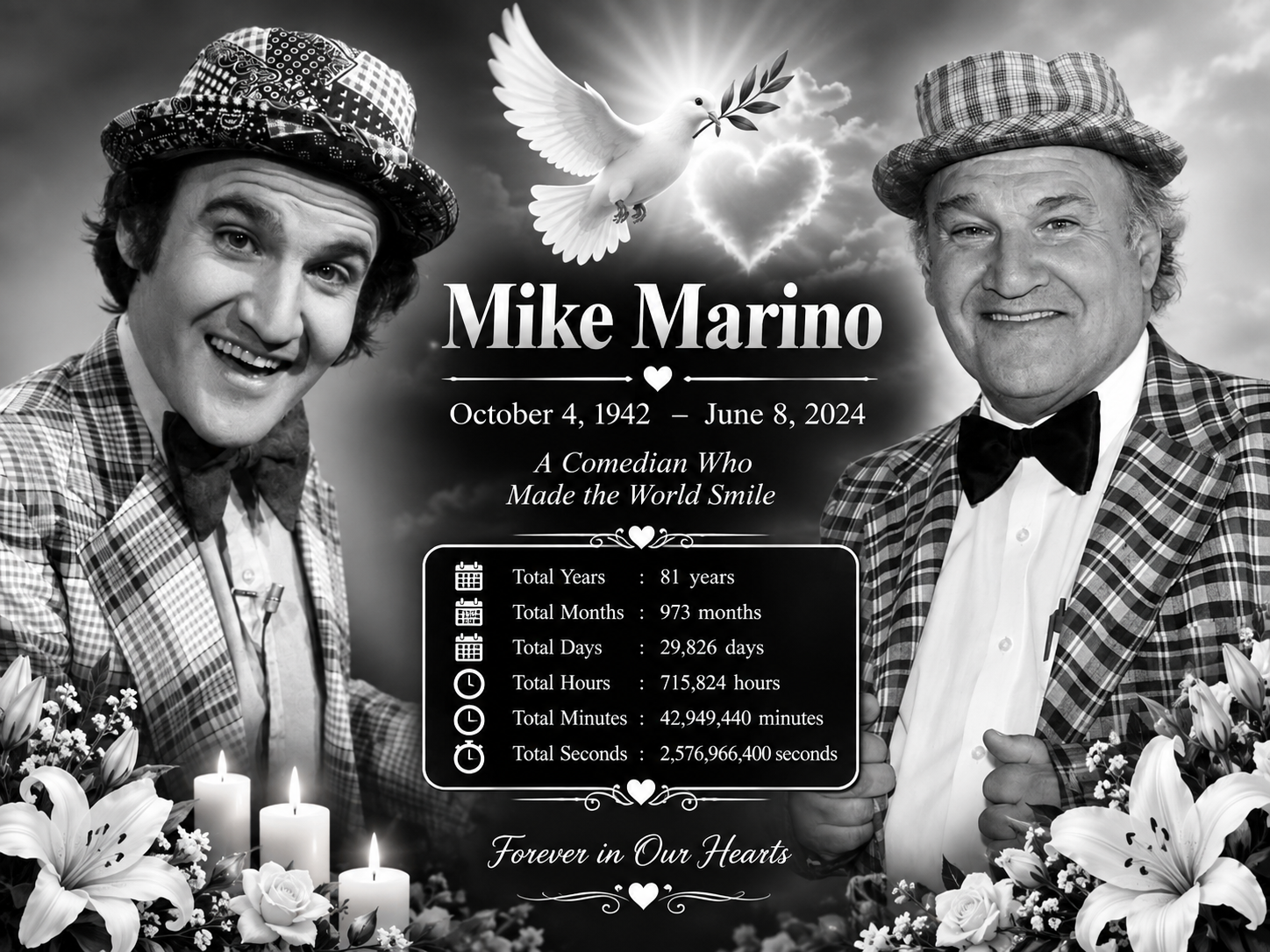
Mike Marino's final year contained an uncomfortable contradiction.
He was still building projects while his health was becoming increasingly serious.
The comedian who had spent decades traveling from stage to stage was now dealing with a disease that required surgery, rehabilitation, and continued medical care.
In early 2026, Marino had undergone surgery after doctors discovered a brain tumor. A later interview reported that he was working through physical therapy and follow-up treatment while trying to regain his health. ([Deborah Kobylt][10])
The diagnosis changed the practical rhythm of his life.
Comedy depends on energy.
Travel depends on physical stamina.
Stand-up requires concentration, memory, timing, movement, and the ability to respond to an audience in real time.
A serious neurological illness could affect any of those things.
Yet Marino continued working.
That decision was visible in the projects surrounding him during his final months.
“Mike Marino Back 2 School” had been filmed at Scotch Plains-Fanwood High School, the place where his entertainment ambitions had first taken shape. The production brought his career back to the auditorium where he had once been a student performer and drummer. ([SPF K12][2])
The special was more than nostalgia.
It documented a working comedian still creating material.
Marino's high-school memories became part of the performance.
His Italian-American family remained part of the stories.
His New Jersey identity remained intact.
The setting itself became part of the joke.
A performer who had spent decades traveling around the world was now standing on the stage where much of the journey had begun.
The project also represented his relationship with Daniel Catullo, another alumnus whose professional career had taken him into directing and producing. Their collaboration demonstrated how old local connections could become new creative partnerships decades later. ([SPF K12][2])
That kind of return was characteristic of Marino.
He traveled extensively.
But he continued returning to Scotch Plains.
The place was not simply the origin of his career.
It remained part of his identity.
The community recognized that connection when it inducted him into the Scotch Plains-Fanwood High School Hall of Fame in 2024. The school described his career in acting and comedy and noted his induction into the New Jersey Comedy Hall of Fame and receipt of the USO Bob Hope Comedy Award. ([Renna Media][8])
The honors were accumulated over decades.
The New Jersey Comedy Hall of Fame had recognized him in 2008.
The USO Bob Hope Comedy Award followed in 2015.
The high school recognition came in 2024.
Each honor marked a different part of the career.
The first emphasized his place in New Jersey comedy.
The second reflected his work entertaining service members.
The third connected the established professional back to the community where he had started.
Together they traced a path from local performer to internationally touring comedian.
But awards could not change the medical reality.
By the summer of 2026, reports described Marino as battling advanced brain cancer.
News 12 New Jersey reported that posts on Marino's official social media accounts said he was battling brain cancer and had been receiving medical care after surgery. Other reports said he had been placed in hospice care shortly before his death. ([News 12 – Default][9])
There is an important distinction in the public record concerning the cause of death.
Legacy's obituary states that Marino died on September 15, 2026, at age 63 and says a cause of death was not announced. News 12, citing posts from his official social media accounts, reported that he died following a battle with brain cancer. Thus brain cancer is the reported medical context of his death, but the available sources do not provide a formal medical death certificate or more specific cause. ([Legacy.com][7])
That distinction should remain in the story.
It is tempting to turn a reported illness into a precise medical conclusion.
The responsible account is narrower.
Marino was battling brain cancer.
He had undergone surgery.
He had been receiving treatment and rehabilitation.
His condition worsened.
He died on September 15, 2026, at sixty-three.
Those facts are supported by the reporting available after his death. ([News 12 – Default][9])
The final days were a sharp contrast to the public image he had maintained for decades.
Marino's comedy was physical and energetic.
His characters were expressive.
His performances depended on movement and timing.
His voice carried the personality of New Jersey.
Now the illness was affecting the body and brain that had made that performance possible.
Yet the work created before those final weeks remained.
The characters remained.
The recordings remained.
The television appearances remained.
The podcast episodes remained.
The comedy special remained.
And the stories about growing up in New Jersey remained.
That is one of the strange things about a comedian's legacy.
Laughter is temporary in the room.
A person tells a joke.
The audience laughs.
The moment disappears.
But when the performance is recorded, the moment can return.
Marino's work therefore had a life beyond the stage.
His “Back 2 School” special was one example.
His podcast was another.
His television appearances were another.
Clips of his performances could continue circulating.
The comedian who had spent decades making a living from temporary moments had unintentionally created an archive of those moments.
His recurring characters gave that archive another layer.
Cousin Mooney.
Uncle Tommy.
Cousin Michelle.
G.I. Giovanni.
They were fictional, but they were part of the recognizable world Marino built around himself. ([AOL.com][4])
The characters helped preserve something essential about his performance style.
Marino was not simply a man telling jokes.
He was a performer capable of becoming someone else for a few minutes.
That ability connected his early acting career with his later comedy.
The path from the American Academy of Dramatic Arts to television commercials, soap operas, sitcom appearances, and stand-up was not a series of unrelated occupations.
It was one long development of performance.
The comedian emerged from the actor.
The storyteller emerged from the comedian.
The hometown identity emerged from the storyteller.
And the public figure emerged from all of them together.
That explains why Marino could move so comfortably between formats.
A comedy club.
A television studio.
A corporate event.
A theater.
A military performance.
A podcast.
A school auditorium.
Each setting required a slightly different version of the same skill: connecting with people.
That connection was central to the tributes that followed his death.
A family statement described him as a comedian, actor, storyteller, and performer whose Italian-American heritage and New Jersey upbringing had shaped his work for more than three decades. The statement also emphasized his recurring characters and his ability to make audiences feel connected to the world he created. ([Parade][11])
The wording matters because it describes a career larger than stand-up alone.
Marino had spent decades building a world.
It was a world populated by exaggerated relatives, familiar New Jersey situations, Italian-American traditions, and the contradictions of everyday life.
His audience entered that world for an hour.
Sometimes they entered it through a theater.
Sometimes through a television screen.
Sometimes through a podcast.
Sometimes through a short online clip.
Sometimes through a military show far from home.
The medium changed.
The central performer remained.
Then, on September 15, 2026, the performer was gone.
He was sixty-three.
The cause was reported in connection with his battle with brain cancer, although the Legacy obituary noted that no formal cause had been announced. ([Legacy.com][7])
His death ended the possibility of another live performance.
There would be no new character created by him.
No new story about his family.
No new Jersey observation.
No new podcast episode recorded in the basement.
No new appearance at the school where he had begun.
That is the point where the story turns from career to legacy.
The question is no longer what Marino would do next.
The question is what remains from everything he already did.
The answer is unusually concrete.
There are recordings.
There are television appearances.
There are films and commercials.
There are comedy specials.
There are photographs.
There are awards.
There are the memories of audiences.
There is a hometown that recognized him.
There are fellow performers who worked beside him.
There are military audiences who saw him perform.
And there is the particular comic voice he built from the place where he grew up.
That voice cannot be recreated exactly.
Another comedian can tell a New Jersey joke.
Another performer can use an Italian-American family story.
Another actor can play a larger-than-life character.
But Mike Marino's combination of timing, background, characters, and personal history belonged to him.
His final return to Scotch Plains therefore takes on a different meaning after his death.
The school auditorium was once where a young performer was beginning.
It later became the place where an established comedian returned to tell stories about that beginning.
The circle had nearly completed itself.
Marino had spent decades leaving home and coming back.
The final return happened through a recorded performance that can continue to be watched.
The teenager who entered entertainment at an early age could not have known where the road would lead.
The comedian who became known around the world could not have known exactly when the road would end.
But the record now shows the path.
From Scotch Plains theater to New York acting schools.
From commercials to television.
From acting to stand-up.
From New Jersey clubs to stages around the world.
From comedy to military performances.
From the USO Bob Hope Comedy Award to the New Jersey Comedy Hall of Fame.
From the 2024 hometown Hall of Fame induction to the “Back 2 School” special.
From a brain tumor and surgery to a final battle with brain cancer.
And finally, on September 15, 2026, to the end of a sixty-three-year life.
The microphone is silent now.
But the recordings are not.
The characters are not.
The stories are not.
And the laugh that once disappeared as soon as it left the room can still return whenever someone presses play.
Click Here to continue read next: PART5: After Surgery, the Road Became Slower and More Uncertain, but Marino Kept His Work Moving, Turning Home, Memory, and the Jersey Past Into One Final Creative Chapter
The Laughs Had Always Been Easy to Hear, but Behind the Jersey Jokes Was a Performer Quietly Building a Career From the Ground Up
Part 4 of 16

