
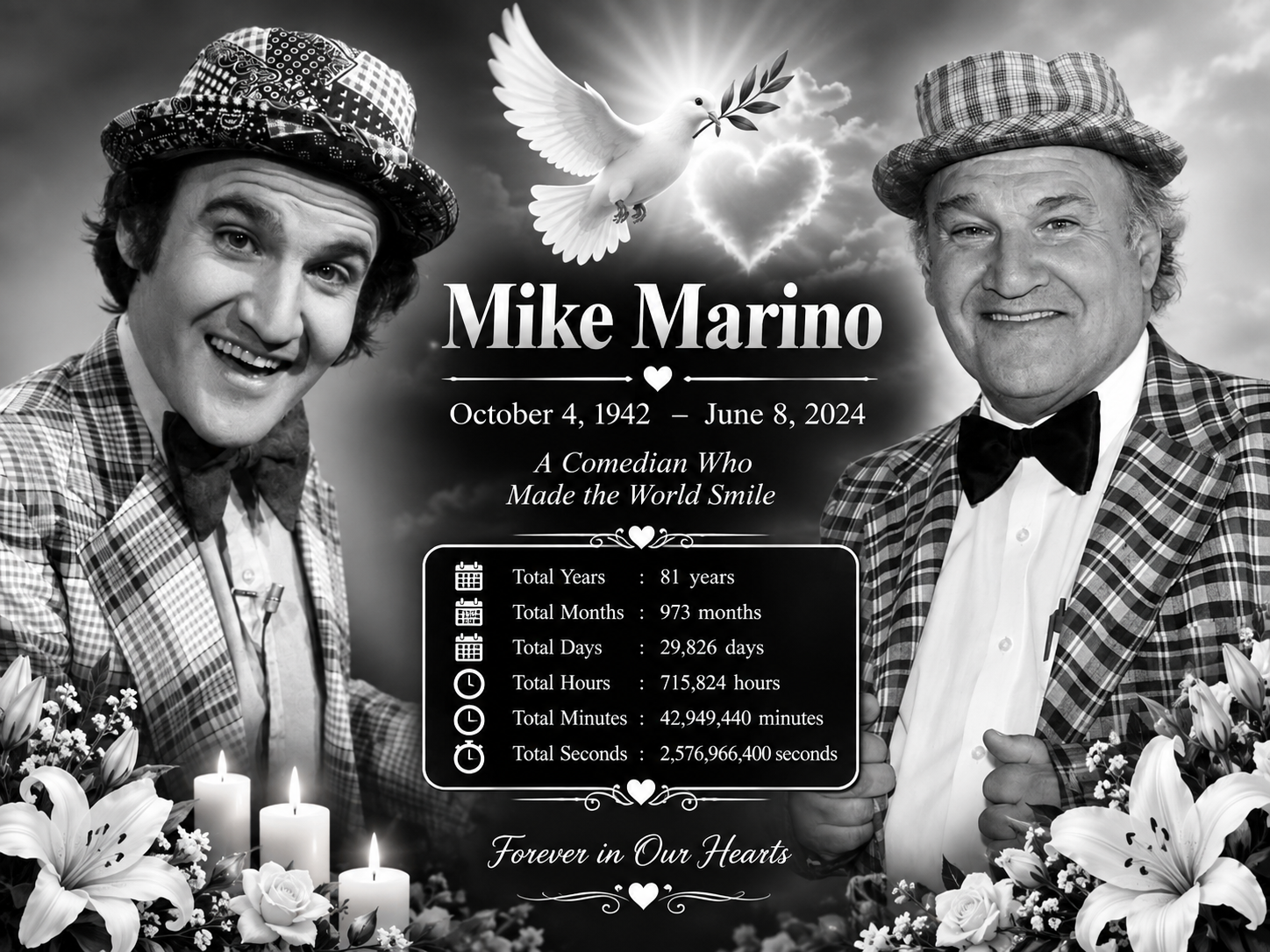
The microphone had gone quiet, but the story had not stopped. By the beginning of 2026, Mike Marino’s career was no longer moving according to the familiar rhythm of flights, comedy clubs, television appearances, and long stretches of touring. A serious medical problem had interrupted that pattern. Yet the interruption did not erase the person who had spent decades building a career around performance. It simply changed the pace at which he could continue.
The first major turning point came when a brain tumor was discovered after Marino became ill while performing on a cruise ship. According to an April 2026 interview, doctors removed the tumor, and Marino was then concentrating on physical therapy and follow-up appointments. The medical development was significant because it arrived while he was still actively working rather than after he had already withdrawn from public life. He had projects underway, appearances behind him, and plans still taking shape.
One of those projects was especially personal. “Mike Marino: Back 2 School” was not simply another stand-up recording added to a long list of performances. It brought him back to Scotch Plains-Fanwood High School, the place where much of his early identity as a performer had taken shape. The production connected the adult comedian with the teenager who had once participated in the Repertory Theatre, Drama Club, Moonglowers, and marching band.
That return mattered because Marino had spent so much of his career transforming memories of New Jersey into comedy. Now the physical place behind those memories became part of the work itself. The school stage and auditorium were no longer merely locations from his youth. They became the setting for a project that allowed him to revisit the experiences that had helped form his voice.
The production was created with Daniel Catullo, and the school described the project as a full-circle moment for Marino. The stage was transformed into an approximation of a 1981 classroom, while the auditorium became a comedy club. The design connected different periods of Marino’s life: the teenager who was learning performance and the veteran entertainer who had spent decades making audiences laugh.
That connection between past and present had always been visible in his work, but “Back 2 School” made it unusually concrete. Marino could look backward without abandoning the career he had built afterward. The teenage misadventures, Italian-American family experiences, and memories of growing up in New Jersey became material for the adult performer who had eventually taken those same themes to audiences far beyond his hometown.
The project also arrived shortly after another important recognition. In 2024, Marino was inducted into the Scotch Plains-Fanwood High School Hall of Fame. The honor placed his professional achievements back inside the community where his ambitions had first become visible. By then, his résumé included television, film, advertising, stand-up comedy, major venues, military performances, and years of touring.
The recognition was particularly meaningful because Marino had not simply attended the school and moved on. His extracurricular life there was closely connected to entertainment. He participated in theater and music, and records of his school years describe him as a drummer in the marching band as well as a participant in several performance groups. His connection to acting had developed remarkably early, with his involvement in the Screen Actors Guild while still a teenager.
From there, formal training followed. Marino studied at the Herbert Berghof Studio and the American Academy of Dramatic Arts. That background helped explain something important about his later comedy: performance was never limited to standing behind a microphone and delivering jokes. Acting, character work, physical expression, timing, and the ability to inhabit different personalities all remained part of his toolkit.
That foundation became useful as his career expanded. Marino developed recurring characters including Cousin Mooney, Uncle Tommy, Cousin Michelle, and G.I. Giovanni. They allowed him to approach familiar family and cultural situations from different angles. Instead of presenting only one version of himself, he could build a broader comic world populated by recognizable personalities.
His New Jersey identity remained at the center of that world. He became widely known as “New Jersey’s Bad Boy of Comedy,” a nickname that became closely associated with his public persona. The phrase captured the regional energy of his act, but the career behind it was considerably broader. He had performed in clubs, theaters, casinos, event centers, and major comedy venues, and he had appeared on national television.
His television history stretched beyond stand-up. Marino had acting credits on programs including “As the World Turns,” “One Life to Live,” “Becker,” “Nikki,” “Frasier,” and “Party of Five.” He also appeared on comedy and variety programs and became associated with “The Tonight Show with Jay Leno.” These credits reinforced the fact that his career had never fit neatly into a single category.
Commercial work formed another substantial part of that history. Marino was credited with more than 200 national television commercials and received a Best Actor Clio Award nomination for commercial work. For an entertainer whose public image was strongly connected to stand-up comedy, the scale of his advertising career offered another measure of how long he had been working professionally in front of cameras.
There was also a period when his comedy reached audiences through the United Service Organizations. Marino performed for service members overseas, including in Bosnia and Afghanistan, and later received the USO Bob Hope Comedy Award. Those performances represented a different kind of audience from the comedy clubs and television studios where he had spent so much of his career.
The difference was not that the fundamentals of comedy disappeared. Timing, storytelling, observation, and character still mattered. But the settings were different, and the purpose of the appearances carried another layer of significance. Marino had repeatedly used his own background as material, yet he had also spent years bringing that performance to people far away from the New Jersey places that had inspired it.
Meanwhile, another part of his creative identity was developing at home. Marino had hosted “Live From My Mother’s Basement,” a podcast recorded in the basement of the house where he grew up. The project carried an unusual sense of continuity. The same home that had existed before the fame, before the national television appearances, and before the decades of touring became part of the setting for his later work.
An April 2026 interview described how Marino had bought that house after the recent deaths of his parents. He also spoke about walking through the neighborhood where he had grown up. Those details gave his later work a strong connection to place. The comedian who had once carried New Jersey onto distant stages was now spending time physically surrounded by the streets and memories that had supplied so much of his material.
His “Make America Italian Again” project continued another long-running theme. Italian-American identity had been present throughout his comedy, not as a separate subject detached from New Jersey, but as part of the family and neighborhood experiences through which he understood the world. The project extended that identity into a broader digital format.
By then, Marino had accumulated enough material to look at his career from several directions at once. There was the young actor who had joined the Screen Actors Guild. There was the commercial performer with hundreds of television spots. There was the stand-up comedian who became known nationally as New Jersey’s Bad Boy. There was the actor appearing in television series. There was the military performer receiving the Bob Hope award. And there was the hometown entertainer returning to his high school decades later.
The health crisis changed how those pieces could move forward. Physical therapy and follow-up appointments became part of his schedule, replacing the assumption that another tour or performance was always just around the corner. But the available record from this period does not show him simply disappearing. He remained involved in his work, including the school special that had become increasingly personal.
Then, during the summer, the public picture became more serious. News 12 reported that Marino was battling Stage 4 brain cancer following the earlier surgery. His own social-media posts, as reported by the station, showed him discussing the illness and his efforts to recover through therapy and medical follow-up. The change was stark: the comedian who had spent decades controlling the room through performance was now publicly confronting circumstances that could not be managed through a punchline.
Yet the significance of the story was not that illness suddenly erased everything that came before. It was that the final chapter was unfolding alongside the work of the previous chapters. “Back 2 School” remained connected to the place where his professional ambitions had started. His recordings preserved performances made before the diagnosis. His characters continued to exist independently of his physical condition. His television appearances remained part of the public record.
The question was no longer whether Marino had built a career. That answer was already documented in decades of work. The harder question was how much of that career could be carried forward when the person who had created it was confronting a rapidly changing reality. The answer would come not through another reinvention, but through the preservation of what he had already made.
Click Here to continue read next: PART6: The Career Behind the Jersey Persona Was Larger Than the Nickname, Spanning Acting, Advertising, Television, Touring, Military Stages, and Characters That Outlived the Moment
The Laughs Had Always Been Easy to Hear, but Behind the Jersey Jokes Was a Performer Quietly Building a Career From the Ground Up
Part 5 of 16

