
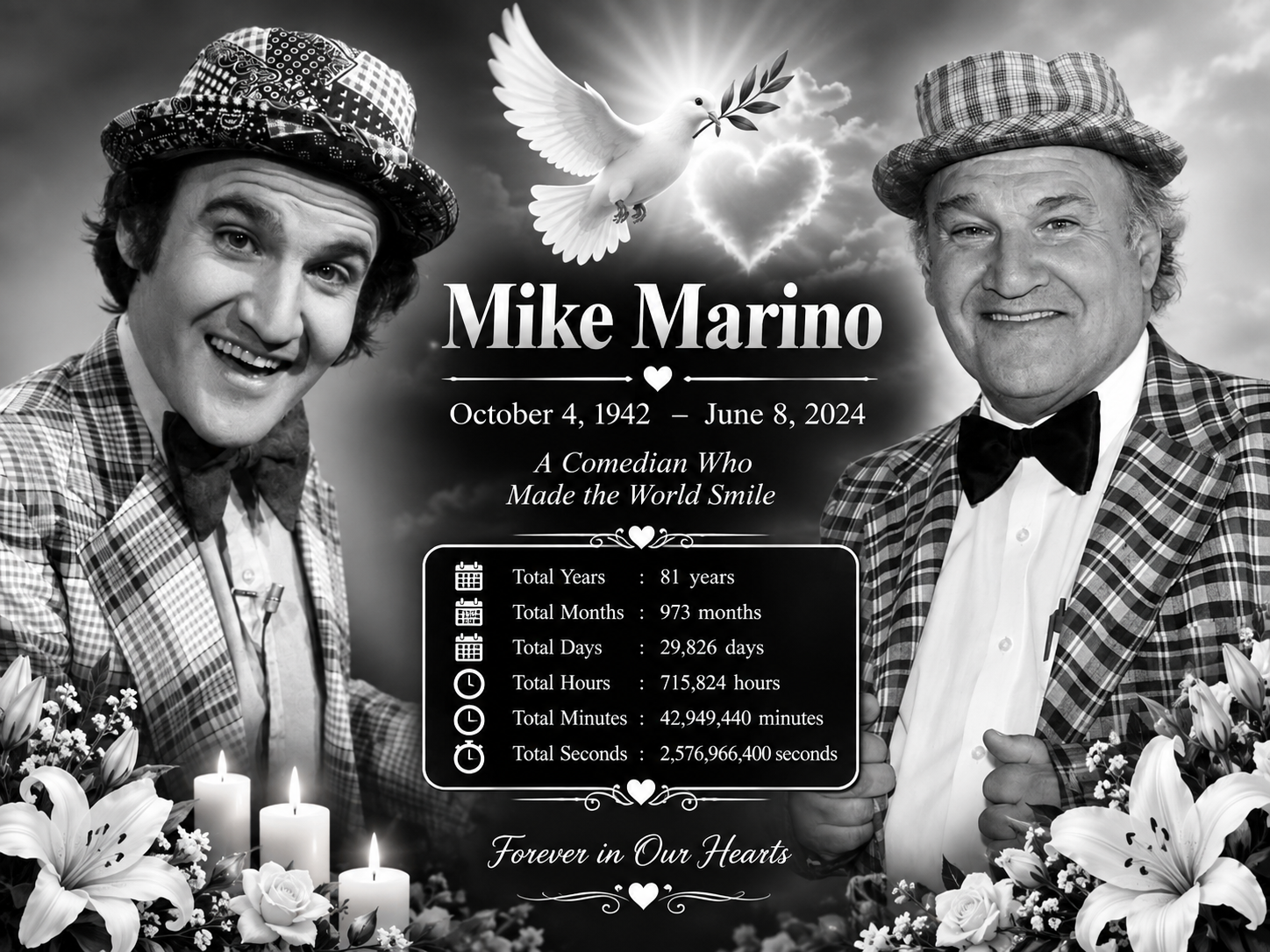
For years, the easiest way to introduce Mike Marino was with the phrase that had followed him through much of his career: “New Jersey’s Bad Boy of Comedy.” It was memorable, immediately recognizable, and closely connected to the voice he had developed on stage. But the longer the record of his career became, the less sufficient a single nickname was to describe it.
Marino had entered entertainment through acting rather than through a simple decision to become a stand-up comedian. His studies at the Herbert Berghof Studio and the American Academy of Dramatic Arts gave him formal training, while his early professional work brought him into commercials, television, and performance opportunities. Comedy eventually became the most recognizable part of his public identity, but acting never disappeared from the résumé.
The commercial work alone represented a substantial professional history. Marino was credited with more than 200 national television commercials, and his performance in that field earned a Best Actor Clio Award nomination. Commercials demanded a different kind of discipline from stand-up. A performer might have only seconds to establish a personality, communicate an idea, and make a performance memorable.
That skill translated naturally into comedy characters. Marino's recurring figures were not simply names attached to jokes. Cousin Mooney, Uncle Tommy, Cousin Michelle, and G.I. Giovanni gave him different voices and personalities through which he could approach stories. The characters reflected the same fascination with family, culture, regional identity, and recognizable human behavior that appeared throughout his stand-up.
Television provided another avenue for that range. Marino appeared in programs including “As the World Turns” and “One Life to Live,” connecting him to the long-running tradition of American daytime drama. He also appeared on sitcoms and comedy programs, with credits including “Becker,” “Nikki,” “Frasier,” and “Party of Five.”
His television work also included appearances associated with “The Tonight Show with Jay Leno.” For a touring comedian, national television exposure could introduce the performer to viewers who might never have encountered him in a comedy club. Marino repeatedly used those opportunities to expand an audience while keeping the regional voice that had made him distinctive.
That regional voice was not an accident. Marino grew up in New Jersey in an Italian-American family, and those experiences became a reliable source of material. Family relationships, neighborhood observations, cultural habits, and the contradictions of growing up in New Jersey gave him a large supply of recognizable situations.
The important point was that he did not have to abandon those subjects when he began traveling. Instead, they became portable. A story that began with a New Jersey family experience could make sense in another state because the underlying behavior was familiar even when the setting was not.
His touring career demonstrated that portability. Marino performed in comedy clubs, theaters, casinos, and event centers, and he spent years traveling to audiences across the United States and beyond. He also appeared at Just for Laughs in Montreal for seven consecutive years, adding one of the major comedy festivals to the list of professional stages associated with his career.
That longevity required more than a recognizable accent or a collection of local references. A touring comedian has to keep material functioning in different rooms, for different audiences, under different conditions. Marino's continued work suggested a willingness to adapt his performance while maintaining the identity audiences had come to expect.
The internet later created another way for individual performances to travel. A clip from “Comics Unleashed” reportedly reached more than seven million views. That kind of audience was different from the people sitting in a club or theater. Instead of a room reacting once, a recorded performance could continue finding viewers long after the original broadcast.
The same principle applied to his later digital projects. “Make America Italian Again” extended themes that had been present throughout his comedy into a web-based format. The project gave him another way to explore Italian-American culture and his relationship with the identity that had shaped so much of his stage persona.
“Live From My Mother’s Basement” carried the idea in a more intimate direction. Recording from the basement of the house where he grew up gave the project an unusual relationship with memory. It was not a studio created specifically for a celebrity. It was part of the physical environment that existed before the career became what it eventually became.
That home also became more important after the deaths of Marino’s parents. According to his April 2026 interview, he had purchased the house and was spending time walking around the neighborhood where he had grown up. The detail connected the adult entertainer with the younger person whose experiences had supplied so much of his comedy.
The return to home was echoed in “Back 2 School.” The special brought Marino to Scotch Plains-Fanwood High School, where he had participated in theater and music as a student. By recreating elements of the school environment and presenting his performance there, the project connected the beginning of his ambitions with the later stage of his career.
The school itself documented his involvement in the arts. He had been part of the Repertory Theatre, Drama Club, and Moonglowers, and he played drums in the marching band. He was also involved with professional acting remarkably early, with his school history noting that he became a member of the Screen Actors Guild at sixteen.
The 2024 induction into the Scotch Plains-Fanwood High School Hall of Fame added another layer to that return. Marino’s professional career was now being recognized by the institution where his interest in performance had first been visible. The honor arrived before the later health crisis and therefore stands as an important marker of his career independent of what happened afterward.
His relationship with the military community formed a separate part of his professional story. Marino performed for service members through the USO, including appearances in Bosnia and Afghanistan. He later received the USO Bob Hope Comedy Award in 2015. That recognition linked his comedy career to a tradition of entertainers who used performance to reach service members far from home.
His charitable activities also extended beyond those performances. Marino was associated with support for first responders and events connected with families affected by tragedy. These activities were not identical to his commercial career or his stage work, but they occupied part of the same public life.
By this point, the pieces of Marino’s career could be viewed as a network rather than a straight line. Acting led to commercials. Commercials and stage experience reinforced his performance skills. Stand-up became a major identity. Television broadened his audience. Characters gave him additional comic voices. Touring carried his material across regions. Digital projects gave the work another life.
And underneath all of it remained the same basic source: observation. Marino repeatedly drew from family, place, culture, and everyday experiences. The material changed as he aged, but the connection between personal history and performance remained unusually strong.
That made his later return to his old school more than a nostalgic gesture. It was an opportunity to place the completed career beside the beginning. The teenager who had participated in school productions could be seen in the background of the adult comedian who had performed at major venues. The distance between those two people was measured not simply in years, but in thousands of performances and countless professional decisions.
Then the health crisis forced another distinction. A career can be measured by credits, awards, appearances, recordings, and years of work. A life cannot be reduced to those categories. In Marino’s case, the public record became especially focused on his medical condition during 2026, but the body of work remained larger than the final illness.
The challenge in describing those final months is to avoid allowing the diagnosis to swallow the rest of the story. Marino did not begin his career because he would eventually become ill. He built it over decades. The illness was the final major development in the chronology, not the explanation for everything that came before.
His public identity had always been larger than a single performance. It included the teenager on a school stage, the actor in commercials, the television performer, the stand-up comic, the creator of recurring characters, the military entertainer, the podcaster, and the hometown performer who eventually returned to the school that had helped shape him.
By the middle of 2026, however, those earlier chapters had become something else as well: an archive. Recordings, television appearances, photographs, specials, interviews, and character performances could continue to circulate even when Marino could no longer create new material at the same pace.
That distinction would become central after September arrived. The career could be revisited. The performances could be replayed. The stories could be retold. But the person who had stood behind the microphone was approaching the end of his own timeline.
Click Here to continue read next: PART7: In His Final Months, Public Attention Shifted From the Stages He Had Conquered to the Illness He Was Facing, While His Work Remained Visible Around Him
The Laughs Had Always Been Easy to Hear, but Behind the Jersey Jokes Was a Performer Quietly Building a Career From the Ground Up
Part 6 of 16

