
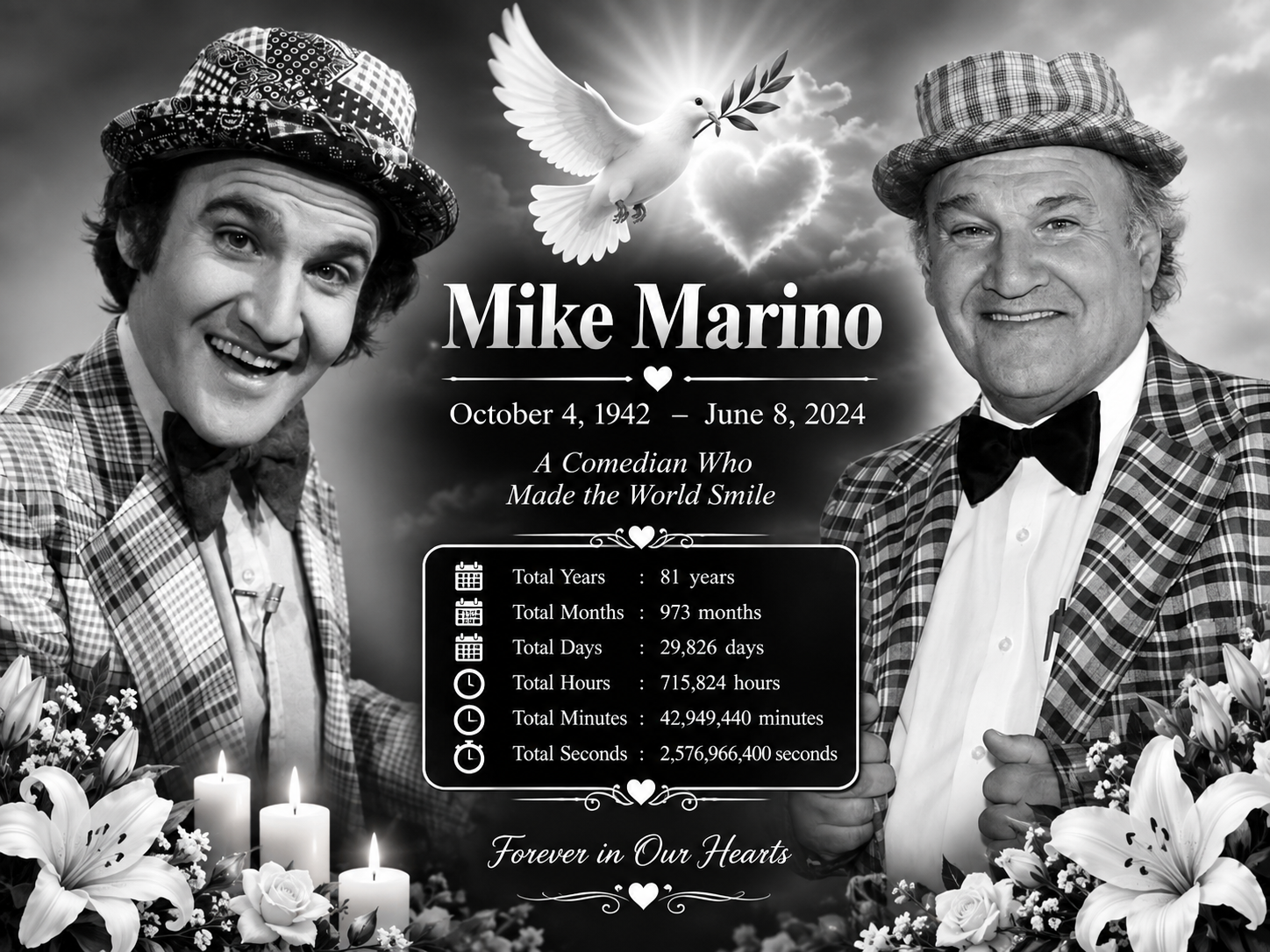
The final months of Mike Marino’s life were defined by a contrast that had not existed earlier in his career. For decades, public attention had followed him because he was performing. In 2026, attention increasingly followed him because he was seriously ill. The same public persona that had once been built through jokes, characters, television appearances, and stories from New Jersey was now being seen through reports about his health.
The medical crisis had begun earlier in the year. After becoming ill while performing on a cruise ship, Marino was found to have a brain tumor. Doctors removed it, and he subsequently worked through physical therapy and follow-up appointments. The April interview in which he discussed the experience showed that he was still thinking about work and recovery rather than treating the diagnosis as the only subject of his public life.
That distinction matters because his career had never been built around a single defining event. It had developed gradually through years of performance. By the time illness entered the public record, Marino had already accumulated a body of work large enough to stand on its own.
The “Back 2 School” special was particularly important in that context. It had been developed with Daniel Catullo and filmed at Scotch Plains-Fanwood High School, the place where Marino had first participated in theater and music. The project gave the audience a version of Marino connected directly to his origins.
The school environment also reinforced the chronology. The stage where the adult comedian performed was tied to the teenager who had once taken part in the Repertory Theatre, Drama Club, and Moonglowers. The marching band, the early acting experience, and the later professional career could all be connected to the same physical institution.
The 2024 Hall of Fame induction had already recognized that connection. Marino had returned to the community as an established actor and comedian rather than as the aspiring student he had once been. The recognition came before the health crisis and therefore reflected the career he had built over decades.
That career included the New Jersey Comedy Hall of Fame, where Marino had been inducted in 2008. It also included the USO Bob Hope Comedy Award in 2015. These were milestones separated by years, but together they illustrated the different audiences and institutions that had become part of his professional history.
His acting credits added another layer. Television programs such as “Frasier,” “Becker,” “Nikki,” “Party of Five,” “As the World Turns,” and “One Life to Live” placed him in scripted productions, while his work on “The Tonight Show with Jay Leno” connected him to late-night comedy and national television.
The commercial record was equally substantial. More than 200 national television commercials were associated with his career, and he received a Best Actor Clio nomination. The work demonstrated that his performance skills were useful outside the comedy club and helped establish him professionally long before social media could provide performers with direct access to audiences.
His stage characters remained another part of that archive. Cousin Mooney, Uncle Tommy, Cousin Michelle, and G.I. Giovanni represented different pieces of the comic world he had created. They were recognizable extensions of the family and cultural themes that appeared repeatedly throughout his material.
Those characters also demonstrated why the word “comedian” alone did not capture every aspect of Marino’s professional identity. Character comedy requires acting. It requires changes in voice, physicality, timing, perspective, and personality. Marino had developed those skills through both formal training and years of practical performance.
His Italian-American identity was another continuing thread. It appeared in his stories about family, his New Jersey material, and projects such as “Make America Italian Again.” The cultural references were not separate from his regional identity. They were intertwined, creating the distinctive combination that audiences associated with him.
His podcast work extended that connection to his personal history. “Live From My Mother’s Basement” was recorded in the house where he had grown up. After his parents died, Marino purchased the house, according to the April interview, and spent time walking through the surrounding neighborhood.
That detail became especially poignant in retrospect, although there is no need to turn it into something it was not. At the time, the house was simply part of his life and work. It provided a setting from which he could speak, remember, perform, and continue creating.
The same could be said about his school project. “Back 2 School” was not created as a memorial. It was a working entertainment project, a special built around memories of teenage life, family, Italian-American culture, and the place where Marino had grown up. Its significance changed because of what happened afterward.
By July 2026, News 12 reported that Marino was battling Stage 4 brain cancer following the surgery earlier in the year. The report said his official social-media posts described the illness and his efforts to recover through physical therapy and follow-up medical care. The information provided a clearer picture of the seriousness of his condition while still showing that he remained engaged with the public.
The progression from tumor surgery to an advanced cancer diagnosis transformed the context around his earlier recovery efforts. Physical therapy was no longer simply part of returning to ordinary life. It was part of navigating a serious disease that had become increasingly difficult.
There were no need for invented final speeches to make the moment significant. The documented facts were enough. A performer who had spent decades controlling the timing of his public appearances was now living within a schedule determined partly by medical treatment and physical limitations.
The contrast was especially striking because Marino’s public persona had always been energetic. His comedy depended on movement, voices, characters, observations, and the ability to engage a room. His professional life involved travel, touring, television, and repeated appearances. Illness introduced limits that had nothing to do with audience response or professional preparation.
Yet the work did not disappear simply because the circumstances changed. Recordings remained. Television appearances remained. His comedy special remained. The characters remained. His podcast and web projects remained. The people who had seen him perform carried their own memories of those performances.
His connection to service members remained part of the record as well. Years earlier, he had traveled through USO programs and performed in places including Bosnia and Afghanistan. The Bob Hope Comedy Award had recognized that work. It belonged to a chapter of his career that was separate from the later diagnosis, but it also showed how broadly he had used performance.
His community involvement provided another dimension. Marino had supported first responders and related charitable efforts, and his public career repeatedly returned to themes of family and community. His New Jersey identity was not merely an advertising label. It was rooted in the places and people he continued to revisit throughout his career.
By September, the illness had progressed to the point that public reports were increasingly focused on his final days. Reports indicated that he had been placed in hospice shortly before his death. The chronology was becoming shorter, and the distance between medical updates was narrowing.
On September 15, 2026, Mike Marino died at age 63. That date is the verified endpoint of the public timeline. The circumstances surrounding the cause of death require careful wording. News 12 reported that, according to posts on his official social-media accounts, he died following a battle with brain cancer. Legacy reported his death but stated that a cause of death had not been announced.
Those two pieces of reporting can be held together without forcing them into a more specific conclusion than the public record supports. Brain cancer was publicly reported as the illness he had been battling, while a formally announced cause of death was not identified by every obituary source. What can be stated with confidence is that he died on September 15, 2026, at 63, after a serious battle with brain cancer.
The news closed a career that had stretched across several forms of entertainment. Marino had been an actor, comedian, commercial performer, television personality, character creator, touring entertainer, podcaster, and digital creator. He had also performed for service members and participated in charitable activities.
The final public chapter therefore did not replace the earlier ones. It completed them. The teenager who had performed in school productions had become a professional actor. The actor had become a widely recognized comedian. The comedian had created characters and television appearances. The touring performer had reached military audiences overseas. The established entertainer had returned to his high school for a deeply personal special.
Then the person behind all those roles was gone.
What remained was not only a collection of achievements but an accessible record of performance. Someone watching one of his television appearances could encounter the actor. Someone playing a stand-up clip could encounter the comedian. Someone watching “Back 2 School” could encounter the performer returning to the place where his ambitions began. Someone listening to his podcast could hear the connection between his adult career and the home where he grew up.
That was the unusual shape of Marino’s final chapter. His illness narrowed his physical world, but his recorded work continued to widen his reach. The performances no longer depended on whether he could travel to the next city or walk onto the next stage.
The silence after September 15 was therefore real, but it was not total. The live performance had ended. The archive had not.
Click Here to continue read next: PART8: Mike Marino’s Final Chapter Ended in September 2026, Leaving Behind a Jersey-Born Career Built From Characters, Family Stories, Acting, Service, and Decades of Performance
The Laughs Had Always Been Easy to Hear, but Behind the Jersey Jokes Was a Performer Quietly Building a Career From the Ground Up
Part 7 of 16

