
The story began long before the nickname “New Jersey’s Bad Boy of Comedy” became familiar. It began with a young performer in New Jersey who discovered early that entertainment could become more than an interest. School theater, music, acting, and professional opportunities gradually turned that interest into a career.
Mike Marino was born in 1963 and grew up in New Jersey in an Italian-American family. His later comedy would repeatedly draw from that background, but the connection was more than a source of jokes. New Jersey and family became part of the language through which he understood his experiences and communicated them to audiences.
At Scotch Plains-Fanwood High School, Marino participated in the Repertory Theatre, Drama Club, and Moonglowers, and he played drums in the marching band. His involvement in performance began early enough that his professional ambitions were already visible while he was still a student. His school history records that he became a member of the Screen Actors Guild at sixteen.
Formal training followed. Marino studied at the Herbert Berghof Studio and the American Academy of Dramatic Arts. Those studies gave him a foundation in acting that remained visible throughout the decades that followed. Even when comedy became his most recognizable field, the actor remained present in his work.
Commercials became one of the earliest major parts of his professional career. Marino appeared in more than 200 national television commercials and received a Best Actor Clio Award nomination. The scale of that work demonstrated the breadth of his performance career before the public primarily knew him as a stand-up comedian.
Television expanded the record further. Marino appeared in programs including “As the World Turns,” “One Life to Live,” “Becker,” “Nikki,” “Frasier,” and “Party of Five.” He also appeared on “The Tonight Show with Jay Leno” and other comedy and entertainment programs.
Stand-up eventually became the center of his public identity. Marino developed a style built around observations, family experiences, New Jersey life, Italian-American culture, and character work. The resulting persona became closely associated with the title “New Jersey’s Bad Boy of Comedy.”
The nickname was only one part of the identity. Marino created recurring characters including Cousin Mooney, Uncle Tommy, Cousin Michelle, and G.I. Giovanni. Through them, he could approach the same cultural and family themes from different personalities and perspectives.
His touring career carried those characters far beyond New Jersey. Marino performed in comedy clubs, theaters, casinos, and event centers and appeared at major comedy venues. He also performed at Just for Laughs in Montreal for seven consecutive years, adding an international comedy festival to his professional history.
Television gave his comedy another route to audiences. A “Comics Unleashed” clip associated with Marino reportedly received more than seven million views, demonstrating how a recorded performance could reach people far beyond the room where it had originally been performed.
His career also moved into digital media. “Make America Italian Again” gave him a platform to explore Italian-American identity in a format beyond traditional stand-up. The project reflected themes that had already been present throughout his career: family, culture, humor, and the particular experiences of growing up Italian-American in New Jersey.
“Live From My Mother’s Basement” offered another unusually personal setting. Marino recorded the podcast in the basement of the home where he had grown up. After the deaths of his parents, he bought the house, according to an April 2026 interview, and spent time walking around the neighborhood where his life had begun.
That return to home became especially meaningful when placed beside “Mike Marino: Back 2 School.” The special was filmed at Scotch Plains-Fanwood High School with Daniel Catullo, bringing Marino back to the institution where he had participated in theater and music decades earlier.
The production recreated elements of the school environment, including a 1981 classroom, while turning the auditorium into a comedy club. The concept connected the student Marino with the professional entertainer he had become. It was a performance, but it was also a record of the distance traveled between those two stages of life.
In 2024, Marino was inducted into the Scotch Plains-Fanwood High School Hall of Fame. The recognition followed decades of professional work and reflected the connection between his career and the community where his early ambitions had taken shape.
Other honors marked different sides of his career. Marino had been inducted into the New Jersey Comedy Hall of Fame in 2008. In 2015, he received the USO Bob Hope Comedy Award after performing for service members, including in Bosnia and Afghanistan.
The USO work was important because it showed Marino performing outside the usual commercial entertainment circuit. He brought comedy to military audiences and became part of a long tradition of entertainers using performance to reach service members far from home.
His public work also included support for first responders and related charitable efforts. These activities were separate from the television credits and comedy specials, but together they formed part of the public life surrounding his entertainment career.
By 2026, Marino was still developing projects when his health changed dramatically. After becoming ill while performing on a cruise ship, doctors discovered a brain tumor and removed it. He then worked through physical therapy and follow-up appointments while continuing to be involved in his professional projects.
His illness later became more serious. News 12 reported that Marino was battling Stage 4 brain cancer after the surgery, citing posts from his official social-media accounts. Those reports described his efforts to recover and his continued medical treatment.
The illness did not erase his connection to “Back 2 School.” Instead, the special became one of the final major projects through which audiences could see Marino doing what he had done for decades: turning personal history into performance.
There is a temptation in any final biography to make the ending appear predetermined, as though every earlier event existed only to lead toward the final illness. Marino’s career does not require that interpretation. His work had its own development, its own successes, its own changes, and its own purposes long before the diagnosis appeared.
The teenager in the school theater could not have known where the career would lead. The young actor working in commercials could not have known that he would later become known primarily for stand-up. The comedian developing New Jersey characters could not have known that he would eventually return to his high school to film a special.
Each stage existed in its own time. The meaning of the entire career becomes clearer only when the stages are viewed together.
That career crossed boundaries that are easy to overlook when a performer becomes associated with one nickname. Marino was not only a New Jersey comedian. He was also an actor trained in formal studios, a commercial performer with hundreds of national spots, a television actor, a touring stand-up comedian, a character performer, a military entertainer, a podcaster, and a digital creator.
His Italian-American identity was equally central to the story. He repeatedly transformed family and cultural experiences into comedy, but he also used those themes to establish continuity between his personal history and his public work.
New Jersey supplied the geography. Family supplied many of the stories. Acting supplied the performance foundation. Comedy supplied the central public identity. Television expanded the audience. Touring carried the material outward. Digital projects gave the work additional forms. His hometown later became the setting for a return to the beginning.
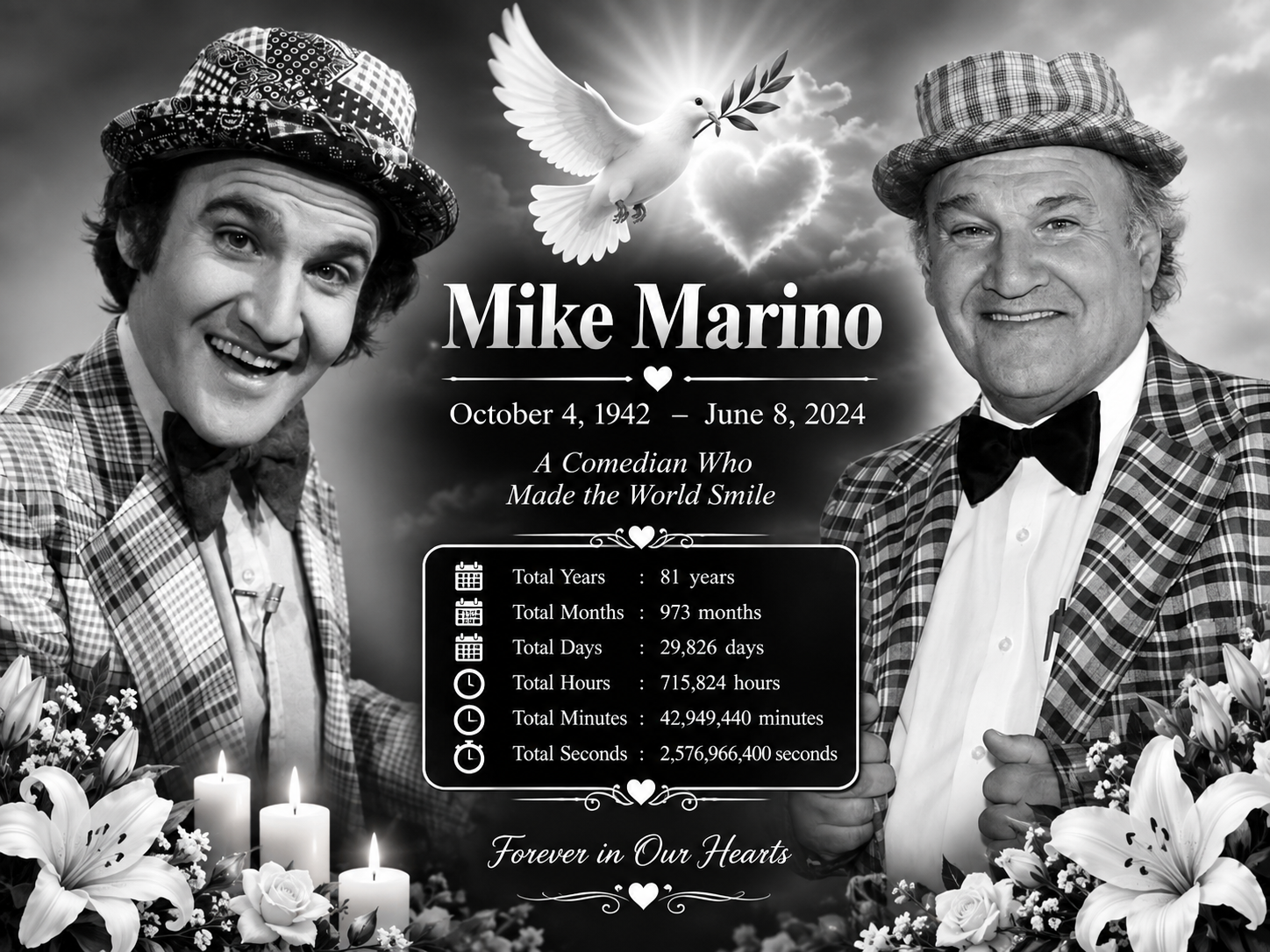
Then, on September 15, 2026, Mike Marino died at age 63.
The public record surrounding his death should be described carefully. News 12 reported that he died following a battle with brain cancer, based on posts from his official social-media accounts. Legacy reported his death and stated that a cause of death had not been announced. The most precise account is therefore that Marino died on September 15, 2026, at 63, after publicly battling brain cancer, while the exact formal cause of death was not uniformly reported as officially announced.
The final date does not erase the decades before it. His career remains documented through recordings, television appearances, interviews, comedy specials, photographs, credits, awards, and the memories of audiences who encountered him in person or through a screen.
There is also something fitting about the fact that one of his later projects brought him back to the school where the story had begun. “Back 2 School” placed the adult comedian inside the environment of his youth, surrounded by reminders of the student who had already been drawn toward theater, music, and performance.
The circle was not perfect, because real lives rarely are. There were years of touring, television work, commercial jobs, military performances, family changes, new media projects, health struggles, and unfinished plans. But the connection between the beginning and the later career was unmistakable.
Marino spent decades turning experiences into stories. Some were about family. Some were about New Jersey. Some came through characters. Some appeared in scripted television. Some were performed for service members. Some were recorded in a school auditorium. Some were shared from the basement of the home where he had grown up.
Those stories now have a different relationship with time. A live performance ends when the audience leaves. A recording can remain. A television appearance can be replayed. A podcast can continue circulating. A comedy special can introduce a performer to people who never had the chance to see him in person.
That is where the final chapter leaves Mike Marino: not with the suggestion that a recording replaces a person, and not with a manufactured final message, but with a body of work that remains accessible after his death.
The microphone is silent now. The stage no longer waits for his next entrance. The touring schedule has ended. The new project that might have followed the last one will never arrive.
But the performances that already happened remain.
The young man from New Jersey became the actor, comedian, character performer, television personality, touring entertainer, military performer, podcaster, and storyteller that audiences came to know. He returned repeatedly to the places that shaped him, carried his family and cultural history into his comedy, and spent decades making those experiences understandable through laughter.
Mike Marino died at 63, but his professional timeline reaches far beyond the date printed at the end of it. It reaches back to a teenager on a school stage, forward through decades of work, and outward through recordings that can still be watched and heard.
The final chapter, then, is not a new performance. It is the point at which the performances become history.
And somewhere inside that history are the voices he created, the places he remembered, the stages he crossed, the audiences he reached, and the stories he left behind.
Click Here to continue read next: PART9: After the Final Curtain, Marino’s Work Began Moving Through Memory, Recordings, Hometown Tributes, and the Digital World He Had Helped Make Part of His Career
The Laughs Had Always Been Easy to Hear, but Behind the Jersey Jokes Was a Performer Quietly Building a Career From the Ground Up
Part 8 of 16

