
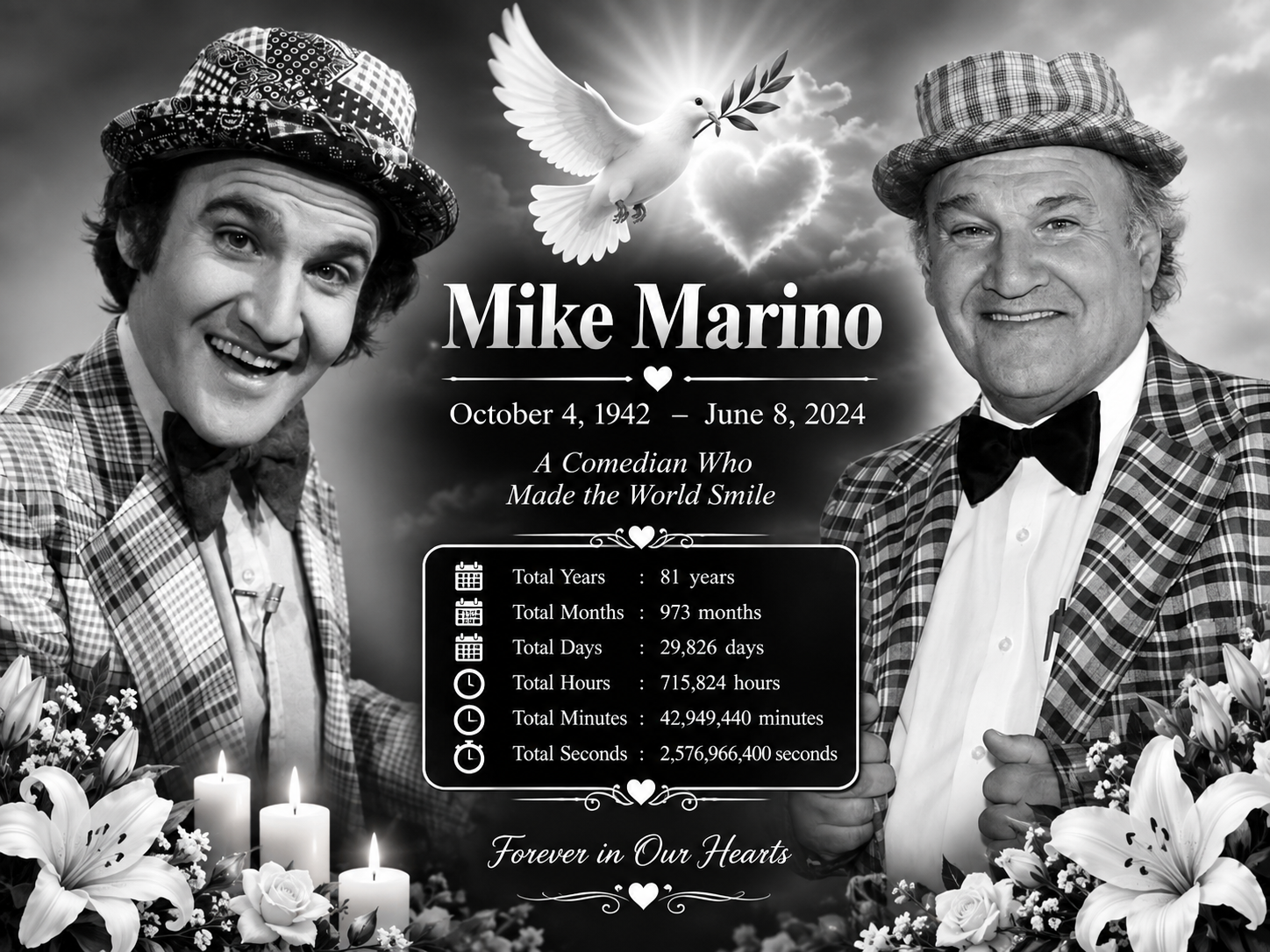
The image of Mike Marino returning to his old high school carried a meaning that could be understood without inventing anything about his private thoughts. The documented record already showed that the school had been important to his early development and that he later chose to return there professionally.
Marino’s connection to Scotch Plains-Fanwood High School went back to his teenage years. He participated in theater programs, music activities, and the marching band. His school history records his involvement in the Repertory Theatre, Drama Club, and Moonglowers, while also noting his early membership in the Screen Actors Guild.
Those activities were not merely background details. They represented the first documented stages of the performance career that would eventually take him far beyond New Jersey. The teenager who appeared in school productions later became a professional actor and comedian.
His education after high school continued that trajectory. Marino studied at the American Academy of Dramatic Arts and at the Herbert Berghof Studio. The formal training complemented the practical experience he had already gained through acting and school performance.
Then came professional commercial work. More than 200 national television commercials became part of his résumé, along with a Best Actor Clio Award nomination. The scale of that work established him as a professional performer long before his later reputation as a stand-up comedian became dominant.
Commercial acting also placed Marino in front of large audiences without requiring him to appear under his own name. A commercial character may last only seconds, but the performer still has to create something immediately understandable. Those years contributed to the fluency with cameras that later became useful across television and comedy.
His acting credits expanded beyond commercials. Marino appeared in daytime programs, sitcoms, dramas, and comedy shows, including “As the World Turns,” “One Life to Live,” “Becker,” “Nikki,” “Frasier,” and “Party of Five.” His appearance history also included “The Tonight Show with Jay Leno.”
The variety of those credits reflected an entertainer comfortable moving between formats. Yet stand-up remained the central public identity.
The phrase “New Jersey’s Bad Boy of Comedy” became associated with Marino because his comedy remained strongly connected to the place where he had grown up. His family experiences and Italian-American background became recurring sources of material.
That identity did not remain confined to one kind of joke. Marino developed characters that allowed him to dramatize family and cultural personalities. Cousin Mooney, Uncle Tommy, Cousin Michelle, and G.I. Giovanni became recognizable elements of the act.
The characters were important because they brought his acting background into his comedy. Marino was not simply telling stories as himself. He could become another person, alter the rhythm of the performance, and create a larger comic environment.
That same skill helped his comedy survive across different stages. He performed in clubs, theaters, casinos, and event centers, while also appearing at Just for Laughs in Montreal for seven consecutive years.
The touring life meant repeatedly rebuilding an audience connection. A familiar character or recognizable regional story could serve as an entry point, while the underlying subjects remained understandable to audiences from different places.
New Jersey gave the comedy its identity. Family gave it its emotional material. Acting gave it technique. Touring gave it reach.
Those elements eventually returned to the school.
In 2024, Marino was inducted into the Scotch Plains-Fanwood High School Hall of Fame. Two years later, the school became the setting for “Mike Marino: Back 2 School,” a project created with Daniel Catullo.
The school described the production as a full-circle moment and explained that the auditorium would be transformed into a comedy club while the stage would be made to resemble a 1981 classroom. The physical transformation allowed the production to combine the environment of Marino’s adolescence with the professional identity he had developed afterward.
The subject matter also remained connected to his established material. The special drew from teenage misadventures, Italian-American family life, and memories of growing up in New Jersey. In other words, the project did not require Marino to invent a new identity for the occasion. It gave him a new setting in which to use the identity he had already spent decades developing.
His later podcast created another connection with home. “Live From My Mother’s Basement” was recorded in the basement of his childhood home. After his parents’ deaths, Marino purchased the house and discussed the neighborhood during an April 2026 interview.
The house and the school were different places, but they represented the same larger theme: the continuing presence of the past in Marino’s adult creative life.
That theme was also visible in “Make America Italian Again.” The project allowed Marino to continue exploring Italian-American identity in a digital format, extending a subject that had been central to his comedy for years.
By the time these later projects appeared, Marino had already achieved several major professional milestones. His 2008 induction into the New Jersey Comedy Hall of Fame recognized his place within the state’s comedy tradition. His 2015 USO Bob Hope Comedy Award recognized another side of his work.
The USO chapter had taken him into Bosnia and Afghanistan, where he performed for service members. The settings were dramatically different from New Jersey, but the purpose remained connected to his profession: bringing an audience an experience built around performance.
The award demonstrated that his work could be valuable in environments far removed from entertainment-industry venues. Comedy was still the medium, but the surrounding circumstances were different.
That breadth continued into his public and charitable activities. Marino had supported first responders and participated in events connected with families affected by tragedy. These efforts existed alongside, rather than instead of, his entertainment work.
Then the health crisis arrived.
After becoming ill while performing on a cruise ship, Marino was diagnosed with a brain tumor and underwent surgery. In an April 2026 interview, he discussed the surgery and his efforts to regain strength through physical therapy and medical follow-up.
The timing is significant because he was still working. “Back 2 School” was still part of his professional life, and the podcast and other projects remained connected to his identity.
Later reporting made clear that the medical situation had become more severe. News 12 reported that Marino was battling Stage 4 brain cancer and had spoken publicly about the condition following surgery.
The public record therefore contains two simultaneous stories from 2026. One is the story of a performer continuing to create, return to familiar places, and remain connected with audiences. The other is the story of a serious illness that increasingly limited the future.
Neither story cancels the other.
The final months should not be described as though every earlier career decision was secretly leading toward the illness. They were not. Marino’s work had its own history and development.
But the illness did change how the final projects would later be remembered.
“Back 2 School” became one of the last major pieces of work associated with him. The school return became part of his final professional record.
The childhood home became part of the later podcast record.
The characters remained part of the archive.
The television appearances remained available.
The comedy recordings remained available.
The USO work remained documented.
The awards remained documented.
The hometown honors remained documented.
The final illness eventually became documented too.
When Marino died on September 15, 2026, at age 63, those separate strands suddenly belonged to a completed chronology.
News 12 reported that he died following a battle with brain cancer, citing posts from his official social-media accounts. Legacy reported his death and said that a cause of death had not been announced.
That distinction matters because a final biography should not make medical claims more specific than the sources allow.
What can be established is the date, the age, the publicly reported illness, and the career that preceded the death.
The final physical return had already happened before the final illness became the dominant public story.
Marino had returned to the school.
He had returned to the neighborhood.
He had returned to the house.
He had returned repeatedly to the family and cultural material that had shaped his comedy.
And through those returns, the career had come back into contact with its beginning.
Click Here to continue read next: PART15: When the Future Closed, the Existing Work Became the Record, Preserving the Voices, Places, Characters, and Performances That Had Defined Marino Across Four Decades
The Laughs Had Always Been Easy to Hear, but Behind the Jersey Jokes Was a Performer Quietly Building a Career From the Ground Up
Part 14 of 16

