
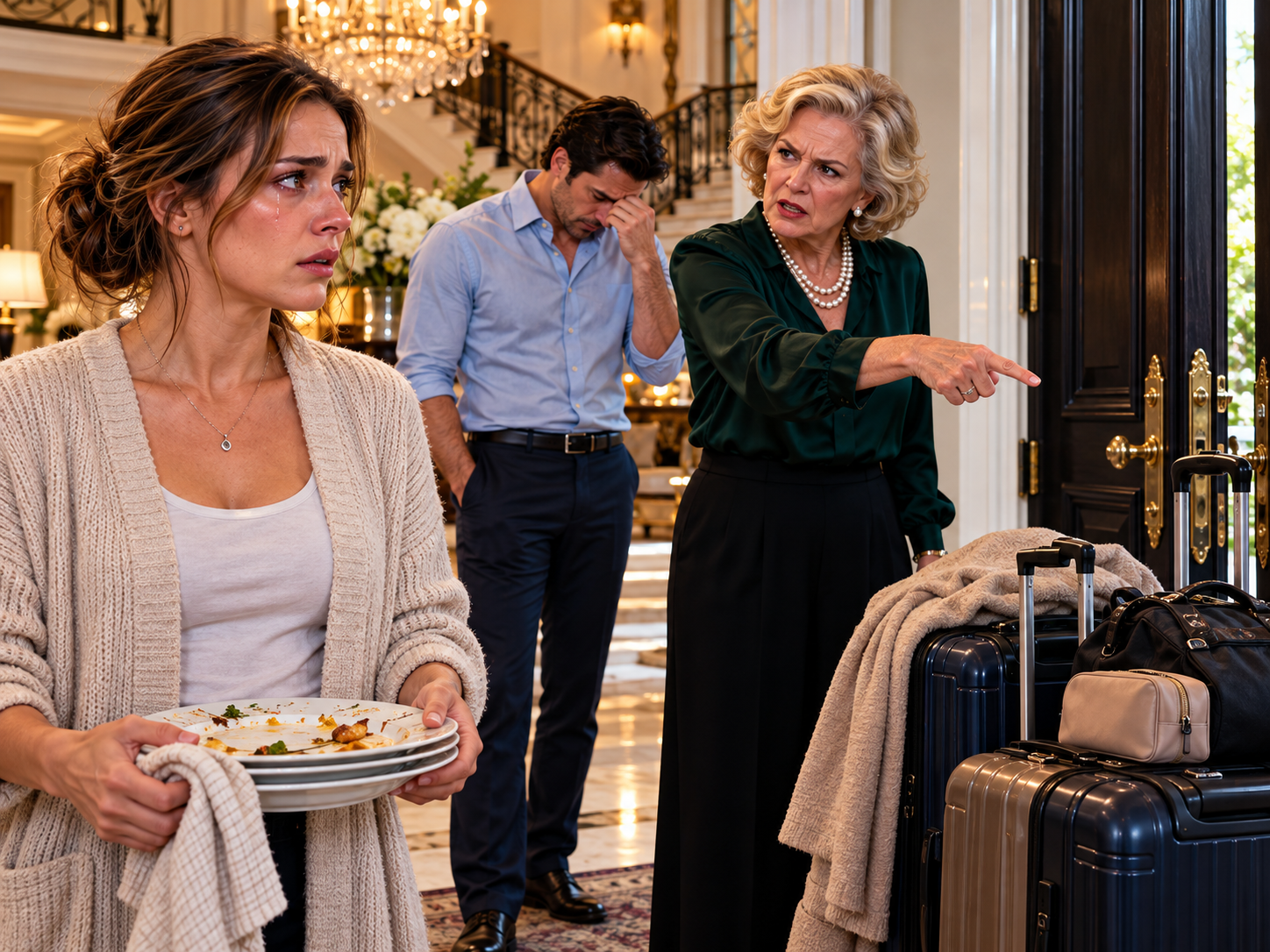
The change in Michael did not arrive in one dramatic conversation. It appeared gradually, through the questions he stopped asking and the space he began to leave between them.
He no longer asked whether I had thought about moving back into the mansion. He did not ask whether Eleanor’s letter had changed my feelings about the family. When we met for coffee, he stopped watching my face for clues that might tell him whether the afternoon had brought us closer to reconciliation.
At first, I wondered whether his silence meant he was giving up. A part of me had grown accustomed to measuring his feelings by how urgently he tried to repair things. His earlier attempts to reassure me had often become pressure, but they had also been evidence that he was afraid of losing me.
Now he seemed to be learning that fear could not be the foundation of a future.
One Saturday, we met at a café near the park. The weather had turned colder, and people entered with their coats buttoned to the throat, stamping rain from their shoes. Michael arrived with a book tucked under his arm. He had finished reading the novel I had lent him and wanted to return it.
“I liked the ending,” he said as he handed it over.
“Even though it wasn’t neat?”
“Especially because it wasn’t neat. The characters had to live with what they’d done. The story didn’t pretend that understanding something meant you could undo it.”
I smiled. “That sounds like a review you’ve been thinking about.”
“I probably have.”
We ordered coffee and talked about the book. After a while, he told me that his counselor had asked him to think about the difference between wanting forgiveness and accepting responsibility.
“I used to think apologizing meant I was supposed to do something afterward that would make the other person feel better,” he said. “If you stayed hurt, I thought I hadn’t apologized properly, so I would keep explaining or asking what else I could do.”
“And now?”
“Now I’m trying to understand that an apology isn’t a way to control the other person’s response. I can be sorry and still have to accept that they may not be ready to forgive me.”
I stirred my coffee. “That’s true.”
“I think I was asking you to make me feel less guilty. I didn’t understand how much of that I was putting on you.”
I looked at him. “You did that a lot.”
“I know.”
There was no defense in his answer. He did not explain how hard things had been with Eleanor or how much pressure he had felt when we lived in the mansion. Those things might have been true, but they did not change the fact that he had transferred the burden to me.
“I’m glad you’re seeing it,” I said.
“So am I.”
He looked out the window, where a couple was trying to fold a large umbrella while standing beneath the narrow café awning. Their efforts were so awkward that both began laughing. Michael watched them for a moment before turning back to me.
“I want you to know something,” he said. “I still love you. I still hope we might find a way to be together again. But I don’t want to keep asking you to decide whether that will happen.”
I felt my chest tighten, not because he had surprised me, but because he had finally said what I needed to hear without attaching a request to it.
“Thank you,” I said.
“I don’t want you to think I’m stepping away because I don’t care. I’m trying to stop making my feelings another responsibility for you.”
“I understand.”
He took a breath. “If you eventually decide you don’t want to rebuild the marriage, I’ll have to accept that. I won’t pretend it wouldn’t hurt. But I can’t ask you to return just because I’m afraid of losing you.”
For a moment, I could not find the right words. I had wanted him to recognize that truth for so long, yet hearing it did not produce the certainty I once imagined it would. I did not suddenly know whether I wanted to be his wife again. I did not feel an obligation to reward his progress by moving closer.
Instead, I felt a quiet respect for the fact that he was finally allowing me to have a choice.
“I still care about you,” I said. “And I’m grateful for the work you’re doing. But I’m not ready to tell you what the future will be.”
“I know.”
“I don’t want you to wait for me as though I’ve promised that if you wait long enough, I’ll come back.”
“I’m not asking you to promise that.”
We sat together for a while, drinking our coffee. The conversation did not end with a kiss or a decision. When it was time to leave, Michael stood and put on his coat.
“Would you like to do this again?” he asked.
“Yes,” I said. “I would.”
He smiled, and for the first time in a long while, I did not feel that my answer had created an expectation I would later be forced to manage.
We agreed to meet the following week, then went our separate ways.
Over the next several days, I found myself thinking about what a future with Michael might look like if we ever chose to try again. I imagined a home where we made decisions together, where a disagreement did not become a test of loyalty, where neither of us had to scan another person’s face before speaking honestly. I imagined him hearing from Eleanor that she was upset and responding without asking me to change my position. I imagined myself being able to say no without preparing for the emotional consequences.
But I also imagined a future in which we did not reconcile. I pictured myself continuing to build a life in the apartment, perhaps eventually moving somewhere larger, making friends, traveling when I could, and learning to enjoy my own company without interpreting solitude as failure.
Neither future frightened me as much as it once would have.
That was the part I had not anticipated. Leaving the mansion had initially felt like losing a place in the world. I had worried about what people would think, whether Michael would stand by me, and whether I would regret refusing to accept the arrangement Eleanor had imposed. The uncertainty had seemed like a punishment.
Now uncertainty felt different. It was space in which a decision had not yet been made because it did not need to be made.
Eleanor remained part of that uncertainty. Her letter had acknowledged more than I expected, and our brief conversation at the family celebration had been respectful. Still, I did not know whether she could maintain that respect when she felt challenged again. I did not assume that one careful message had changed the habits of a lifetime.
We exchanged a short note around the holidays, and she thanked me for a small gift I had sent to the birthday relative earlier in the season. The exchange was polite and uneventful. It did not make us close, but it did not require us to reopen the conflict, either.
I found that I preferred this modest distance to the forced closeness I had once tried so hard to achieve.
Charles sent one final note confirming that the estate file had been placed with the other relevant records and that there was nothing further required from me at that time. I thanked him for his help. He had never promised that the agreement would make my life simple or that the family would suddenly behave differently. He had simply made sure that the process Jonathan established was respected.
That distinction stayed with me.
The agreement had protected a boundary. It had not given me ownership of the mansion, and I had never wanted it to. It had ensured that the house could not be used as an excuse to remove me arbitrarily while disregarding the safeguards Jonathan had put in place. It had provided a formal review of the reserve and a proper way to address the records. Once that work was finished, the documents returned to being what they had always been: important papers, not a substitute for trust.
One evening, I took them out of the drawer to organize my files. I placed the estate correspondence in a folder, checked that the closing letter was included, and put everything back. I did not feel angry as I closed the drawer. I felt finished with that part of the story.
The next morning, I woke early and opened the window. The air was cold, and the street below was just beginning to fill with people heading to work. I made coffee, fed the small plant on the sill, and stood for a moment in the quiet room.
The apartment still had its imperfections. The radiator knocked. The bookcase leaned slightly to one side. One kitchen drawer stuck unless I lifted it as I pulled. But everything in the room belonged to the life I had chosen, and none of those small inconveniences made me feel that I had to earn the right to remain.
I thought of Jonathan’s words about the house, about how preserving a home should never mean allowing one person to control everyone else. I had once understood that idea only as a principle written in an estate document. Now I understood it as something more personal.
A home was not valuable because it was expensive or because a family had owned it for generations. It was valuable because the people inside could live there with dignity, safety, and a measure of freedom. Without those things, even a mansion could become a place where someone learned to disappear.
I would always remember the Richardson house. I would remember its garden, its long dining table, the family photographs, and the evenings when I had hoped that patience would make me belong. I would also remember the suitcases beside the front door and the moment I realized that the man I loved had already agreed to a decision that should never have been made without me.
I did not have to choose one memory and deny the other.
Michael and I were still finding our way through the consequences. We might eventually discover that the marriage could be rebuilt on different terms. We might discover that affection and regret were not enough to make a shared future possible. Neither outcome would erase the years we had spent together, and neither would determine whether my life could be full.
I had stopped treating reconciliation as the only ending that could make the story worthwhile.
That afternoon, Michael sent a message asking whether I wanted to meet the following weekend. I checked my calendar, considered what I wanted to do, and answered that Saturday would work for me.
He replied with a simple thank-you and suggested a time.
There was no request for reassurance. No hint that agreeing to meet meant I was moving closer to returning. No demand that I explain what the meeting would mean.
I placed the phone on the table and went back to my book.
For five years, I had lived under a roof where my place could be questioned whenever someone else became displeased. I had tried to make myself indispensable, agreeable, and easy to keep. When that failed, I had believed the failure belonged to me.
I knew better now.
I could care about Eleanor without surrendering my boundaries. I could care about Michael without promising him a future. I could respect the home Jonathan had tried to protect without making that home the measure of my own worth.
The next chapter of my life did not need to begin with a grand declaration. It could begin with a quiet Saturday, a cup of coffee, an honest conversation, or an afternoon spent alone in a home where I was free to decide what came next.
And whatever I chose, I would not choose it because I feared being sent away again.
I would choose it because it was mine to choose.
Click here to continue reading: PART 17: Our Next Saturday Together Felt Almost Ordinary, Until Michael Asked Whether I Could Ever Trust Him With a Home Again
My Mother-in-Law Had Packed My Life Into Two Suitcases, but the Question My Husband Refused to Answer Was Only the Beginning
Part 16 of 20

