
The trip lasted three days. I stayed with a friend in a small apartment near the center of the city, and we spent most of our time walking through neighborhoods, trying restaurants, and talking late into the evening. There were no family obligations to negotiate and no familiar rooms to remind me of the years I had spent trying to fit into Eleanor’s idea of a household.
On the first morning, we went to a market where vendors sold bread, flowers, fruit, and small handmade objects. I bought a simple ceramic cup with an uneven blue rim. It was not expensive or especially beautiful, but I liked the way it felt in my hand. I pictured it on my kitchen shelf beside the blue-and-white dish and decided I would take it home.
My friend asked how things were going with Michael. I told her we were speaking regularly and trying to understand what our relationship might become.
“Do you think you'll get back together?” she asked.
“I don't know.”
She looked at me for a moment, then nodded. “That's a real answer.”
I laughed. “It doesn't feel like one sometimes.”
“Maybe because people want a decision they can understand. But you don't have to make one just because they want to know how the story ends.”
Her words stayed with me. I had spent so much time trying to make my choices understandable to other people that I had forgotten how much freedom there was in not knowing yet.
On the second day, I visited a small museum and spent nearly an hour in a room of paintings. One showed a woman standing near an open doorway, looking out at a landscape beyond the frame. I could not tell whether she was about to leave or had just arrived. The uncertainty made the painting more interesting, not less.
I took a photograph and sent it to Michael with a short message saying I thought he might like it.
He replied that the painting reminded him of the way his father used to talk about choices. He did not ask whether I had been thinking about him or whether the trip had changed my mind about our marriage.
I was grateful for that.
When I returned home, I unpacked slowly. The ceramic cup went onto the shelf, where the blue rim caught the light from the window. I put my clothes away, watered the plant, and opened the curtains. The apartment looked much as I had left it, but I felt different. The trip had reminded me that there was a world beyond the conflict that had occupied so much of my attention.
Michael called that evening to ask how the journey had gone. I told him about the market, the museum, and the meal my friend had insisted we try even though neither of us could pronounce half the items on the menu.
He laughed at the story and asked whether I would go again.
“Yes,” I said. “I think I would.”
“I'm glad you went.”
There was no hidden question beneath his words. He seemed to mean exactly what he said.
A few days later, we met for dinner at the restaurant where we had first spoken honestly about the possibility of repairing our marriage. The familiar setting made me think of that earlier evening, when I had told him that enjoying dinner was not a promise to return. Since then, we had learned to spend time together without treating every pleasant moment as evidence that the decision had been made.
We ordered food and talked about the trip. Michael told me he had been working on a difficult conversation with Eleanor, who wanted his opinion on some changes she was considering for the mansion. He had told her he was willing to discuss practical matters, but that decisions about the house had to remain consistent with the agreement and that he would not help her use the property to pressure me.
“How did she respond?” I asked.
“She wasn't happy. She said I was treating every decision as if it might become a legal dispute.”
“What did you say?”
“I told her I wasn't trying to turn ordinary decisions into legal matters. I was trying to make sure we didn't ignore the agreement just because following it was inconvenient.”
I nodded. “That sounds reasonable.”
“I also told her that your decision not to return wasn't something she could solve by changing the house or making another offer.”
I looked at him. “I'm glad you said that. But I hope you made it clear that my decision is mine, not something you need to defend to her.”
“I did. I told her I could speak about my own choices, but I couldn't negotiate yours.”
The words settled between us. It was the kind of distinction I had once tried to explain to him repeatedly. Hearing him make it on his own was encouraging, though I knew that the real test would come again when Eleanor was angry, when family pressure increased, or when the consequences became harder to tolerate.
We ate quietly for a few minutes.
“Can I ask you something?” Michael said.
“You can.”
“Are you happier living on your own?”
I considered the question. It would have been easy to answer yes, but the truth was more complicated. I missed companionship. I missed having someone to share small daily experiences with, someone who understood the history behind a joke or remembered why a particular song mattered. There were evenings when I missed Michael so much that the apartment seemed unusually quiet.
But I also slept better. I made decisions without anticipating criticism. I could invite a friend over or spend an entire afternoon reading without wondering whether my choices would be interpreted as disrespectful. I had stopped measuring the emotional weather in every room before deciding how to behave.
“I feel more like myself,” I said. “That doesn't mean I'm happy about everything that happened. It means I don't spend every day trying to keep the peace.”
He nodded slowly. “I wish our home had felt that way to you.”
“So do I.”
“I know saying that doesn't change anything.”
“No, it doesn't.”
He accepted the answer. We continued eating, and after a while the conversation moved to other things. When the bill came, we split it without discussion. Outside, he walked with me to the corner, then stopped where our routes separated.
“I enjoyed tonight,” he said.
“So did I.”
“Would you want to see me again next week?”
“Yes.”
He smiled, but did not reach for my hand or ask whether the answer meant anything beyond what I had said. We said goodbye, and I walked home.
Over the next few weeks, our meetings continued. Sometimes we talked about difficult subjects; sometimes we simply shared a meal. I began to notice that I could leave an afternoon with Michael feeling peaceful rather than wondering whether I had given him enough hope. He, in turn, seemed less likely to interpret my boundaries as evidence that I was rejecting him completely.
We were not a restored marriage. We were two people learning to relate to each other without relying on the old arrangement.
Eleanor remained in my life at a distance. We exchanged brief messages when there was a practical reason, and our conversations were polite. She did not ask me to return to the mansion, and I did not offer to help her persuade relatives that the family had moved past the dispute. Her apology and later acknowledgment mattered, but I did not treat them as a contract requiring me to become close to her again.
The estate file stayed in my drawer. I rarely thought about it. The agreement had protected a process, the review had addressed the records, and the required steps had been documented. The house remained Eleanor's, and the family would have to decide how to live within the boundaries Jonathan had established.
I no longer needed to follow every development.
One Sunday, I rearranged the photographs on my shelf. I moved the picture of Jonathan and me to the center, not because he had rescued me, but because I wanted to remember the kindness he had shown me. Beside it, I placed a photograph of Michael and me from our first year of marriage. We looked young and hopeful, unaware of the choices that would eventually test us.
I did not take the photograph down. Nor did I place it above the others as though our marriage were the only story that mattered.
Our history belonged on the shelf with everything else.
That evening, I sat at the kitchen table with the new ceramic cup in front of me. The blue rim was slightly uneven, and a small mark in the glaze made it different from every other cup in the shop. I ran my finger along the edge and smiled.
I had bought it because I liked it. No one else had chosen it for me, and I had not needed to justify the price or explain why I wanted it. It was a small thing, but the freedom to make small choices without defending them had become precious.
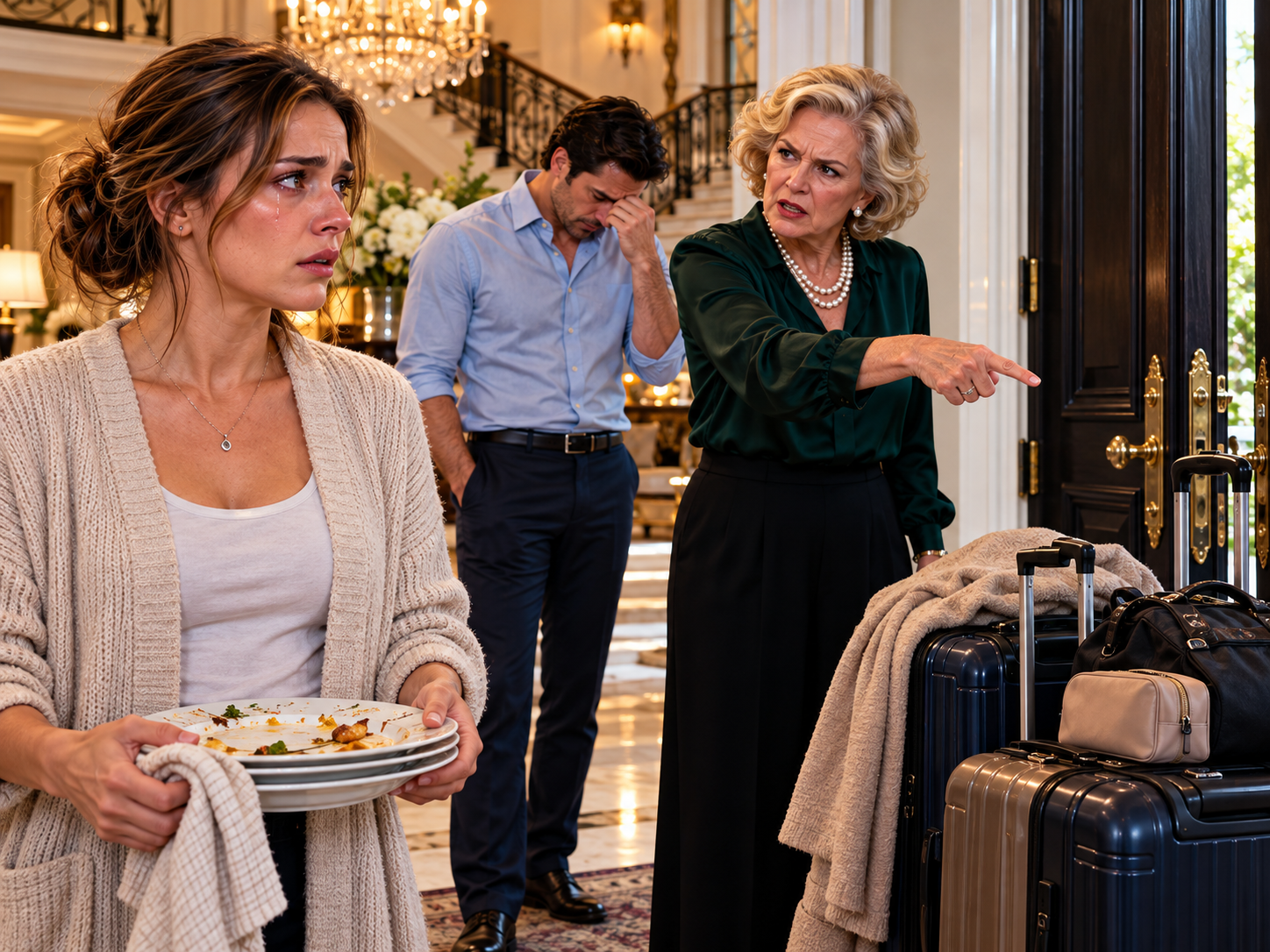
I thought about the night Eleanor told me to leave. I remembered the packed suitcases, Michael's lowered eyes, and the feeling that the life I had worked to maintain could be taken from me in a few sentences. At the time, I had believed I was losing everything.
I had lost a home, at least in the practical sense. I had lost the life I had expected to continue living with my husband. I had lost the illusion that being patient and agreeable would eventually guarantee me a secure place in his family.
But I had not lost my ability to build a life.
The mansion had not been mine to claim, and I had never wanted it to be. What I had wanted was respect, a voice in the decisions that affected me, and a marriage in which I did not have to choose between my dignity and my husband's comfort. The agreement had helped protect those principles, but it could not make Michael live by them. That part had to come from him.
Whether he could sustain the change remained uncertain. Whether I would ever want to share a home with him again remained uncertain, too.
For the first time, neither question felt like an emergency.
I washed the cup, dried it, and placed it beside the blue-and-white dish. Then I turned off the kitchen light and settled into the chair by the window with my book.
Outside, the street continued its ordinary evening rhythm. Someone called to a neighbor. A car passed slowly. A door closed in the building across from mine.
I had no final answer about my marriage, no perfect reconciliation with Eleanor, and no dramatic victory over the family that had once made me feel like a guest in my own life.
I had something quieter.
I had a home where I could breathe, a future I was free to shape, and the knowledge that love did not require me to surrender my right to choose.
That was enough to carry me into the next day.
The End
Read more original stories on Feel Every Story.
My Mother-in-Law Had Packed My Life Into Two Suitcases, but the Question My Husband Refused to Answer Was Only the Beginning
Part 20 of 20

