
Michael asked the question during a walk along the river, nearly a month after our dinner at the restaurant. The afternoon was cool, and the path was crowded with people walking dogs, pushing strollers, and stopping near the railing to watch the water move beneath the bridge. We had agreed to meet for an hour before he needed to return home. Neither of us had called it a date.
We walked side by side, leaving enough space between us that our arms did not brush. It was not a deliberate distance. We had simply learned that being careful with one another sometimes meant allowing a little room.
Michael had been telling me about a difficult conversation at work when he stopped speaking and looked out across the river.
“Can I ask you something without making you feel you have to decide anything?” he said.
“You can ask.”
“What would need to change for you to consider trying again?”
I slowed my pace. I had thought about the question many times, though not in a way that produced a neat answer. Some changes were obvious. I needed to know that my home would not depend on Eleanor’s approval. I needed Michael to stand beside me when a disagreement became uncomfortable, not only afterward when he could explain what he should have done. I needed us to make decisions as partners rather than as a couple waiting for his mother to approve the outcome.
But I also knew that giving him a list could become a substitute for the harder work of change. He might focus on completing each item, then ask whether he had done enough to earn my return. I did not want our marriage to become another system in which I was expected to evaluate his performance and deliver a verdict.
“I can tell you what I would need in a marriage,” I said. “But I can’t give you a checklist that guarantees I’ll come back.”
“I’m not looking for a guarantee.”
“I believe you’re trying not to. But I think part of you still wants to know the exact steps that would make this safe again.”
He considered that. “Maybe. I’m used to thinking that if I can understand the problem, I can find a way to fix it.”
“Some problems can be fixed with a plan. Trust isn’t quite like that.”
He nodded and waited.
“I would need a marriage where we could disagree without one of us being punished for it. I would need our decisions about our home, our money, and our future to belong to us. I would need you to be able to hear your mother’s disappointment without treating it as an emergency that I must help you solve.”
“I understand.”
“And I would need to believe those things were true on an ordinary Tuesday, not just after a crisis. Not only when we’re discussing our marriage or when you’re trying to show me that you’ve changed.”
He looked down at the path. “That makes sense.”
“It also means I don’t know how long it would take. And even if you did everything right, I might still discover that I can’t return to the marriage we had.”
His expression tightened, but he did not interrupt.
“I don’t say that to hurt you,” I continued. “I’m saying it because I don’t want either of us to build a future around a promise I can’t honestly make.”
“I’d rather know that than have you tell me what you think I want to hear.”
The answer sounded sincere. I could not know whether he would still feel that way in six months, or when the uncertainty became harder to bear. But he had heard me without asking me to soften the truth.
We continued walking.
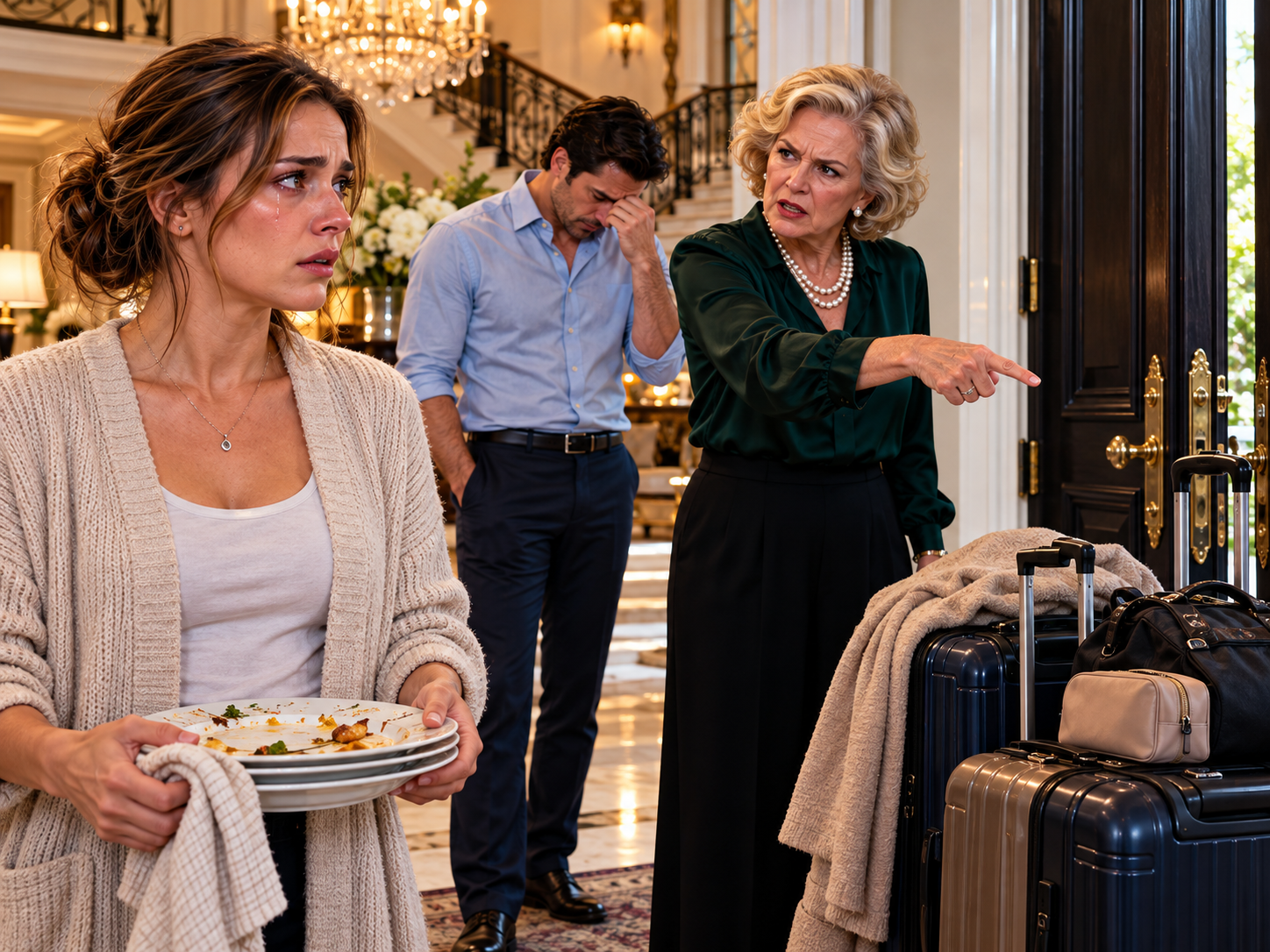
After a while, Michael told me that he had been thinking about the evening he packed my suitcases. In counseling, he had been asked to describe what he believed would happen if he refused Eleanor’s demand.
“I thought she would be furious,” he said. “I thought she might tell me I was ungrateful, that I was allowing you to turn me against her, that I was forgetting everything she’d done for me. I imagined the argument going on for days.”
“And what did you think would happen to me?”
He was silent for a long moment.
“I didn’t let myself think about it properly,” he admitted. “I knew you’d be hurt. But I told myself we could talk later, that you would understand why I had done it, that I could make it up to you. I treated your pain as something that could wait because I was trying to avoid hers.”
I felt a familiar ache beneath my ribs. It was painful to hear him say so clearly what I had known without being able to make him acknowledge it.
“You made a decision about both of us without asking me,” I said.
“Yes.”
“You decided I would leave before I had even been told I needed to.”
“Yes.”
“And you made me the person who had to absorb the consequences of your fear.”
He stopped walking. “I did.”
He did not look away, though his eyes had grown wet. I had once believed that if Michael could finally understand the full weight of what he had done, I would feel relieved. Instead, I felt both sorrow and a strange lightness. I no longer needed to spend energy persuading him that the hurt was real.
“I’m sorry,” he said. “Not because I want you to come back. I’m sorry because I did it.”
I believed that he felt remorse. I also knew that remorse did not automatically make him safe to build a life with. Both truths could remain in place.
We reached a bench and sat down. A dog tugged at its leash nearby while its owner tried to convince it that a fallen sandwich wrapper was not a suitable snack. The small, ridiculous struggle made me laugh unexpectedly.
Michael smiled. “I’m glad you can still laugh with me.”
“I can laugh with you. That doesn’t mean I’ve forgotten what happened.”
“I know.”
He looked at me for a moment before speaking again. “I’m going to keep going to counseling. I’ve also been trying to understand why I feel responsible for managing my mother’s emotions. I don’t want to keep doing that to people.”
“That’s worth working on whether we stay married or not.”
“I agree.”
We sat quietly until it was time for him to leave. When we stood, he did not ask whether the conversation had brought me closer to deciding. He thanked me for being honest and walked toward the parking area.
I watched him go, feeling neither hopeful enough to make a promise nor hopeless enough to close the door.
At home, I wrote a few thoughts in a notebook. I did not write a plan for reconciling with Michael. I wrote about the kind of life I wanted to live: one in which I could make ordinary choices without rehearsing how to defend them, one in which love did not require me to become smaller, one in which the people closest to me were capable of hearing a difficult truth without treating it as betrayal.
I had spent so much time thinking about what I needed to do to become acceptable to the Richardson family that I had rarely asked what kind of relationship was acceptable to me.
The question felt both obvious and new.
Over the following weeks, Michael and I continued to meet occasionally. Sometimes our conversations were easy. Sometimes they touched on the past and left us quiet for the rest of the afternoon. Neither of us tried to force every meeting into progress. We were learning that two people could care about one another and still need time to understand what remained between them.
Eleanor did not contact me to ask whether I had answered Michael’s question. Her letter remained in my drawer, and her invitation remained a declined invitation. We exchanged a brief message about a family birthday, nothing more. The distance between us was not a dramatic punishment. It was the space I needed while I decided what kind of contact I could sustain.
One evening, Michael sent me a photograph of a book Jonathan had once recommended to us. He had found it while sorting through his own things and thought I might want to borrow it.
I replied that I would be happy to read it.
When we arranged the exchange, he met me at a café near my apartment. He handed me the book without making it a symbol of reconciliation. We talked about the story, then about the weather, and eventually said goodbye.
As I walked home, I realized that the most meaningful changes were not necessarily the ones that produced dramatic declarations. They were the small moments in which Michael allowed my answer to remain my answer. He could want me back without insisting that I decide. He could regret what happened without asking me to rescue him from that regret.
Those moments did not settle our future, but they gave me something more reliable than promises: a chance to observe what he did when no immediate reward was offered.
I was no longer looking for a reason to return.
I was learning to see whether returning would ever be a choice I could make without abandoning myself.
Click here to continue reading: PART 15: A Family Celebration Brought Us Into the Same Room Again, but This Time I Did Not Measure My Worth by Whether Eleanor Welcomed Me
My Mother-in-Law Had Packed My Life Into Two Suitcases, but the Question My Husband Refused to Answer Was Only the Beginning
Part 14 of 20

